
Eight Bulk Bag Openings—and the Filling or Discharge Job Each One Is Built For

Dayang Yang
AuthorWith experience in FIBC bulk bag manufacturing and export sales, we operate our own production facility with stable large-scale capacity. We are specialists in bulk bags, conductive FIBCs, food-grade FIBCs, UN certified bags, and customized flexible intermediate bulk containers for industrial packaging and bulk material transportation solutions.
Two bulk bags can carry the same load, use similar fabric and look almost identical in a quotation. Yet one may fill cleanly from a silo and discharge in a controlled stream, while the other needs manual loading and a completely different emptying method.
The difference often starts at the openings.
A bulk bag opening is not simply a hole with a familiar name. It is the point where the bag meets the filling line, the discharge station, the liner and the operator. The top opening controls how product enters, how air escapes and how the bag is closed. The bottom opening controls how product leaves, how quickly it flows and how much remains inside.
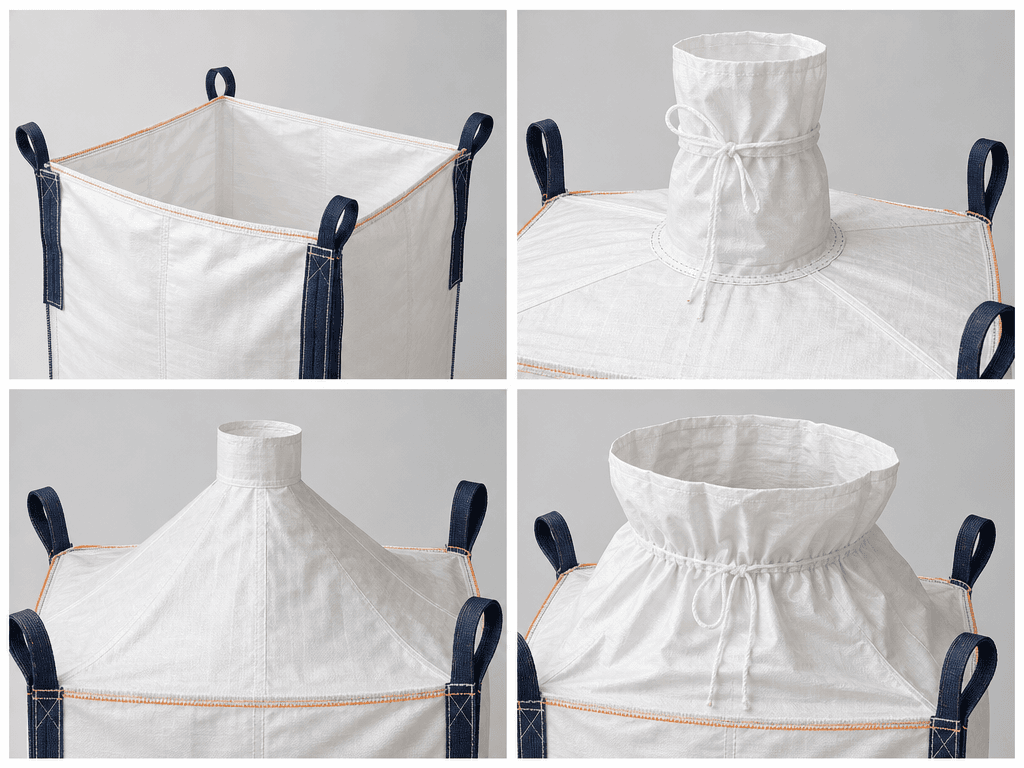
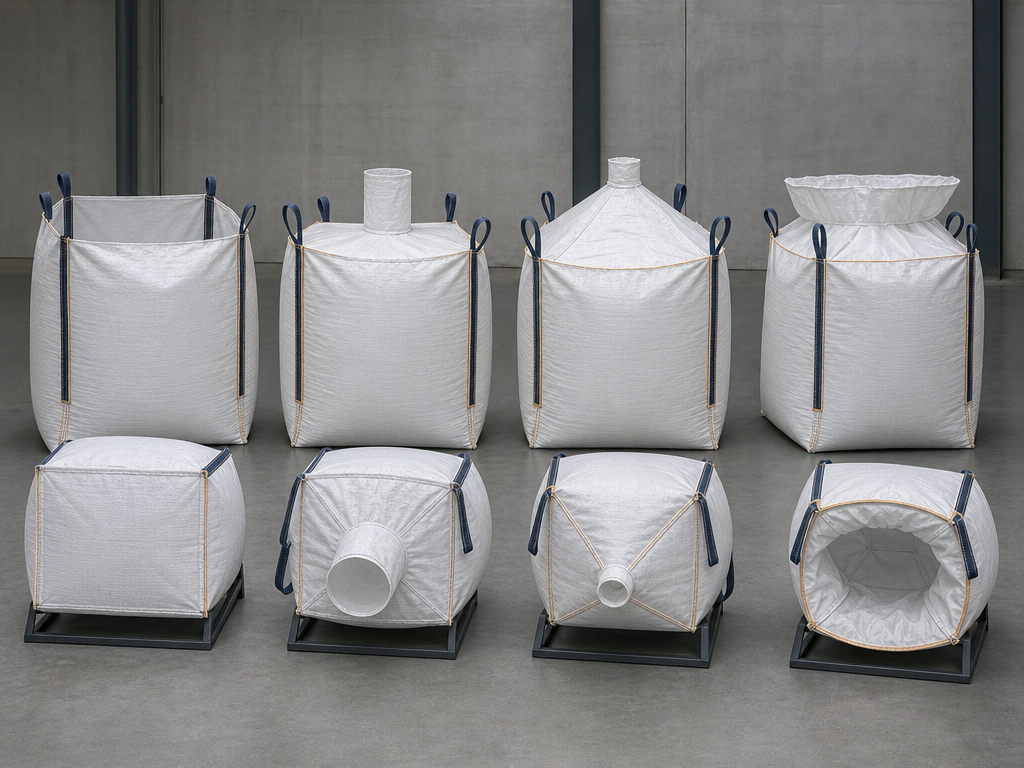
FIBC World’s custom bulk bag guide separates the top into four filling options and the bottom into four discharge options. The useful way to read that list is not as eight catalogue names, but as eight different jobs.
This guide explains each structure, the work it handles best and the details that should be confirmed before a custom FIBC is approved.
The short answer
The top opening is the filling interface. It determines access, equipment connection, dust exposure and closure.
The bottom opening is the discharge interface. It determines flow control, emptying speed, residual material and receiving equipment.
A structure name is not a specification. “Spout,” “duffle” and “conical” can mean different dimensions and closures at different suppliers.
The right choice depends on the product’s flow behaviour, the filling and discharge equipment, the liner and the site’s safety procedure.
The final check is an approved drawing and a realistic sample trial—not a catalogue image.
The four bulk bag top openings
The top opening is where the bag is filled. It also affects how much product is exposed during filling, how the bag is closed for transport and whether the filling equipment can form a stable connection.
Open top bulk bag: the widest access, with the least built-in control
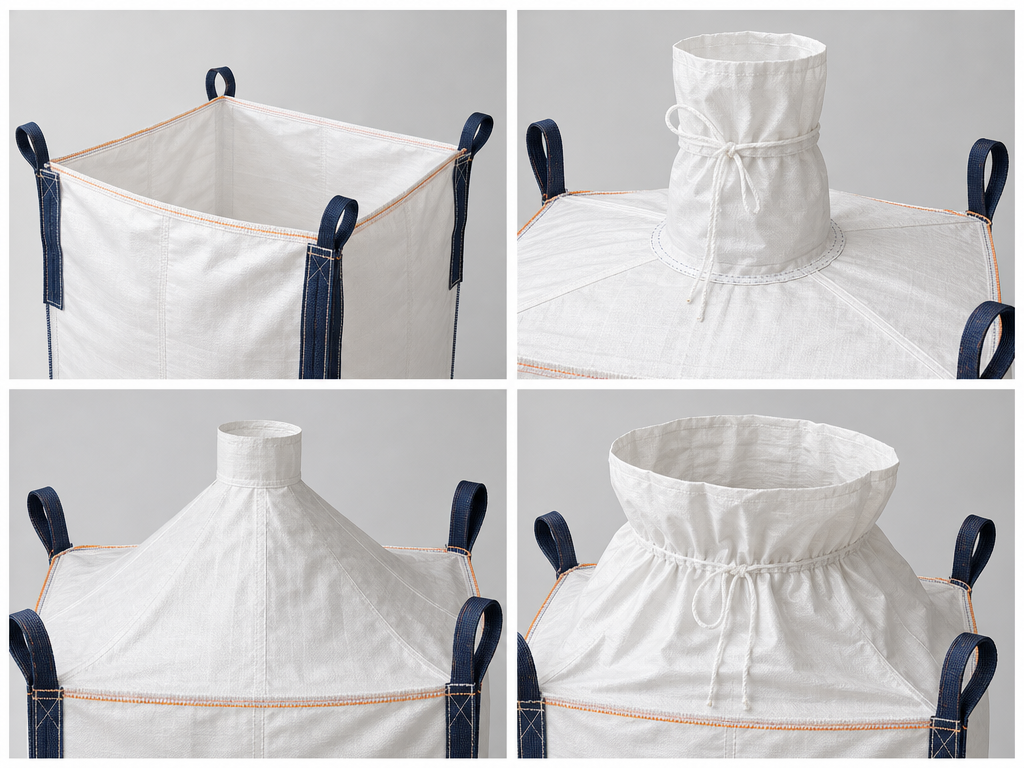
An open top bulk bag has a fully open top panel with no integrated filling spout or full-width closing skirt. The filling chute, hopper or operator has direct access to the bag body.
This is a practical choice when the priority is unrestricted access: manual or semi-automatic filling, coarse or free-flowing products, large lumps, or applications where the operator needs to see the fill point. It is also useful when the bag will be closed with a separate cover or liner arrangement.
The limitation is equally clear. An open top has no built-in closure. Product is exposed during filling, and the bag does not provide weather or dust protection by itself. For fine powders or dusty materials, open-top filling needs a controlled filling area, local extraction or another containment measure.
The job it suits: simple filling, wide access and products that do not require a defined mechanical connection at the top.
What it does not solve: dust containment, weather protection or a sealed transport closure.
When specifying an open top bulk bag, confirm the finished opening size, whether a separate cover or liner is required, how the top will be closed after filling and how the bag will eventually be emptied.
Filling spout: a defined connection for silo and automatic filling
A filling spout is a tubular neck sewn into the top panel. The outlet of a silo, hopper or filling head connects to the spout, and the spout is then tied, clamped or closed according to the bag design.
This structure is built around a defined filling point. It is common for powders, pellets and granules, and for semi-automatic or automatic lines where the bag must locate consistently under the filling equipment. A correctly matched spout can also reduce dust release because the product enters through a smaller, controlled opening rather than an exposed bag mouth.
However, a filling spout is not automatically dust-tight. Containment depends on the spout diameter, its usable length, the clamp or connection, the filling rate, air displacement and the closure. A spout that is the wrong size for the fill head can slow the line, leak at the joint or create handling problems.
The job it suits: controlled filling from a silo or hopper, repeatable connection to filling equipment and a more defined inlet for powders, pellets or granules.
What it does not solve: equipment compatibility by name alone. The spout must match the actual fill head.
Useful RFQ details include the spout’s inside or outside diameter, usable length, closure method, filling equipment connection, expected fill rate and any venting requirement.
Conical top: a raised, centred filling point
A conical top raises the filling point into a cone-shaped section and ends in a central neck or spout. Some suppliers describe a similar structure as a conical spout top.
The purpose is structural: it creates a defined, elevated filling point above the main bag body. This can help position the bag under overhead filling equipment, keep the inlet central during filling and provide a clearer route for the liner or filling neck. It may be useful when the filling head needs a raised connection or when the bag must hang in a controlled shape under the filler.
A conical top should not be treated as a dust seal or a guarantee of better flow. It adds height, which affects headroom, lifting clearance and storage. It also changes the way a liner must be shaped and supported. If the filling equipment does not need a raised central inlet, a standard filling spout may be the simpler choice.
The job it suits: overhead or central filling equipment that needs a defined high filling point, especially where inlet alignment and liner routing matter.
What it does not solve: containment or flow performance without the correct neck, closure and equipment interface.
Confirm the cone height, the central neck or spout dimensions, the available headroom, how the bag is supported during filling and how the liner passes through the top.
Duffle top: full-width access with a closable skirt
A duffle top is a large tubular skirt sewn across the top of the bag. It opens widely for filling and is then gathered, tied or otherwise closed. It gives the operator much more access than a narrow filling spout, while still providing a top closure after loading.
This makes the duffle top useful for manual or semi-automatic filling where the filling chute, hopper or operator needs a broad opening. It is common in food ingredients, agricultural products, pellets and other applications where the bag must be filled through a wide mouth and then closed for transport.
The duffle top is not the same as a filling spout. Its closure is usually manual and operator-dependent. It may reduce exposure after filling, but it should not be assumed to be dust-tight or watertight unless the complete closure and liner arrangement have been designed and tested for that purpose. The extra fabric also needs to be managed during filling and closing.
The job it suits: wide-access filling combined with a closable top, especially where a narrow mechanical spout is not required.
What it does not solve: precise connection to a filling head or automatic dust containment.
Specify the skirt length, closure method, liner attachment, operator access and whether the filling equipment needs a separate spout inside the duffle.
The four bulk bag bottom openings
The bottom opening determines what happens after the bag is full. It is not just an outlet; it is the interface between the bag and the receiving hopper, conveyor, pit or operator.
Flat bottom bulk bag: containment without a built-in outlet
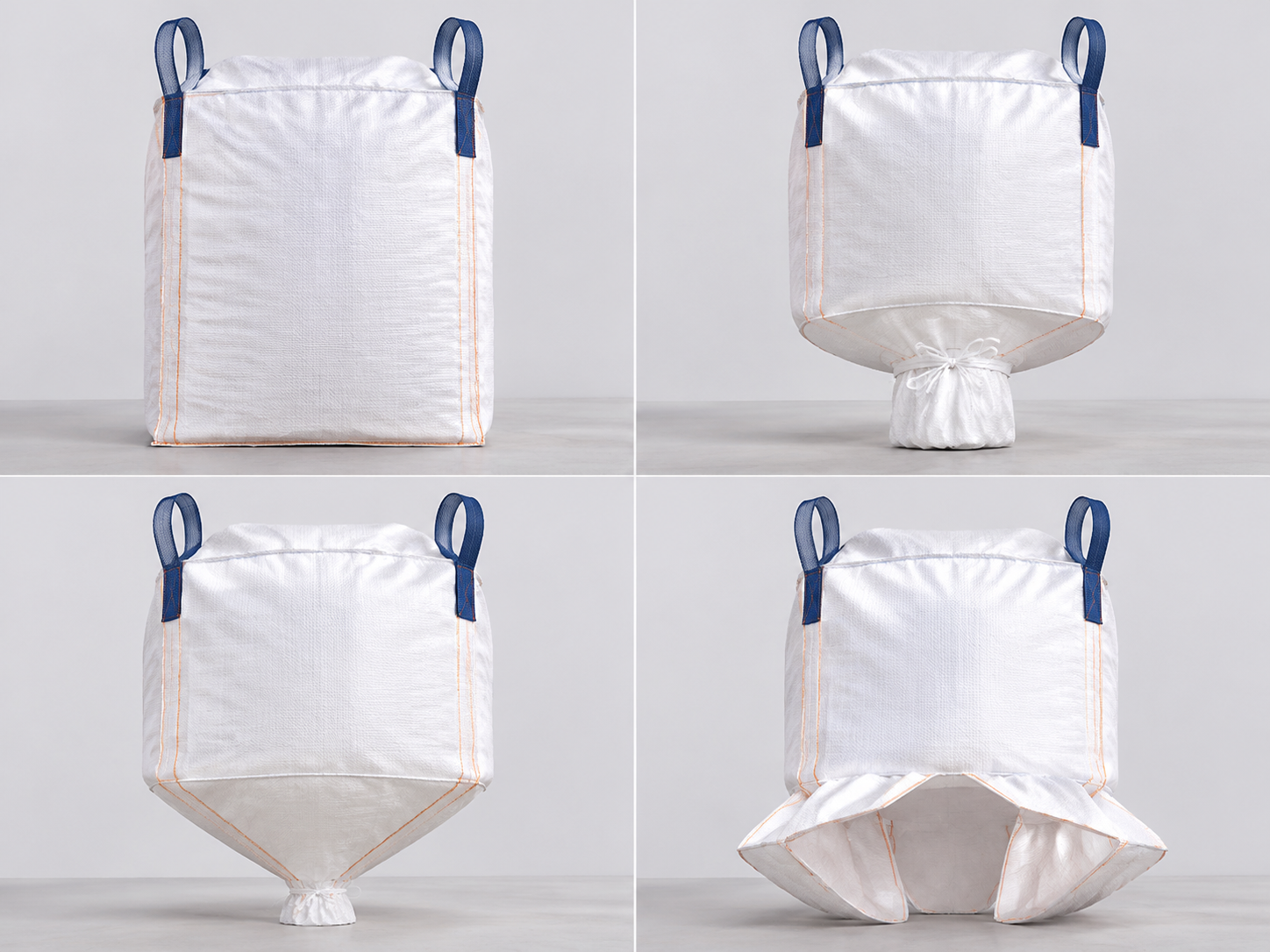
A flat bottom bulk bag has a closed base and no discharge spout. It provides a stable shape for storage and transport and is often used when the product will be removed from the top, by tipping the bag, or through another handling process.
Flat bottoms can be appropriate for bulky or irregular products, scrap, or applications where a bottom outlet would never be used. They can also simplify the bag structure when the receiving process does not require controlled gravity discharge.
The important limitation is that a flat bottom does not provide a controlled bottom discharge point. If the downstream process expects the bag to empty through a spout, a flat bottom is the wrong starting point. The buyer should define the emptying method before choosing this structure.
The job it suits: stable containment, storage and transport where the product will be removed by another method.
What it does not solve: controlled discharge into a downstream process.
Confirm how the bag will be emptied—tipping, top unloading, cutting or another approved method—and how the liner will be handled at the end of discharge.
Spout bottom: controlled discharge through a defined outlet
A spout bottom has a tubular outlet at the base of the bag. The spout is closed during filling and transport, then opened to release product into a receiving hopper, chute or other equipment.
This is one of the most direct ways to control discharge. It can support partial emptying, a defined flow path and a cleaner connection to downstream equipment. It is widely used for powders, granules, pellets and other flowable materials where the plant has a suitable discharge station.
The spout does not make every product flow. Cohesive or caking materials can bridge above the outlet, and a spout that is too small for the product or the receiving equipment can slow discharge or create blockages. Dust exposure, operator access and clearance under the bag also need to be reviewed.
The job it suits: controlled discharge of flowable products into a defined receiving point.
What it does not solve: poor flow behaviour or an incompatible discharge station.
Record the outlet diameter, spout length, closure type, receiving equipment connection, available clearance and the product’s observed flow behaviour. A trial with representative material is more useful than a generic “standard spout” description.
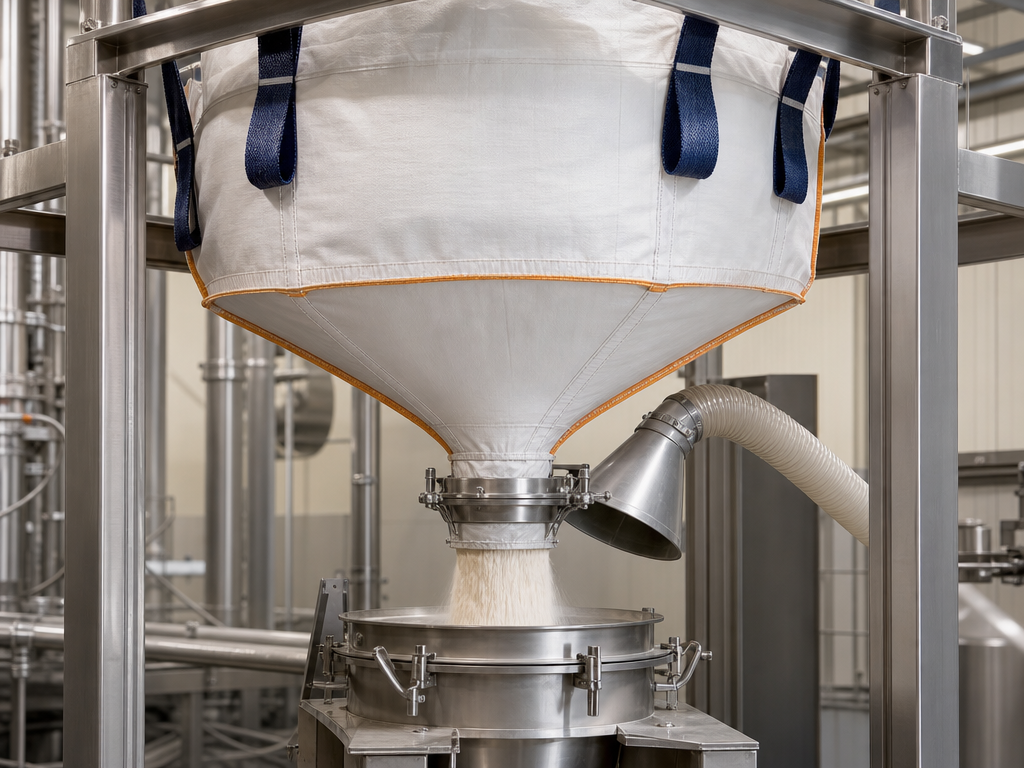
Conical bottom: gravity-assisted flow toward a central outlet
A conical bottom uses a cone-shaped base to direct product toward a central outlet. It is intended to support material flow where a simple flat base or a short spout may leave product trapped or moving too slowly.
This structure is often considered for fine, dense, sticky or poor-flowing products where gravity assistance and low residual material matter. It can help guide product toward the outlet, but it does not guarantee uninterrupted flow for every material. The cone geometry, outlet size, product behaviour and discharge equipment still have to work together.
A conical bottom also affects the bag’s support and height. It may require a frame, a raised discharge station or a receiving arrangement that gives the cone enough clearance. Adding a conical base without checking the site can create a new handling problem instead of solving the old one.
The job it suits: products that need gravity-assisted flow toward a central outlet and a discharge arrangement designed for low residual material.
What it does not solve: flow problems caused by the product, the outlet size or an unsuitable receiving station.
Confirm the support method, available height, outlet dimensions, discharge equipment and trial plan. The correct cone is a project-specific design, not a universal powder solution.
Full discharge: the whole bottom opens
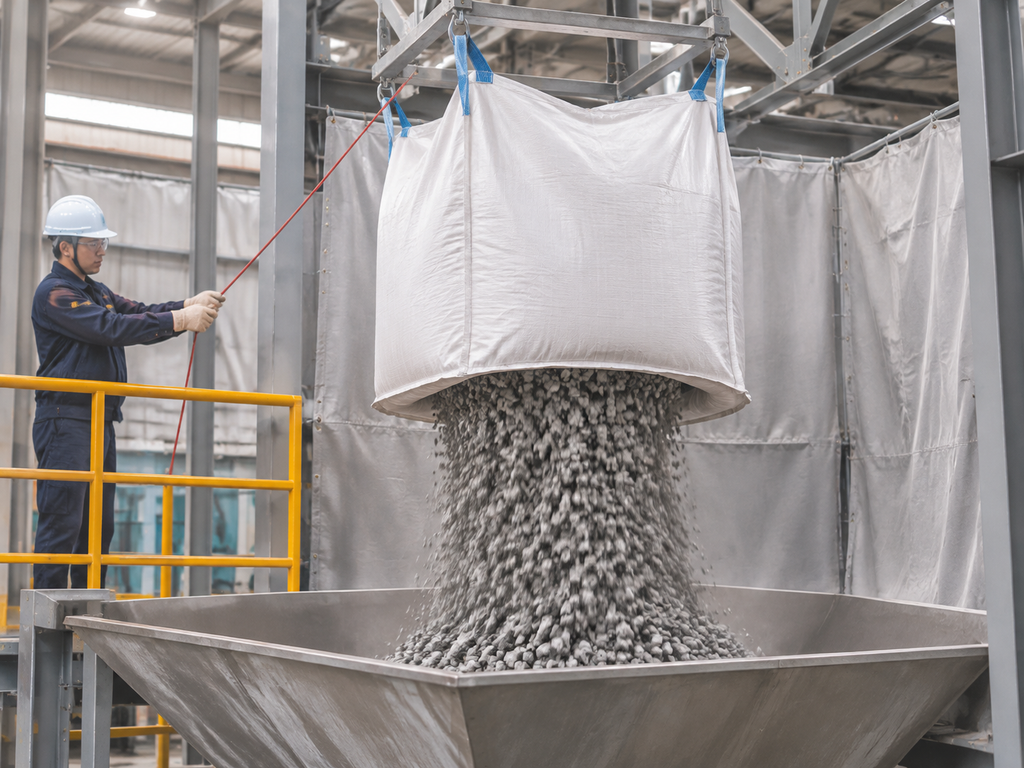
A full discharge bulk bag—also described as a full-open or full-drop design—opens across the bottom rather than through a narrow spout. The product is released quickly into a receiving area.
This is a practical option for coarse, clumping, sticky or irregular materials that do not flow reliably through a conventional outlet. It can also suit large lumps or applications where fast complete emptying is more important than controlled dosing.
The trade-off is control. A full discharge opening can release a large volume at once, so dust, spillage, operator exposure and receiving-area design become critical. It is not the right choice for a process that needs a measured flow or precise downstream dosing. The opening mechanism, release method and safe operating procedure should be defined before production.
The job it suits: fast, complete emptying of materials that are difficult to discharge through a narrow outlet.
What it does not solve: flow control, dust containment or spill prevention without a suitable receiving arrangement.
Specify the release mechanism, receiving pit or hopper, clearance, dust controls, operator position and the approved procedure for opening the base.
Pair the openings by the job, not the product name
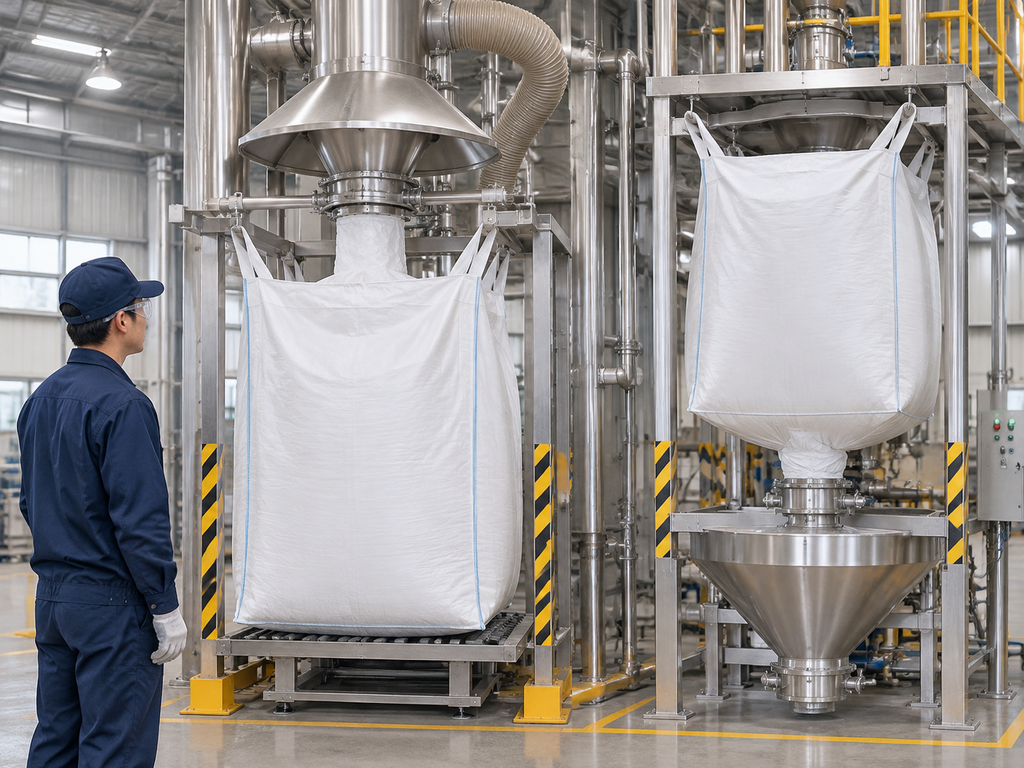
The top and bottom are selected separately, but they operate as one system. The bag body, liner, lifting design and discharge equipment also affect whether the combination works.
These are practical starting points, not automatic approvals:
| Job to be done | Practical starting combination | Why it can fit | What must be confirmed |
|---|---|---|---|
| Manual filling and simple containment, with no bottom outlet | Open top + flat bottom | Wide filling access and a stable base | Top closure, weather protection, how the bag will be emptied |
| Wide filling access, closable top and controlled discharge | Duffle top + spout bottom | Full-width filling plus a defined outlet | Manual closure, dust exposure, spout flow and receiver connection |
| Silo or automatic filling plus controlled discharge | Filling spout + spout bottom | Defined connections at both the inlet and outlet | Spout dimensions, clamping, venting, fill and discharge rates |
| Central filling and low-residual discharge for poor-flowing product | Conical top + conical bottom | Raised central inlet and gravity-assisted outlet | Headroom, support frame, outlet size and a representative trial |
| Fast filling and fast full emptying for coarse or clumping material | Open top or duffle top + full discharge | Large access at both ends | Spill control, dust control, receiving area and safe release procedure |
| Closed transport with top unloading | Duffle top + flat bottom | A closable top and a stable base | Unloading method, liner access and operator handling |
A conical top is not required just because the bottom is conical. If the filling equipment does not need a raised inlet, a filling spout may be the better top. Likewise, a full discharge bottom may solve an emptying problem while creating a dust problem if the receiving area is not designed for it.
Five details that decide whether the opening works
1. The product’s actual flow behaviour
“Powder” and “granule” are not enough to define an opening. Bulk density, particle size, moisture sensitivity, caking tendency, temperature and the product’s behaviour after storage all affect filling and discharge.
A material that flows freely in a sample jar may behave differently after being compressed under 1,000 kg of load for several weeks. For cohesive, sticky or clumping products, a trial with representative material is more valuable than a catalogue recommendation.
2. The filling and discharge equipment
The opening must match the plant, not only the bag drawing. Record the filling head’s outside diameter, insertion depth, clamp type and available movement. At the discharge end, record the receiving hopper, chute, conveyor, clearance and connection method.
A spout that is correctly named but wrongly sized is still a mismatch. The same applies to a duffle top that cannot be reached by the filling chute or a full discharge bag that cannot be positioned over the receiving area.
3. Dust, hygiene and containment
An opening that is suitable for a coarse material may be unacceptable for a fine powder. Dust can affect operator exposure, cross-contamination, housekeeping and compliance.
A filling spout or discharge spout can support containment, but only when the connection, closure and local extraction are designed together. A duffle top can close after filling, but it should not be assumed to be dust-tight. Open-top filling may be appropriate only where the filling area and product risk allow it.
4. The liner interface
This is where bag structure and liner design meet. A barrier liner can protect the product from moisture or contamination, but it will not compensate for an opening it cannot follow. The liner’s filling neck, discharge outlet and attachment method must be designed with the outer bag’s openings.
A liner that is too short, poorly aligned or unsupported can fold during filling, block a discharge spout or leave product trapped at the outlet. If a high-barrier or form-fit liner is being considered, the opening drawing should show both the outer bag and the liner interface.
5. Handling, support and safety
The opening is only one part of the approved bag. The lifting design, safe working load, UN certification where applicable, electrostatic classification and site handling procedure are separate requirements.
A conical bottom may need a support frame. A full discharge bag may need a controlled receiving area. A spout may require the operator to reach under the bag or use a remote opening device. These are not minor details; they determine whether the selected opening can be used safely and repeatedly.
What to put in an RFQ
A clear RFQ lets the supplier evaluate the complete interface instead of quoting a bag by name. Include:
bag type, body construction, dimensions and target safe working load;
top opening: open top, filling spout, conical top or duffle top;
filling spout diameter, usable length and closure method;
bottom opening: flat, spout, conical or full discharge;
discharge outlet diameter, length and closure method;
product name, bulk density, particle size and flow behaviour;
moisture, caking, temperature and food-contact requirements;
filling equipment photos or a sketch, including the connection and available height;
discharge equipment photos or a sketch, including receiving height and clearance;
liner type, attachment method and whether the liner has its own spouts;
any UN, anti-static, hygiene or other qualification requirement;
the sample trial plan and the person responsible for technical approval.
The most useful RFQ is not the longest one. It is the one that makes the critical interfaces visible.
Common mistakes
Ordering a “spout” without dimensions. Diameter, length, closure and equipment connection all change the result.
Treating a duffle top as a dust-tight closure. It provides access and a closable top, not automatic containment.
Choosing a flat bottom for a process that needs controlled discharge. The bag may be stable, but the downstream line may have no way to empty it.
Using full discharge without a receiving plan. Fast emptying can also mean fast spillage, dust release and operator exposure.
Adding a conical bottom without checking support and headroom. The cone needs space and a suitable discharge arrangement.
Specifying the bag and liner separately. The two interfaces must be designed together.
Approving a drawing that shows only length, width and height. The opening position, spout dimensions, closure and equipment connection belong on the approval drawing.
Conclusion
The right bulk bag opening is not the one with the most familiar name. It is the one that matches the filling method, the discharge method, the product’s flow behaviour, the liner and the equipment around the bag.
An open top, filling spout, conical top and duffle top each solve a different filling job. A flat bottom, spout bottom, conical bottom and full discharge each solve a different emptying job. The value comes from pairing them deliberately—and then checking the complete arrangement on a drawing and a representative trial.
To review a custom FIBC opening for your process, start with the FIBC World custom bulk bag guide, then send your bag dimensions, product details and photos of the filling and discharge stations for a project-specific review.
Related News
Other news you might be interested in

FIBC Bag Handling and Safety: Best Practices for Safe Use
Proper FIBC handling is closely connected with operator safety, bag integrity and efficient bulk-material movement. An FIBC is a system of components rather than simply a woven fabric container. Lifting loops or sleeves, seams, fabric, closures, filling arrangements, discharge components and, where applicable, liners all contribute to how the bag performs during use.

Recyclable FIBC: Mono-material PP, with liner and ventilated type
When a buyer asks, "Is this FIBC recyclable?", the answer depends on which part of the bag is being discussed, where it will be used and what recycling route is actually available. A woven PP bag with a PE liner, a paper label, a polyester thread and a foil barrier is not the same product as a predominantly mono-material PP bag. Even a mono-material bag is not automatically recycled at scale if collection, cleaning and sorting are missing.This guide separates three questions that are often mixed together: what the bag is made of, what the bag is designed to do, and what evidence supports the claim. It is a buyer checklist, not a legal opinion or a certification statement.
Want to know more?
Get in touch with us for more information about our services and products.