
Engineering Zero-Leakage Seams: Sift-Proof Felt Piping vs. Plastic Liners for Micron-Sized Chemical Additives

Dayang Yang
AuthorWith experience in FIBC bulk bag manufacturing and export sales, we operate our own production facility with stable large-scale capacity. We are specialists in bulk bags, conductive FIBCs, food-grade FIBCs, UN certified bags, and customized flexible intermediate bulk containers for industrial packaging and bulk material transportation solutions.
In the logistics of dry bulk chemicals and fine materials, containment failure at the microscopic level presents severe financial and operational risks. When packaging micron-sized chemical additives—such as technical-grade flame retardants, polymer stabilizers, carbon black, and high-purity crystalline catalysts—standard woven polypropylene (PP) fabric introduces an immediate engineering vulnerability: needle punctures.
During the manufacturing of a standard Flexible Intermediate Bulk Container (FIBC), industrial sewing needles pierce the woven fabric to secure the panels and lifting loops. Under the internal head pressure of a 1.0 to 2.0-ton payload, these microscopic needle holes become paths of least resistance. During structural displacement—such as forklift transit, crane hoisting, or ocean freight vibrations—fine powders undergo fluidization and sift through the seam lines. This creates airborne product loss, warehouse contamination, and regulatory non-compliance.
To eliminate seam leakage, packaging engineers rely on two distinct containment strategies: Sift-Proof Felt Piping and Internal Plastic Liners. Choosing the optimal method requires analyzing the chemical's particle micron rating, moisture sensitivity, and downstream discharging equipment.
1. Defining the Technical Mechanics
Achieving a zero-leakage seam profile requires either blocking individual fabric apertures mechanically or isolating the entire payload within an unpenetrated barrier matrix.
🧵 Sift-Proof Seam Engineering (Mechanical Aperture Blocking)
Core Engineering Principle: Localized Porosity Compression.
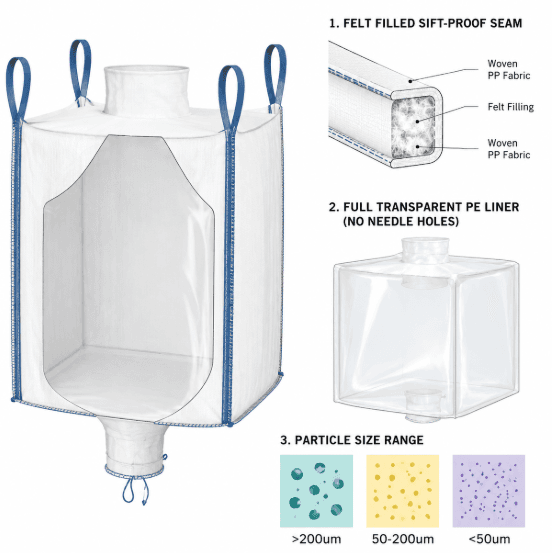
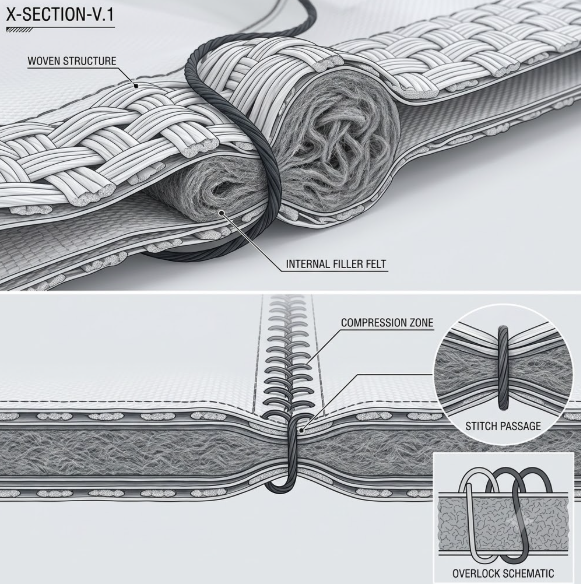
Structural Architecture: Specialized texturized polypropylene yarn or multi-layered synthetic felt piping (filler cord) is fed directly into the sewing line along with the structural thread.
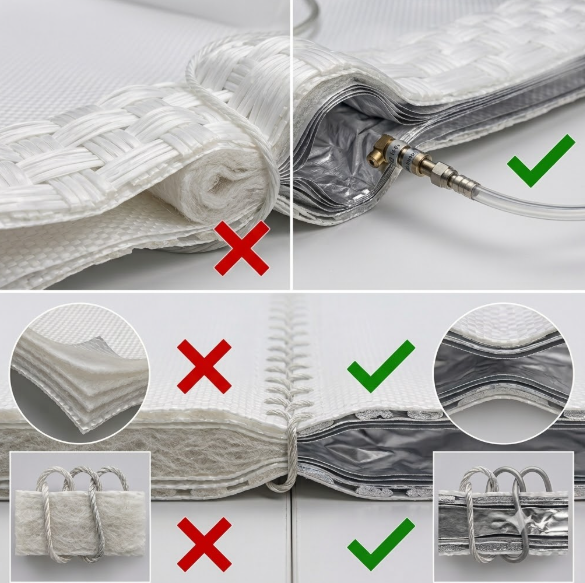
Leakage Defense Path: The overlock stitching compresses the compressible felt strip directly against the needle punctures. The felt expands inside the needle holes and between the overlapping fabric panels, forming a tight, dense physical labyrinth that traps moving micro-particles while allowing air to escape during filling.
Operational Limit: Purely mechanical containment. It does not provide an absolute atmospheric barrier against moisture vapor or gas migration.
🧪 Internal Plastic Barrier Matrix (Absolute Isolation)
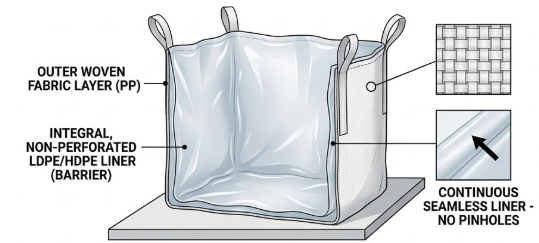
Core Engineering Principle: Continuous Physical Material Isolation. Structural Architecture: A separate, unpenetrated, extruded flexible polymer bag—manufactured from Low-Density Polyethylene (LDPE), High-Density Polyethylene (HDPE), or multi-layer co-extruded barrier films—is inserted into the outer woven container.
Leakage Defense Path: The chemical powder remains completely isolated within the continuous plastic layer. Because this inner matrix has no structural needle punctures or woven seams, powder sifting is physically impossible, regardless of particle micron sizing.
Operational Limit: Traps internal air during rapid filling, requiring specialized pre-inflation, vacuum cycles, or degassing valves to prevent bag bursting under heavy compaction.
2. Granular Micron Matching: When to Specify Sift-Proof Felt
Woven polypropylene bulk containers cannot be selected based on load capacity alone; the particle size distribution (PSD) of the chemical additive dictates the required seam technology.
🔴 Coarse Crystals and Granules (>200μm)
Materials like standard nylon granules, plastic pellets, and coarse mineral aggregates have particle diameters far larger than standard sewing needle punctures (which typically range from 100μm to 150μm). For these stable materials, standard overlock stitching without additional sift-proofing is structurally sufficient, as the particles cannot physically migrate through the fabric joints.
🟡 Fine Technical Powders (50μm to 200μm)
When handling specialized industrial materials, such as technical flame retardants or fine mineral crystals, the particle size approaches the diameter of the needle path. For this classification, specifying single or double sift-proof felt piping provides the ideal engineering balance.
The Venting Advantage: During high-speed pneumatic filling, a massive volume of displacement air must escape the bag. Sift-proof felt acts as a high-density filter; it catches and retains the $100\ \mu\text{m}$ chemical dust while allowing the compressed air to vent safely through the seams. This prevents the bag from ballooning and ensures rapid filling cycles without powder sifting.
🔵 Ultra-Fine Micro-Powders (<50μm)
For micronized additives, sub-micron powder catalysts, or highly fluid battery materials, mechanical felt piping hits its performance limit. Under high dynamic stacking pressures, ultra-fine dust can eventually bypass the felt matrix. These materials require absolute containment within an unpenetrated liner.
3. Selecting the Liner Geometry: Lay-Flat vs. Form-Fit
If your chemical additive's micron rating or extreme hygroscopic nature mandates an internal plastic barrier, specifying the correct liner geometry is critical for avoiding downstream operational failures.
| Engineering Parameter | Standard Lay-Flat Liners | Form-Fit Shape-Fit Liners |
|---|---|---|
| Geometry Profile | A simple, oversized cylinder or flat plastic tube inserted into the bag. | Pre-shaped to precisely replicate the outer bag’s cube, inlet, and discharge spout dimensions. |
| Wrinkle & Crease Factor | High (Excess plastic folds over itself inside the bag corners). | Zero (Sits perfectly flush against the interior woven PP walls). |
| Material Trapping Risk | High (Fine chemical powders get trapped inside internal plastic folds, causing material yield loss). | Zero (Smooth, unwrinkled interior lines ensure clean, $100\%$ material discharging). |
| Downstream Discharge Match | High risk of the liner slipping, stretching, or pulling out into the hopper valve during rapid emptying. | Anchored firmly using integrated perimeter adhesive tabs or glue to eliminate liner displacement. |
For high-end chemical processing plants utilizing automated FIBC Bulk Bags with Discharge Spout , a Form-Fit FIBC Liner is mandatory. It prevents the plastic from collapsing into the discharge stream and clogging downstream rotary feeding valves.
4. Atmospheric and Hazard Boundary Controls
Beyond managing powder sifting, the choice between felt piping and plastic liners alters how the package interacts with the surrounding facility environment:
- Moisture Protection: Sift-proof felt piping provides no protection against relative humidity. If your chemical additive degrades, oxidizes, or clumps when exposed to ambient moisture, it must be sealed inside a plastic liner or an advanced Aluminum Foil Bag supporting vacuum sealing and dry nitrogen gas flushing.
- Electrostatic Mitigation: When fine powders flow through plastic liners, intense friction generates static electricity. If the chemical is packed in a hazardous ATEX zone, a standard non-conductive plastic liner will insulate the charge, neutralizing the bag's grounding system. In these zones, you must combine your sift-proof outer seams with specialized conductive liners or utilize a grounded Conductive Type C Anti-Static FIBC Bulk Bag with integrated anti-static film layers.
Technical Selection and Material Evaluation
Eliminating chemical powder leakage requires a precise assessment of your material’s particle size distribution, moisture sensitivity, and plant discharging infrastructure.
- Email: [email protected]
- Technical Inquiry: Contact Our Engineering Team
- Direct Line / WhatsApp:+86 15232851009
- Production Center: Handan, Hebei
Related News
Other news you might be interested in
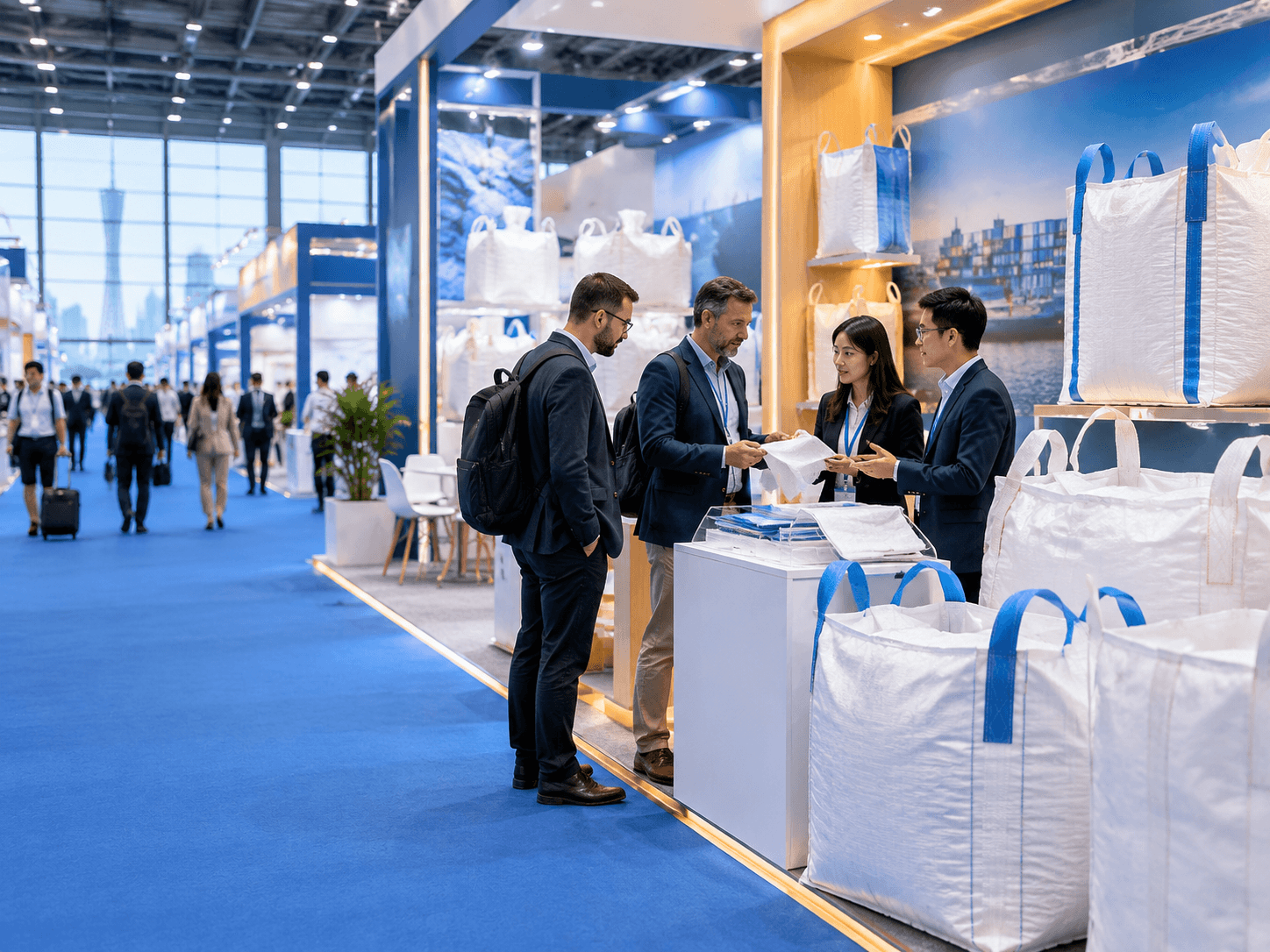
The 140th Canton Fair: New Global Sourcing Opportunities for FIBC Ton Bags and Industrial Packaging Companies
The 140th Canton Fair will be held in Guangzhou from October 15 to November 4, 2026, across three phases. The first phase will focus on advanced manufacturing, industrial manufacturing, machinery, new materials, and chemical products. For export-oriented industrial packaging companies, the 140th Canton Fair will serve not only as a product exhibition platform, but also as an important opportunity to connect with overseas buyers, suppliers, and global supply chain resources.
Woven Polypropylene FIBC Bulk Bags: How Material, Construction and Coating Affect Bulk Packaging Performance
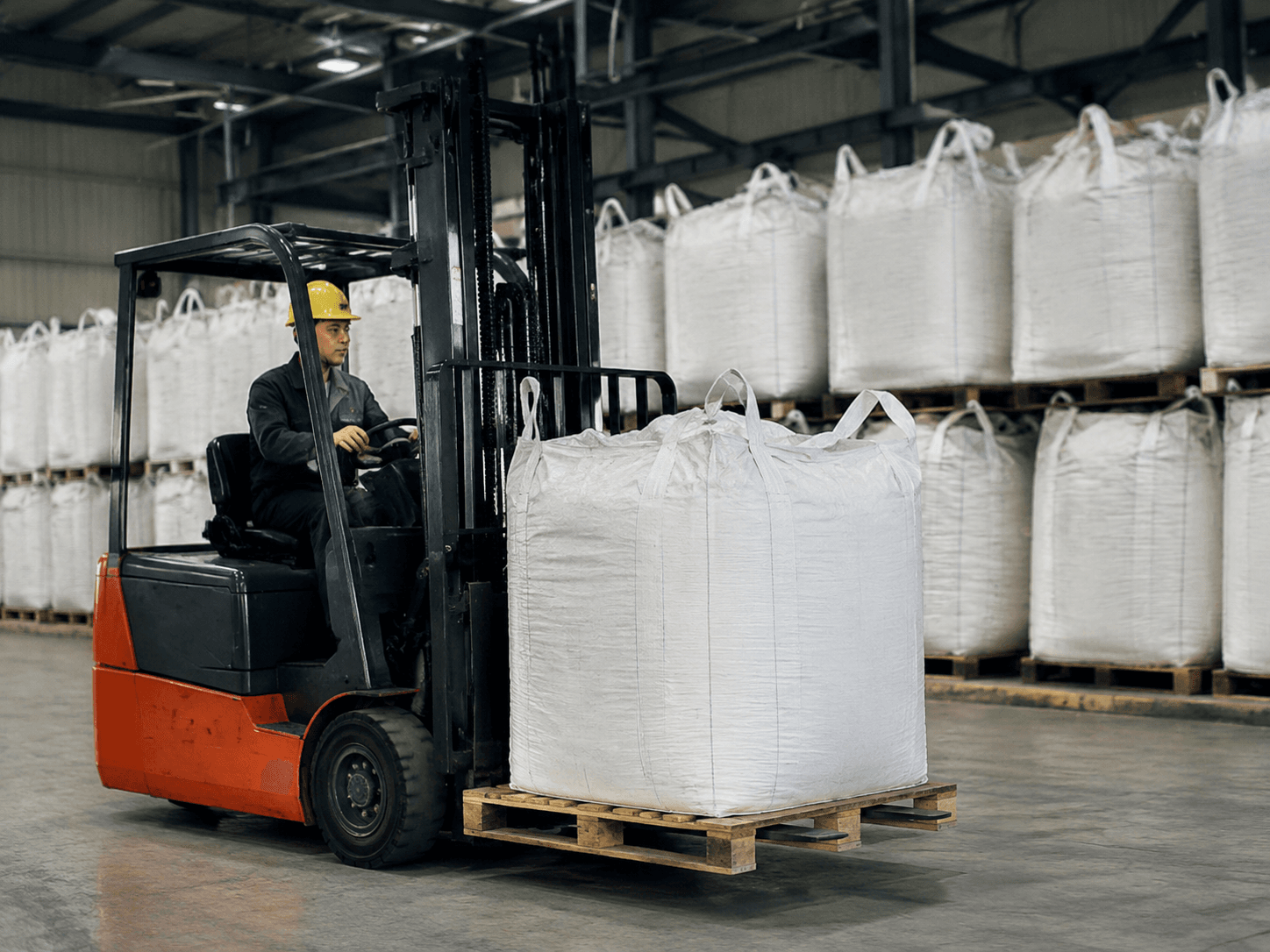
In global bulk-material supply chains, FIBC bulk bags have developed from simple transport containers into important logistics tools connecting production, warehousing, loading, unloading, and end use. Their actual performance depends not only on capacity, but also on woven polypropylene, bag construction, coating, liners, safety factors, and the application environment. For the food, chemical, agricultural, mining, and construction-material industries, selecting the right FIBC bulk bags affects load-bearing performance, material loss, transport efficiency, warehouse space, and operational safety.
Want to know more?
Get in touch with us for more information about our services and products.