
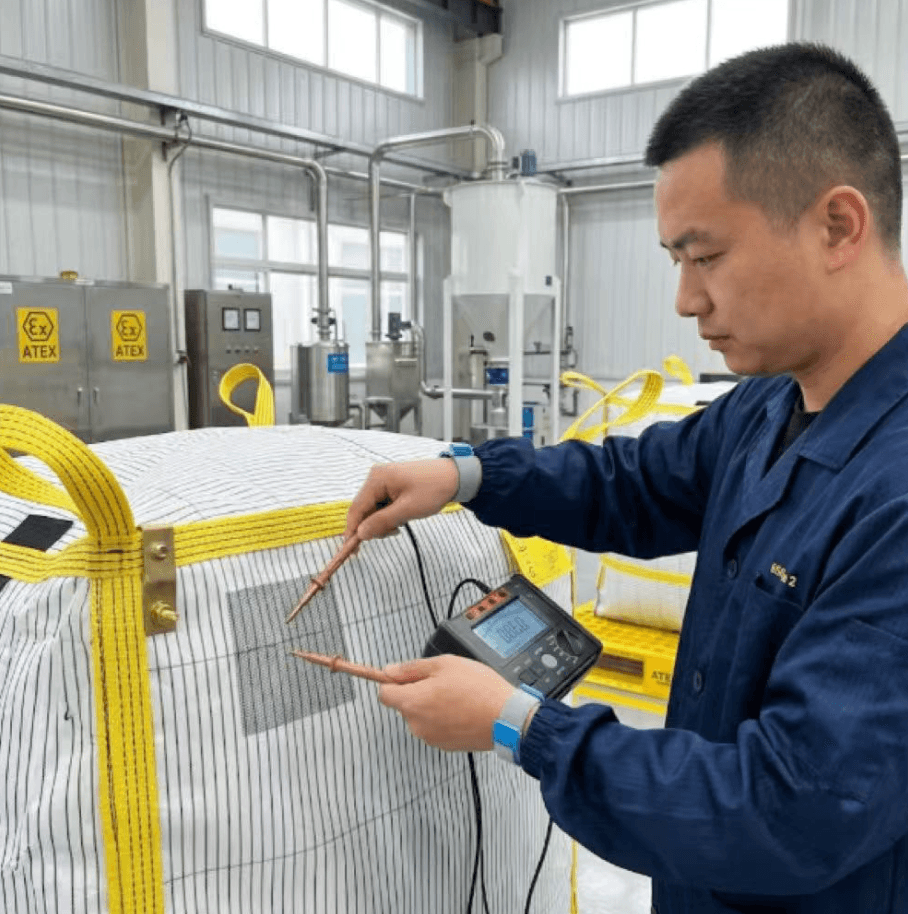
How to Verify Electrical Continuity and Grounding Integrity in Type C Anti-Static FIBC Bulk Bags

Dayang Yang
AuthorWith experience in FIBC bulk bag manufacturing and export sales, we operate our own production facility with stable large-scale capacity. We are specialists in bulk bags, conductive FIBCs, food-grade FIBCs, UN certified bags, and customized flexible intermediate bulk containers for industrial packaging and bulk material transportation solutions.
In hazardous manufacturing environments classified under ATEX zoning, deploying Conductive Type C Anti-Static FIBC Bulk Bags is the standard protocol for preventing dust explosions during high-velocity material charging and discharging. However, simply purchasing a Type C bag and attaching a grounding clamp is not enough to guarantee safety.
If the internal conductive carbon or silver grid suffers a micro-fracture during sewing, or if multi-trip handling creates fiber fatigue, the loop path can break. An isolated panel converts the bag from a protective safety shield into an ungrounded, floating conductor that stores dangerous electrostatic potential.
To maintain facility compliance and protect workers, plant safety teams must establish a rigid inspection protocol to verify electrical continuity and grounding connection integrity before every loading cycle.
1. The Physics of the Circuit Verification
Verifying a Type C container requires proving that any static charge generated at any geometric point on the bag can seamlessly travel through the fabric network to the designated grounding tabs.
🔍 The 10⁷Ω Resistance Threshold
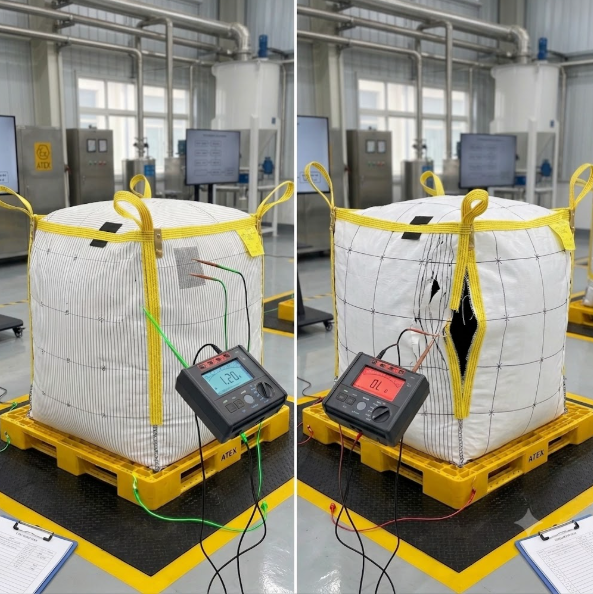
- The Compliance Standard: According to international safety standards (such as IEC 61340-4-4), the total electrical resistance from any part of the FIBC bag—including the side panels, lifting loops, top filling spouts, and bottom discharge spouts—to the primary grounding tab must remain consistently less than 1.0*10⁷Ω(10 Megohms)).
- The Testing Baseline: Resistance below this limit ensures that electrons can bleed off to the earth dynamically, tracking faster than the accumulation rate driven by material friction. Any reading showing resistance approaching infinity (∞) indicates a severed conductive yarn path.
2. Step-by-Step Electrical Continuity Verification Protocol
To execute a precise, factory-level safety audit on a Type C bag before connecting it to a bulk storage silo, quality control technicians should strictly implement the following multi-point electrical loop sequence:
Step 1: Isolate the Container Matrix
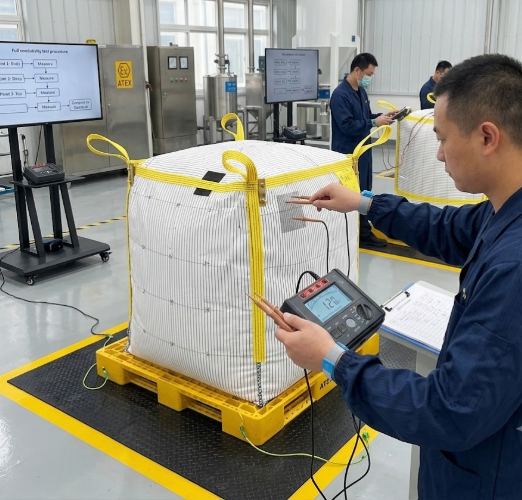
Place the bag on an insulated staging surface or suspend it from insulated forklift prongs. Ensuring the bag body is not touching any structural metal beams avoids false continuity readings from accidental ground paths.
Step 2: Configure the Insulation Resistance Tester (Megohmmeter)
Utilize a calibrated insulation resistance meter capable of delivering a test voltage of $100\text{V}$ or $500\text{V}$ DC. Standard pocket multimeters do not apply enough electrical pressure to measure high-resistance carbon grids accurately.
Step 3: Establish the Primary Ground Terminal
Attach the negative (-) lead clamp of the meter firmly to one of the heavy-duty Grounding Tabs sewn onto the bag's loop anchors. This tab serves as the zero-potential anchor point for the test loop.
Step 4: Execute Multi-Point Probe Tracking
Press a 50mm flat copper disc electrode (or standard weighted probe) connected to the positive (+) lead against multiple high-stress zones on the bag fabric. Apply the test voltage for 15 seconds at each location and verify the metrics:
- 🔴 Panel Test: Place the probe on the furthest diagonal fabric sheet to confirm the grid spans all structural components.
- 🔴 Seam Test: Position the probe across intersecting stitch lines to verify the conductive sewing threads are functional.
- 🔴 Spout Test: Press the probe onto the surface of the FIBC Bulk Bags with Discharge Spout to ensure the lower high-friction zones are completely integrated into the conductive loop.
3. Trouble-Shooting Faulty Readings: Common Failure Points
If the megohmmeter reports a breakdown reading or resistance exceeding 10⁷Ω, technicians should immediately isolate the bag and inspect for the following mechanical issues:
- Tarnished or Coated Grounding Tabs: Dust accumulation, dried chemical residues, or oxidized contact wires on the grounding tabs can create a high-resistance barrier. Clean the contact surface using dry industrial solvents before re-testing.
- Severed Conductive Threads at Seam Intersections: The point where two separate woven panels meet relies on specialized conductive sewing threads to bridge the electrical gap. If a sewing machine needle breaks or snaps a carbon strand during manufacturing, that panel becomes isolated.
- Liner Disconnection: If you are using a dual-layer system with a Form-Fit FIBC Liner or an Aluminum Foil Bag, verify that the liner's inner anti-static tabs are physically linked to the outer bag’s ground grid. A non-conductive standard plastic liner will insulate the powder, preventing static dissipation even if the outer bag passes inspection.
4. Operational Alignment and Grounding Clamp Verification
Even a perfect Type C bag will fail if the facility's grounding assembly is broken. The ultimate step in the safety loop is verifying the connection between the bag's grounding tabs and the earth.
Use Active Interlock Systems
Relying on manual visual checks leaves a high margin for human error. Modern chemical processing plants utilize active grounding monitors. These systems clamp onto the bag's tab and continuously measure loop impedance. If the monitoring system detects a resistance above the 10⁷Ω safety ceiling, it triggers an automated interlock that instantly shuts down the pneumatic material conveyors or silo discharge valves, completely stopping powder movement until a secure bond is established.
Technical Compliance Support and Material Optimization
Managing bulk powder lines in explosive or static-sensitive environments requires precise alignment between your packaging design, raw material specifications, and facility grounding gear.
If your quality control department requires formal testing blueprints, certified Type C fabric verification sheets, or direct commercial bulk layout profiles, contact our hazardous materials packaging division:
Email: [email protected]
Technical Inquiry: Contact Our Engineering Team
Direct Line / WhatsApp: +86 15232851009
Production Base: Handan, Hebei
Related News
Other news you might be interested in
Woven Polypropylene FIBC Bulk Bags: How Material, Construction and Coating Affect Bulk Packaging Performance
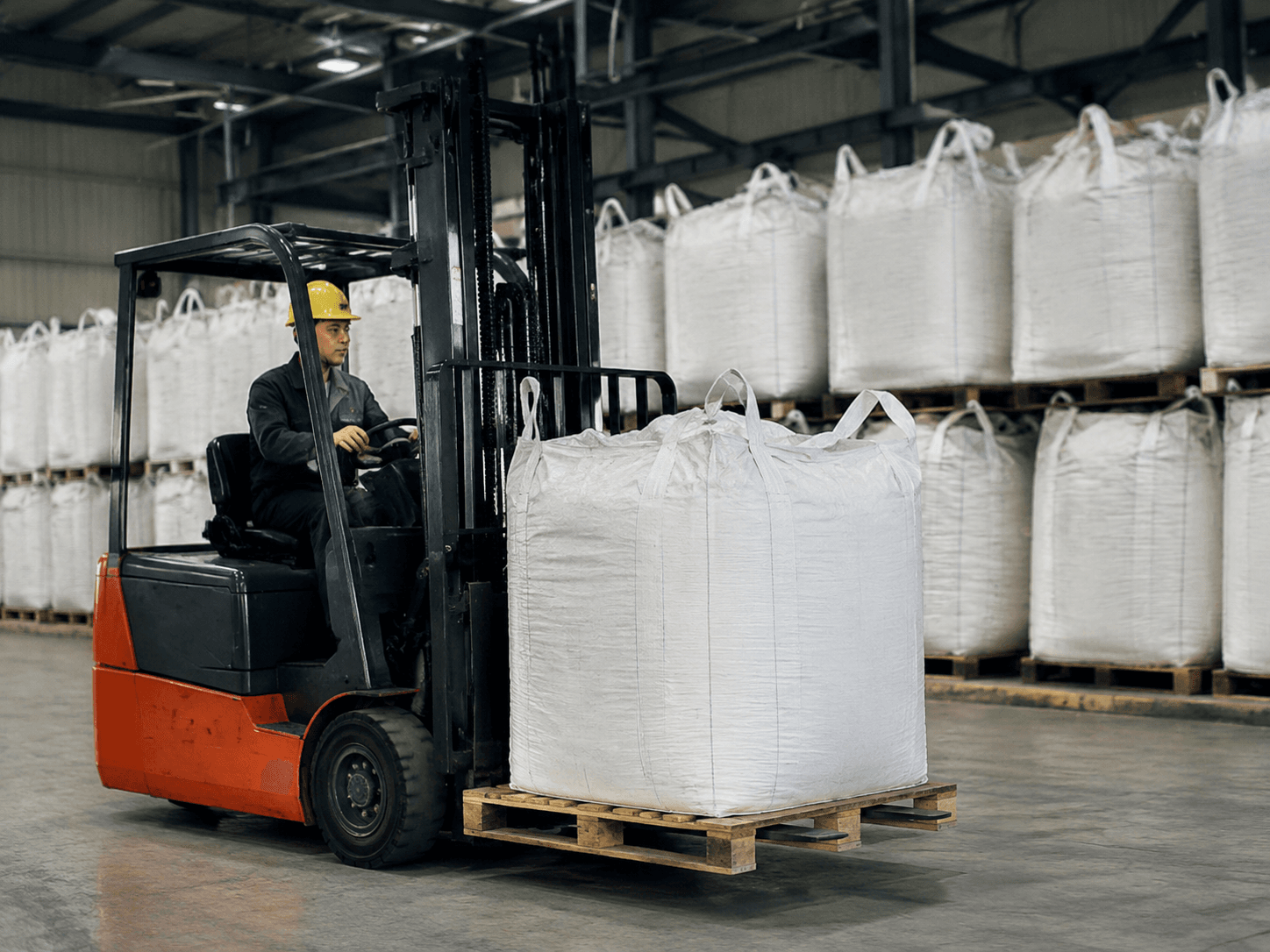
In global bulk-material supply chains, FIBC bulk bags have developed from simple transport containers into important logistics tools connecting production, warehousing, loading, unloading, and end use. Their actual performance depends not only on capacity, but also on woven polypropylene, bag construction, coating, liners, safety factors, and the application environment. For the food, chemical, agricultural, mining, and construction-material industries, selecting the right FIBC bulk bags affects load-bearing performance, material loss, transport efficiency, warehouse space, and operational safety.

Chemical Grade Bulk Bags: How to Select the Right Flexible Intermediate Bulk Containers (FIBC) for Chemicals, Powders, and Hazardous Materials
Bulk materials used in the chemical industry often have characteristics such as fine particle size, high flowability, strong moisture absorption, a tendency to cake, or a high risk of electrostatic charge buildup. For chemicals, powder materials, and certain hazardous materials, packaging does more than hold the product—it directly affects material quality, workplace safety, and transportation reliability.
Want to know more?
Get in touch with us for more information about our services and products.