
FIBC Liner Discharge Problems: A Buyer’s Checklist for Liner Movement, Blocked Spouts and Residual Powder

Dayang Yang
AuthorWith experience in FIBC bulk bag manufacturing and export sales, we operate our own production facility with stable large-scale capacity. We are specialists in bulk bags, conductive FIBCs, food-grade FIBCs, UN certified bags, and customized flexible intermediate bulk containers for industrial packaging and bulk material transportation solutions.
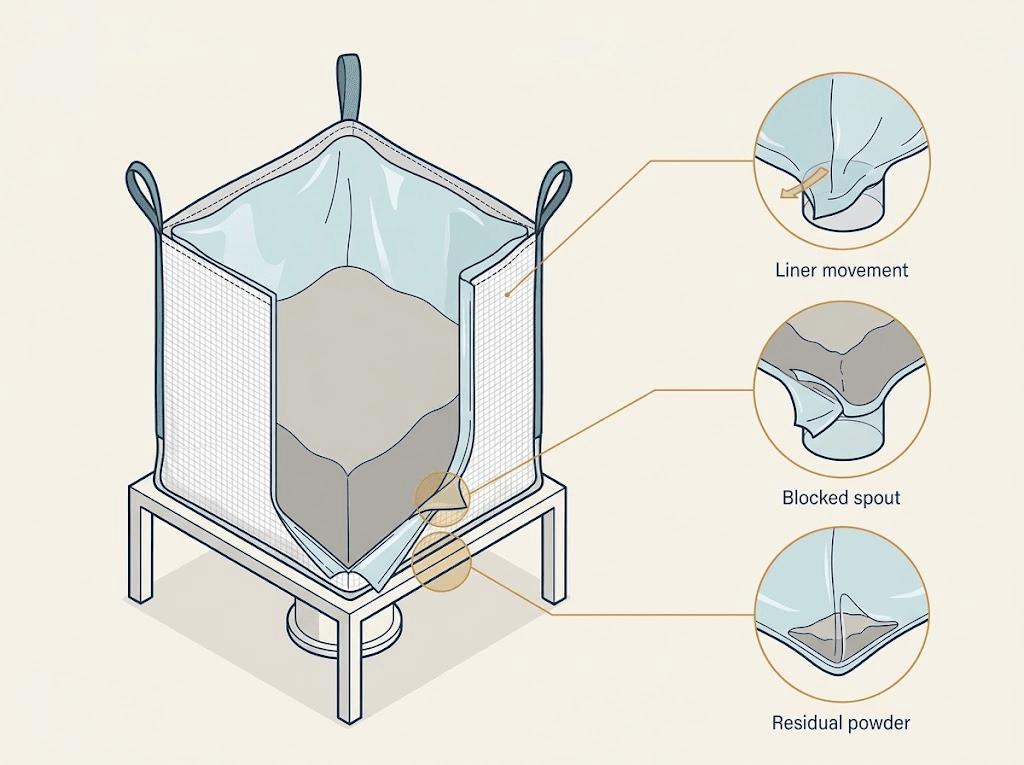
The lined bulk bag arrived at the production line, but the powder stopped flowing before the bag became empty. The lining moves towards the outlet, leaving the material at the bottom corner, or the operator needs repeated assistance to complete unloading.
For buyers who order FIBC liners, a useful question is: What information can help packaging suppliers and equipment suppliers determine the reasons and reach an agreement on better specifications?
Firstly, review the materials, lining, outer bags, and unloading equipment together. Lining fit, folding, outlet configuration, and product flow characteristics all affect emptying performance.
Record what happened before changing the specifications
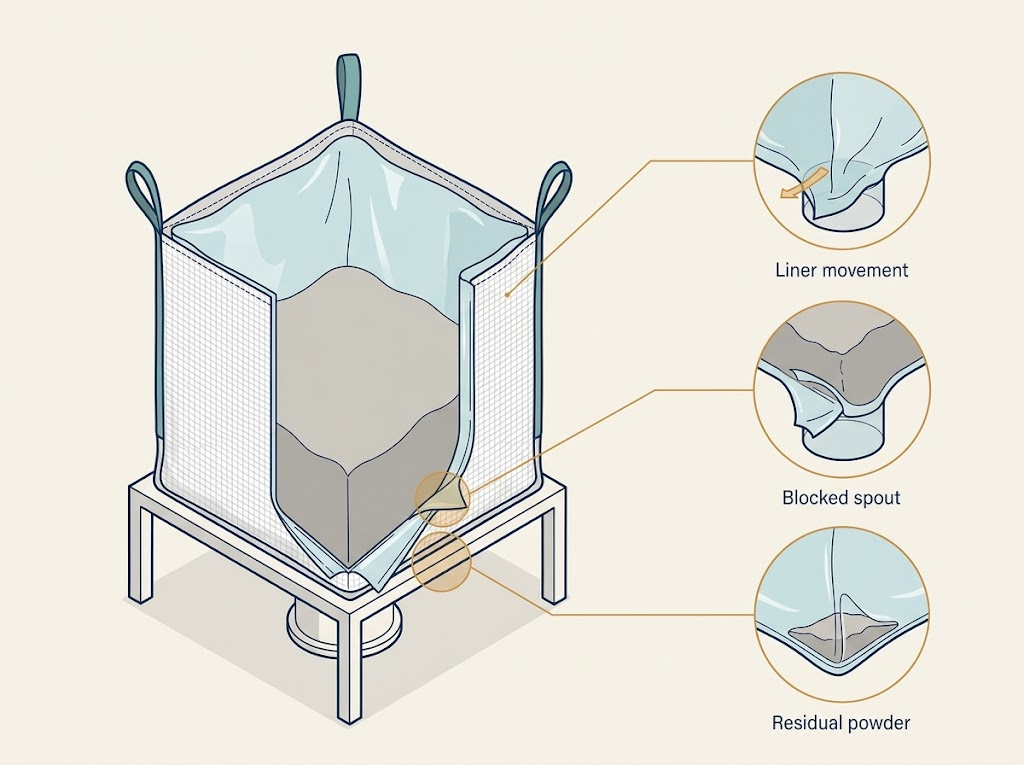
Briefly explain the issue to the supplier and attach photos or videos taken according to your website's security operating procedures. Use the following questions to organize discussions, rather than treating any one symptom as a diagnosis.
| Observed problem | Questions to investigate | Information to send |
|---|---|---|
| Liner moves towards the outlet | How is it retained, and what changes as the bag empties? | Attachment drawing, discharge sequence and equipment details |
| Flow stops with material still inside | Is film obstructing the outlet, or is the product itself no longer flowing? | Location of the obstruction, material condition and outlet photographs |
| Powder remains in corners or folds | Was the liner correctly positioned before filling, and does its shape match the bag? | Liner dimensions, filling procedure and residue locations |
| Flow becomes inconsistent near the end | How do the bag, liner and equipment behave as the load decreases? | Unloading timeline, equipment settings and remaining material |
Also, it is necessary to record whether the issue occurred on each bag, only after storage, or only on one unloading line. These comparisons provide a clearer starting point for the investigation.
Check how the padding is maintained
Confirm if the pad is loose or fixed on the external FIBC. FIBCA distinguishes loose insertion from pads fixed with straps, tabs, glue, or equivalent methods. The handling guidelines require the pads to be properly connected or secured so that they do not fall off during the discharge process.
Request the supplier to determine the retention method and attachment location on the proposed drawings. If your bulk bag unloader uses pad clamps or tensioners, please include their requirements in the discussion. The equipment supplier described different pad retention and winding arrangements; Their applicability depends on specific uninstallation settings.
For custom orders, please confirm:
Which parts of the lining are fixed and how to fix them.
How to connect the lining inlet to any holding or tensioning device.
Is the export layout compatible throughout the entire emission process.
What kind of sample experiments will demonstrate the effectiveness of the proposed arrangement.
During the investigation, please follow the handling instructions provided by the bag and equipment manufacturers. Do not stand or place any part of your body under the suspended FIBC.
Check the lining outlet, outer nozzle, and equipment connection
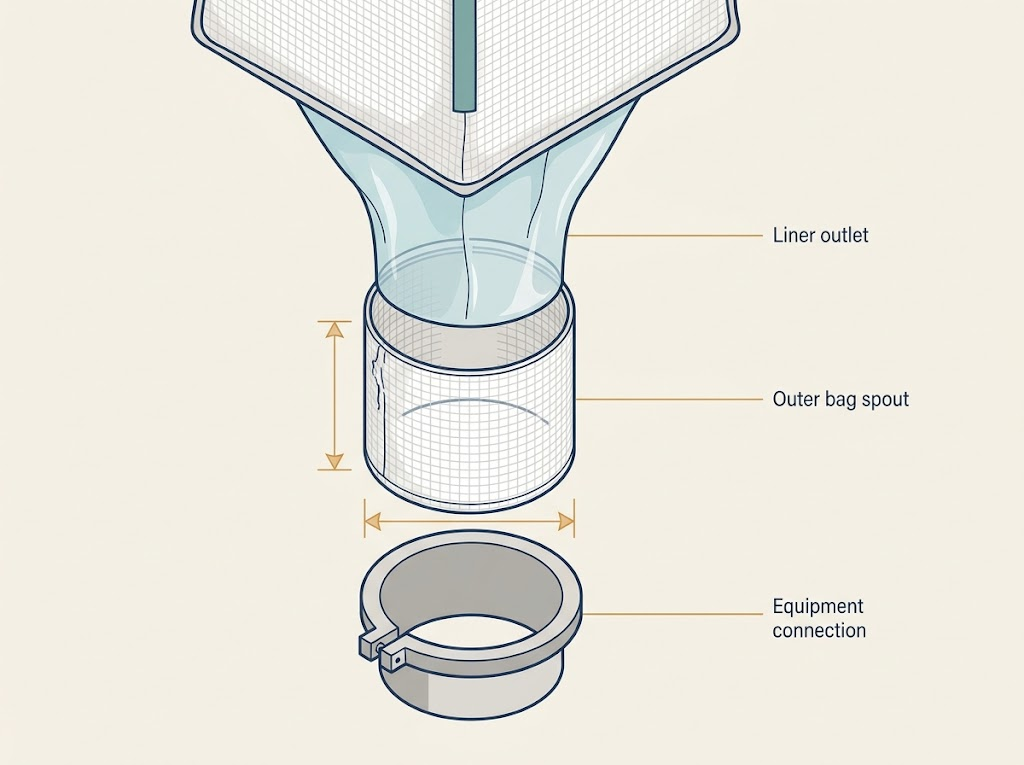
Consider these as three interfaces to be checked together. FIBCA defines the diameter of a circular opening nozzle and the height or length of the nozzle from its connection point to the free end. Clearly label your measurement values, including whether the width is flat.
Send a drawing showing the dimensions of the lining outlet, outer bag discharge outlet, receiving connection, and available workspace. Request two suppliers to confirm the proposed relationship between these components.
Equipment configuration is crucial here. Some emission systems combine nozzle clamps and telescopic tubes to keep the nozzle taut when the bag is emptied. This explains why the lining specifications should be checked based on the actual unloading equipment.
If the supplier proposes different export sizes or lining lengths, inquire about the issues resolved by the change and how it will be evaluated. Maintain approved dimensions and sample references.
Investigate wrinkles and consider whether a cushion with a suitable shape is appropriate
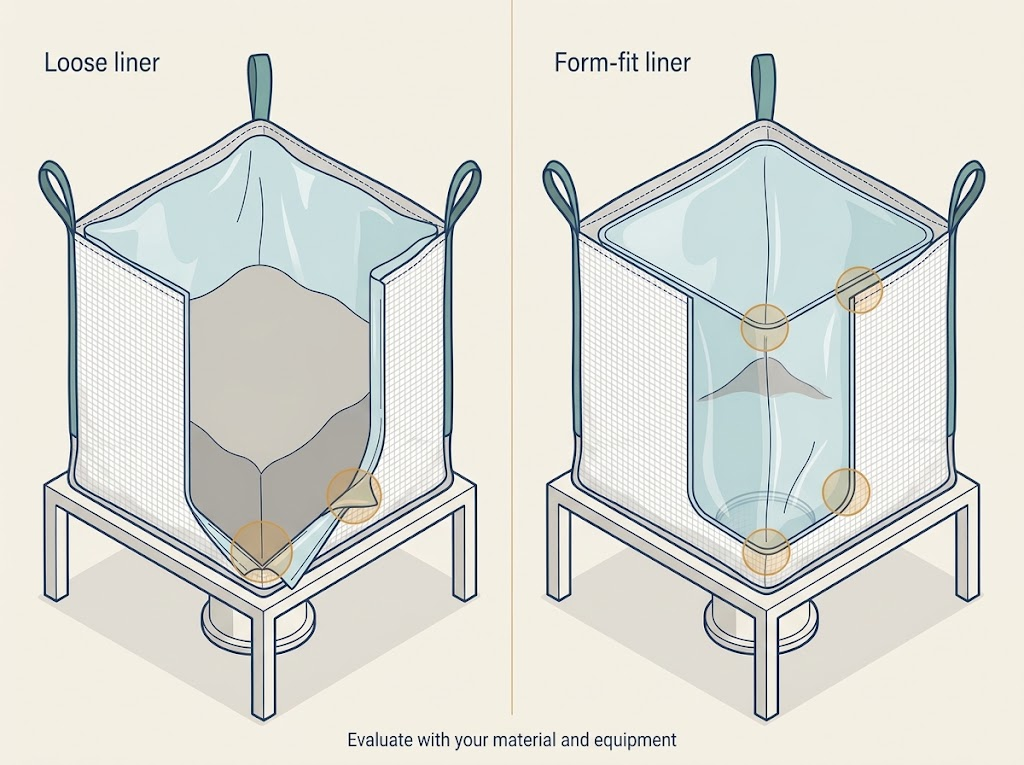
Review the filling process and emission stage. The equipment supplier's guide describes how loose tubular liners that have not properly expanded before filling can retain wrinkles or creases that interfere with discharge. Require the filling equipment supplier to check the preparation of the lining according to the approved procedure.
If wrinkles or poor geometric fit frequently occur, please evaluate the shape fit of the FIBC pad. These shapes correspond to the outer bag and combine the geometric shapes of the inlet and outlet. The shape and attachment are separate choices: labeling the pad as shape matching does not specify its retention method.
Please compare your outer bag design with the actual operating conditions. Including any internal baffles, inlet and outlet dimensions, and connection requirements.
Set measurable emission targets for the sample. The request to 'reduce residual powder' becomes more useful when you define the measurement location and acceptable residual amount of residues.
The investigation includes materials and storage conditions
When discussing the issue of loose bag liner discharge, provide the supplier with the material name, powder or particle form, available bulk density, and related flow or moisture issues. Product characteristics and lining design need to be evaluated together.
For your investigation, please also record:
The filling temperature and material condition during packaging.
Any changes in storage time and environmental exposure.
Is the behavior of the same material different on another line.
Does the recent change involve products, packaging, or equipment.
Please ask the technical team to determine which factors need to be tested. If the application involves food contact, hazardous materials, or electrostatic sensitive environments, please review the complete packaging arrangement for that purpose before approving the change.
Agree on the sample emission list
Using the trial version to answer procurement questions: Is the proposed lining suitable for this material, outer bag, and unloading line?
Agree on the conditions and acceptance criteria before the experiment. Actual records may include:
| Trial item | What to record |
|---|---|
| Sample identity | Liner drawing revision, material specification, outer bag and sample reference |
| Operating conditions | Product, fill weight, storage history and equipment configuration |
| Liner position | Observed movement, attachment condition and outlet behaviour |
| Discharge time | Agreed start and end points, interruptions and interventions |
| Residual material | Measurement method, residue amount and where it remains |
| Condition after unloading | Tears, damaged attachments or other observed changes |
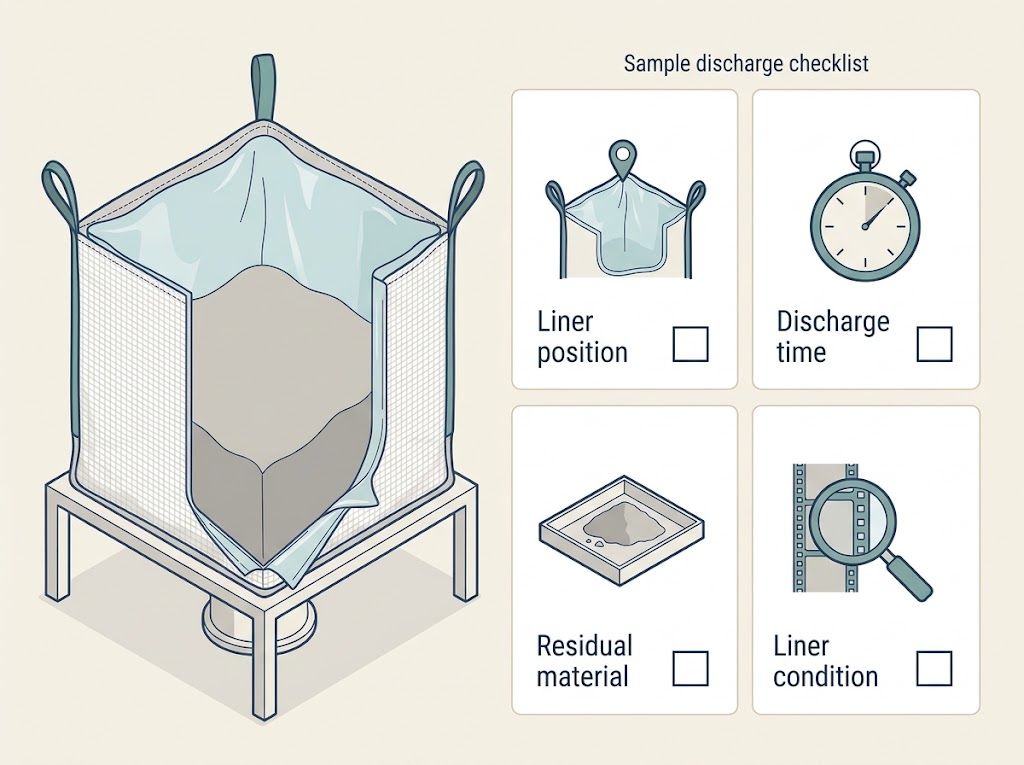
Compare under representative and agreed upon conditions. Change one factor at a time when feasible, and record any unavoidable differences. Choose acceptance restrictions that reflect your process, rather than copying the goals of other buyers.
Prepare a clear inquiry sheet for customized bulk bags with padding
When requesting new specifications or replacement of bulk bag liners, please send:
The question is: what happened, when did it happen, and how often did it happen.
Goods: Material details, expected filling weight, and related handling requirements.
Packaging: Outer bag and inner lining drawings, dimensions, openings, and accessory details.
Equipment: filling and unloading devices, connection dimensions, fixtures, and tensioners (if installed).
Approval requirements: test conditions, acceptable residue and emission performance, and required documents.
Order details: quantity, destination, and required delivery date.
Request drawing review before production. FIBCA will approve drawings as a way to check proposed designs against customer requirements. Put the approved drawings, specifications, and test records together for duplicate orders.
For inquiries from FIBC World, please describe the unloading issue next to the packaging specifications. Send available drawings or photos and request confirmation of the proposed design, sample arrangement, minimum order quantity, and delivery cycle.
Request a proposed specification to address the observed issues, as well as an agreed upon sample test to examine its performance.
Related News
Other news you might be interested in
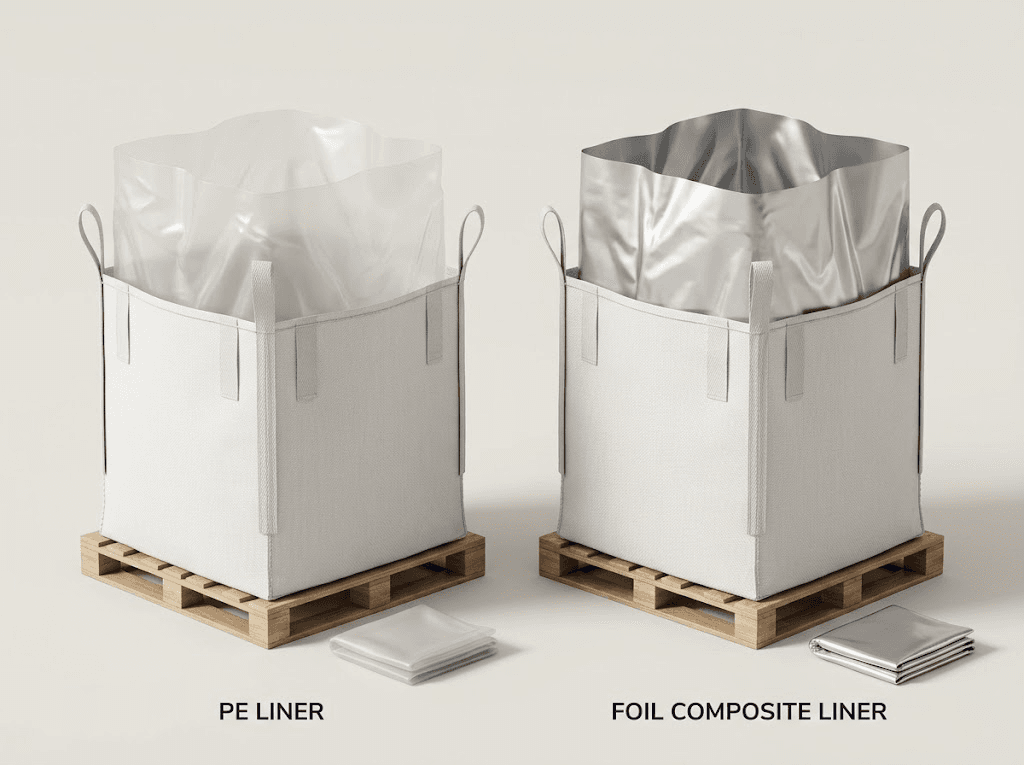
PE vs Aluminum Foil FIBC Liners for Moisture-Sensitive Powders: A Buyer’s Checklist
Choosing a liner for a moisture-sensitive powder starts with a practical question: what protection does the material need throughout filling, transport, storage and discharge?A request for “moisture proof bulk bags” gives a supplier a starting point, but it does not define an acceptable package. A PE liner may meet the requirement. An aluminum foil composite liner may be worth evaluating when the product needs a stronger moisture barrier, oxygen protection or light protection. The decision should follow the actual material specification, closure arrangement and trial results.This checklist helps buyers compare the options and prepare an enquiry for FIBC liners without relying on a material name alone.

Under the EU PPWR, What Packaging Documents Should FIBC Exporters Prepare?
If your bulk bags are intended for the EU market, a buyer may ask for more than a product specification sheet. They may need information about the packaging’s materials, design, intended use and conformity so that the responsible business operator can assess the applicable requirements.
Want to know more?
Get in touch with us for more information about our services and products.