
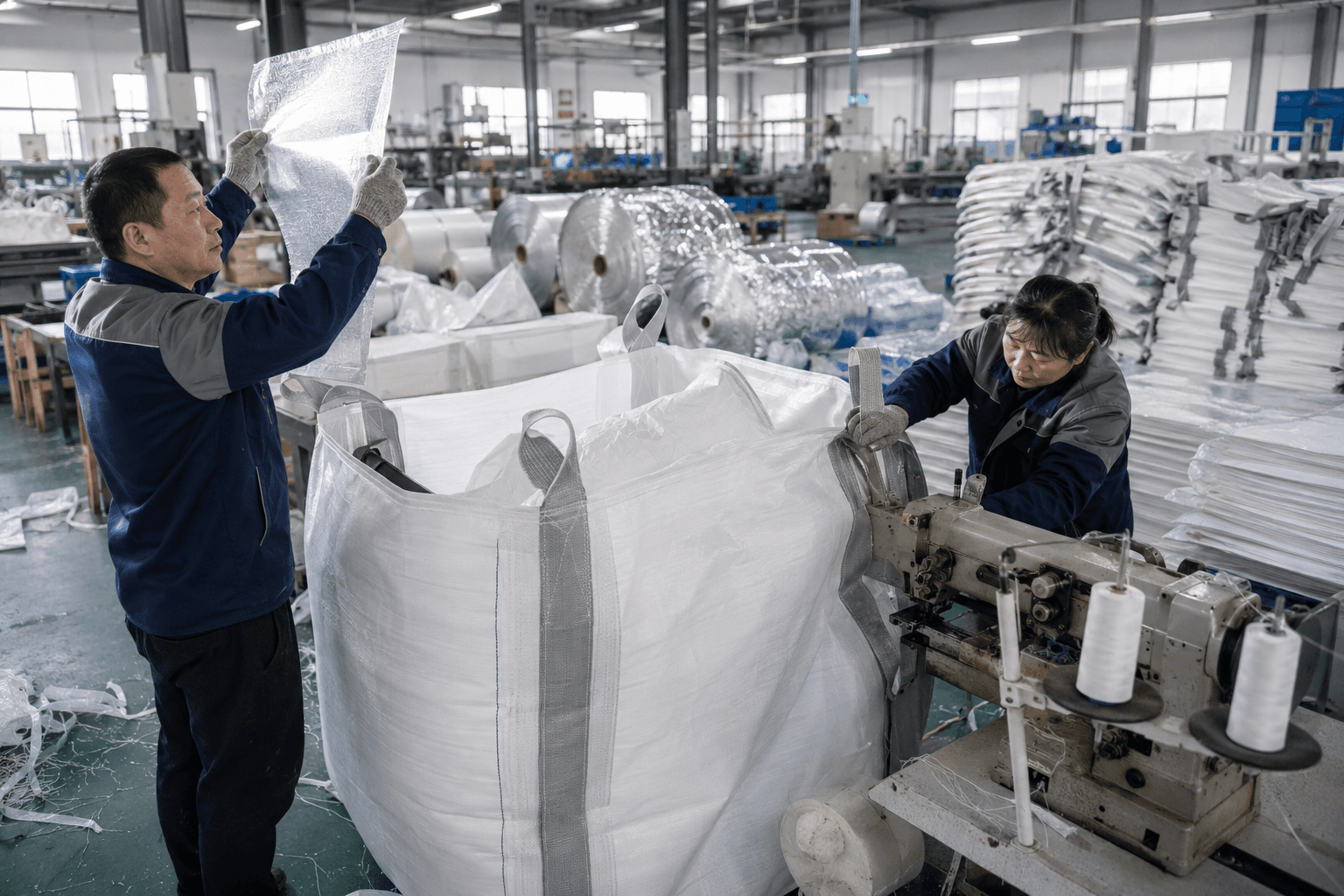
Turning Packaging Pitfalls into Profit: The Case for Custom FIBC Bags in Industrial Bulk Handling

Dayang Yang
AuthorWith experience in FIBC bulk bag manufacturing and export sales, we operate our own production facility with stable large-scale capacity. We are specialists in bulk bags, conductive FIBCs, food-grade FIBCs, UN certified bags, and customized flexible intermediate bulk containers for industrial packaging and bulk material transportation solutions.
The Real Cost of Overlooking Your Bulk Packaging Strategy
Material degradation from moisture, oxygen, or light exposure remains one of the most underestimated risks in industrial supply chains. For sensitive goods like lithium battery cathode materials, standard packaging often fails to prevent chemical reactions that lead to product loss, costly recalls, and damaged customer relationships. Equally dangerous, static discharge risks during chemical powder handling escalate safety hazards and insurance overheads when anti-static bulk packaging isn’t part of the equation. Many operations compound these problems with inefficient bag designs that slow filling and discharge cycles, directly reducing warehouse throughput and inflating labor costs. While the poly-woven packaging market grows at 35% annually, a surprising number of importers cling to outdated, one-size-fits-all solutions—leaving measurable profit on the table.
Why One-Size-Fits-All Bulk Bags Fail Modern Supply Chains
Generic FIBC bags simply weren’t built for the nuanced demands of today’s materials. They lack critical specialization, such as breathable bulk bag construction for powders that require aeration control, or light-proof FIBC designs to protect UV-sensitive powders and granules. Often, inadequate lifting loops create handling instability and safety violations during forklift or crane operations, a problem directly addressed by inner lifting loop bulk bag configurations. Without cross-reinforced jumbo bag bottoms or properly placed discharge spouts, even a 1-2 ton bulk bag can burst under load, causing downtime that eats into margins. Moreover, industries from construction materials to feed processing need moisture barrier FIBC options to prevent clumping, mold, or chemical breakdown—protection that off-the-shelf alternatives never deliver. For example, construction material bulk bags and feed bulk bags exposed to ambient humidity gradually degrade without integrated barrier layers, a failure that often surfaces only after cargo arrives at its destination.
The Anatomy of a High-Performance FIBC: From Lifting Loops to Liners
A purpose-built Flexible Intermediate Bulk Container is engineered layer by layer to match the material it carries. Inner lifting loop bulk bag designs provide reinforced stability for safe overhead handling, while dedicated overhead bulk bag approaches suit crane-based logistics. For maximum product integrity, an aluminum foil liner bulk bag or aluminum foil laminated bag integrates directly into the FIBC, forming an effective oxygen barrier bulk bag that also serves as a superior moisture shield—ideal for hygroscopic powders and fine chemicals. When dealing with irregular bulk materials, formed inner belly bag solutions and soft pallet lifting slings dramatically improve containment and handling efficiency. Customization extends further: custom FIBC bags can incorporate filling spouts, discharge spouts, and anti-static bulk packaging features explicitly tuned for materials like plastic pellets or nylon granules. Even plastic pellet packaging performance improves when antistatic elements are combined with a heavy-duty PP container bag that retains shape under repeated handling.
Proven Results: How Customization Delivered 10X ROI for Global Importers
Real-world outcomes tell the clearest story. A Fiji-based importer eliminated $300K in annual product losses by switching to moisture barrier FIBC with aluminum lined FIBC for their mineral exports—a direct upgrade from generic bulk bags. Across continents, packaging experts have helped clients achieve 10X growth precisely by replacing off-the-shelf jumbo bags with custom FIBC bags designed for the unique stresses of their supply chain. FIBC manufacturers now compress lead times and costs while delivering tailored solutions spanning new energy materials to mineral bulk packaging and chemical powder handling. Case studies consistently show that investing in cross-reinforced jumbo bag designs fitted with oxygen barrier bulk bag liners can slash product waste by up to 50%. For high-value materials like lithium battery cathode material packaging or lithium battery powder packaging, integrating anti-oxidation packaging directly into the container fabric isn’t just insurance—it’s a competitive differentiator that protects margins and expands market reach.
Take the Next Step: Partner with an Industrial Packaging Expert
Move beyond assumptions. Evaluate your current bulk material handling packaging against the specific moisture sensitivity, electrostatic risks, and handling demands of your product. Whether you need flame retardant packaging for safety-critical environments, light-proof FIBC for reactive powders, or 1 ton FIBC bags optimized for dense minerals, the right configuration exists. For operations struggling with irregular loads, a heavy-duty PP container bag combined with a formed inner belly bag can transform line efficiency and worker safety. PP woven bulk bags are just the starting point. Explore configurations that include aluminum foil liner bulk bag technologies for ultimate moisture and oxygen protection, or anti-static bulk packaging to mitigate ignition sources in dusty environments. Every detail matters when you’re moving 1-2 ton bulk bags across the globe. Request your custom FIBC consultation now – our engineers will design a solution precisely matched to your material and supply chain realities.
Related News
Other news you might be interested in
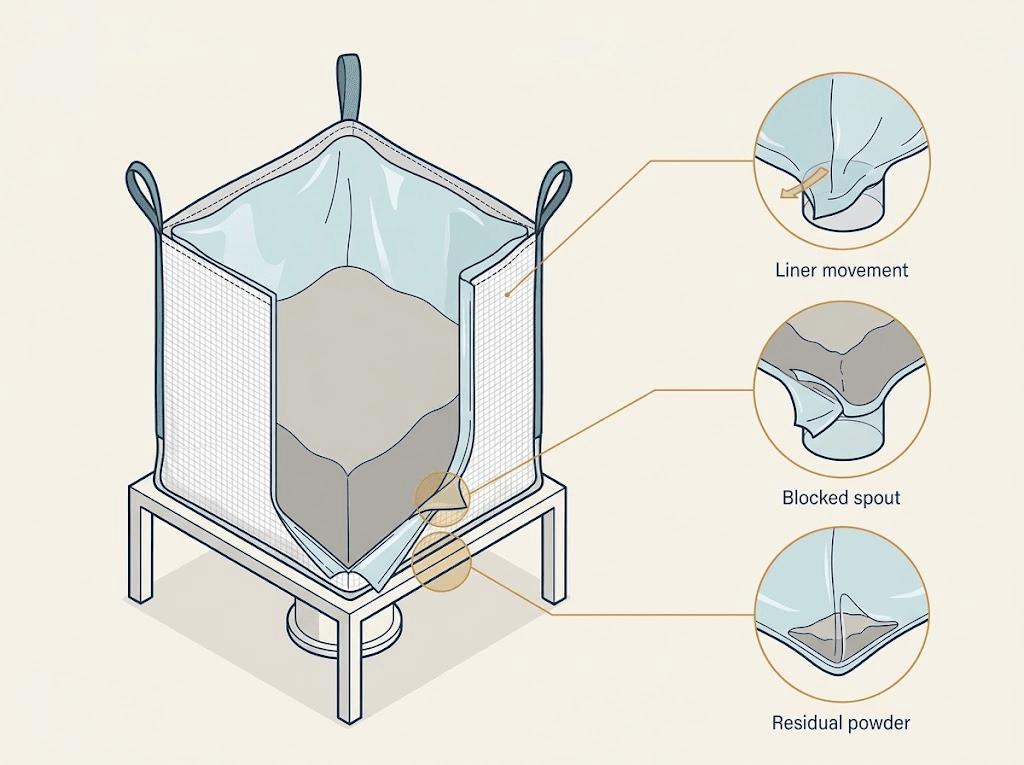
FIBC Liner Discharge Problems: A Buyer’s Checklist for Liner Movement, Blocked Spouts and Residual Powder
A lined bulk bag reaches the production line, but the powder stops flowing before the bag is empty. The liner moves towards the outlet, material remains in the bottom corners, or operators need repeated assistance to finish unloading.For buyers ordering FIBC liners, the useful question is: what information will help the packaging supplier and equipment provider identify the cause and agree on a better specification?Start by reviewing the material, liner, outer bag and discharge equipment together. Liner fit, folds, outlet configuration and product flow characteristics can all affect emptying performance.
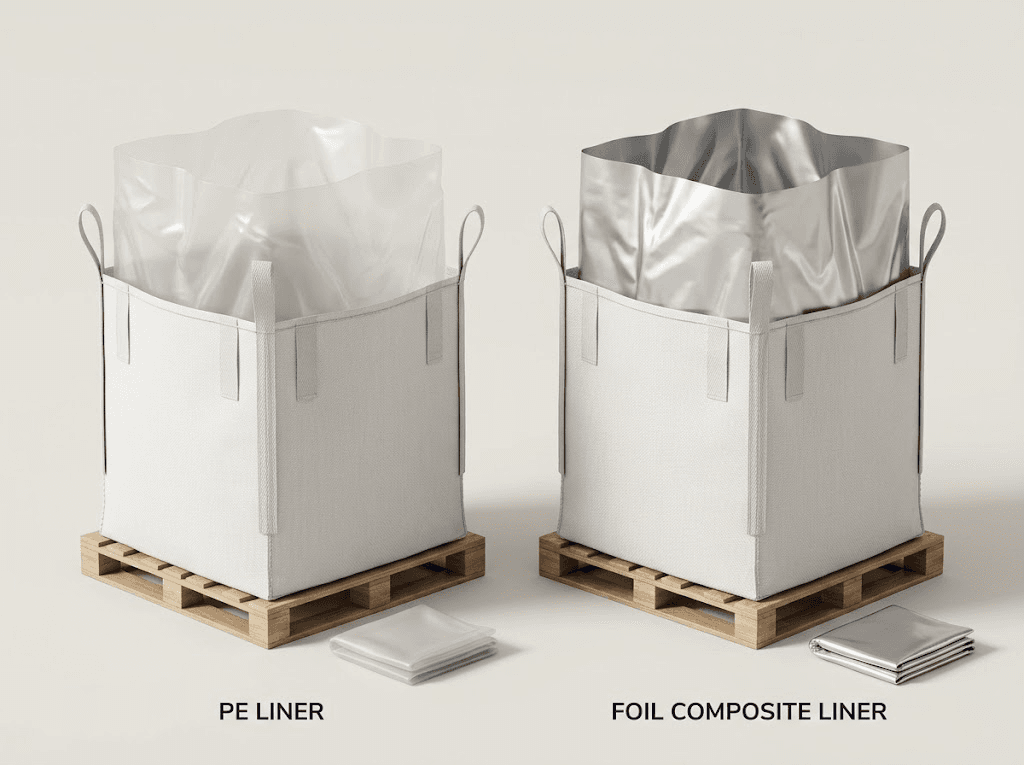
PE vs Aluminum Foil FIBC Liners for Moisture-Sensitive Powders: A Buyer’s Checklist
Choosing a liner for a moisture-sensitive powder starts with a practical question: what protection does the material need throughout filling, transport, storage and discharge?A request for “moisture proof bulk bags” gives a supplier a starting point, but it does not define an acceptable package. A PE liner may meet the requirement. An aluminum foil composite liner may be worth evaluating when the product needs a stronger moisture barrier, oxygen protection or light protection. The decision should follow the actual material specification, closure arrangement and trial results.This checklist helps buyers compare the options and prepare an enquiry for FIBC liners without relying on a material name alone.
Want to know more?
Get in touch with us for more information about our services and products.