

Aluminum Foil FIBC for Battery and New-Energy Powders: A Specification Checklist for Moisture, Light and Contamination Control

Dayang Yang
AuthorWith experience in FIBC bulk bag manufacturing and export sales, we operate our own production facility with stable large-scale capacity. We are specialists in bulk bags, conductive FIBCs, food-grade FIBCs, UN certified bags, and customized flexible intermediate bulk containers for industrial packaging and bulk material transportation solutions.
An aluminum foil FIBC can look like a simple line item: one outer bag, one liner, one price per unit. For a battery or new-energy powder, that description leaves out most of the decision. The buyer is not only choosing a film. The buyer is specifying the product-contact surface, the barrier construction, the filling and sealing arrangement, the discharge path, the contamination controls and the evidence that will be kept for repeat orders.
Project activity is one reason buyers are asking that question earlier. Recent project tracking reported three North American battery-material or component projects among 16 chemical and industrial manufacturing projects planned in September 2026. That is a project-pipeline signal, not a demand forecast. The purchasing question remains the same: can the proposed foil-lined FIBC be qualified for the powder, filling line and receiving site?
In this guide, an aluminum foil FIBC means an outer FIBC fitted with an aluminum foil-containing liner. The foil is one functional layer in a laminate, not the whole package. FIBC World's public form-fit liner page lists aluminum foil composite film, PE, EVOH and anti-static film among the available material directions and names lithium battery materials as an application. The actual construction, dimensions and performance evidence for a project still need to be confirmed in the quotation and sample.
This checklist is for procurement, packaging engineering, quality and EHS teams evaluating aluminum foil FIBC liners for battery and new-energy powders. It is a specification and qualification guide, not a dangerous-goods classification, a battery-material safety assessment or a certification of a particular product.
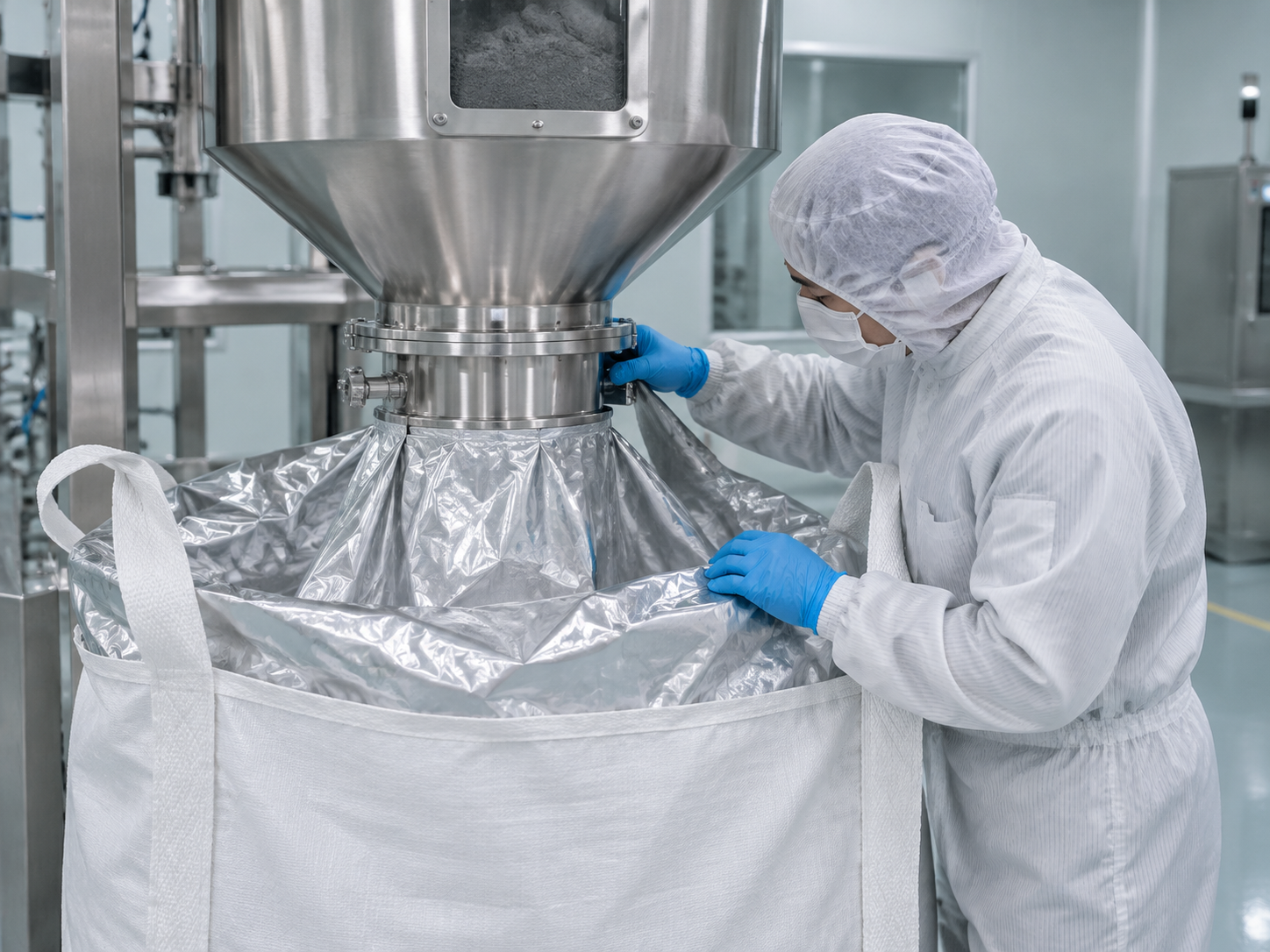
The Buyer Questions This Checklist Answers
What exactly is the powder, and which exposure would make it unacceptable?
Is the quoted "aluminum foil liner" a complete laminate suitable for the product-contact application?
What moisture, oxygen and light requirements apply, and under what test conditions?
Will the seams, spouts and closures preserve the intended protection after filling?
How will the liner be filled, fixed, sealed and discharged in the actual process?
What controls prevent metal particles, fibers, dust, lubricant, ink or packaging debris from reaching the product?
Does the complete FIBC and liner system meet the site's static and hazardous-area requirements?
What sample trial, inspection record and change-control process will support repeat orders?
If these questions are not answered before the price comparison, two quotations may look similar while describing different products and different levels of evidence.
Start With the Powder, Not the Word "Foil"
"Battery powder" is not a specification. Cathode active material, cathode precursor, graphite, silicon-carbon composite, a lithium salt and other new-energy powders can differ in particle size, bulk density, flow behavior, moisture sensitivity, oxygen sensitivity and handling hazards. The material's safety data sheet and the buyer's process specification should govern the review.
Before discussing a liner, record:
the product name, chemical form and safety data sheet revision;
particle size, bulk density and flow behavior where available;
filling temperature and the condition of the powder at filling;
moisture, oxygen and light sensitivity;
any maximum acceptable moisture, contamination or foreign-matter level;
the expected storage and transport duration, including intermediate warehouses;
the filling, sealing and discharge method;
whether the site has a combustible-dust, static or hazardous-area assessment; and
the destination and any transport or import requirements that apply to the material.
Be precise about moisture limits. A product moisture content, a dry-room dew point, a relative-humidity limit and a WVTR result are different measurements. They are not interchangeable. If the product team has a limit, state the property, the test method, the units and the sampling point in the RFQ.
This step prevents a common error: selecting a foil liner because the powder is described as "moisture-sensitive," without defining how much moisture is acceptable or where it must be controlled.
Define the Complete Aluminum Foil FIBC System
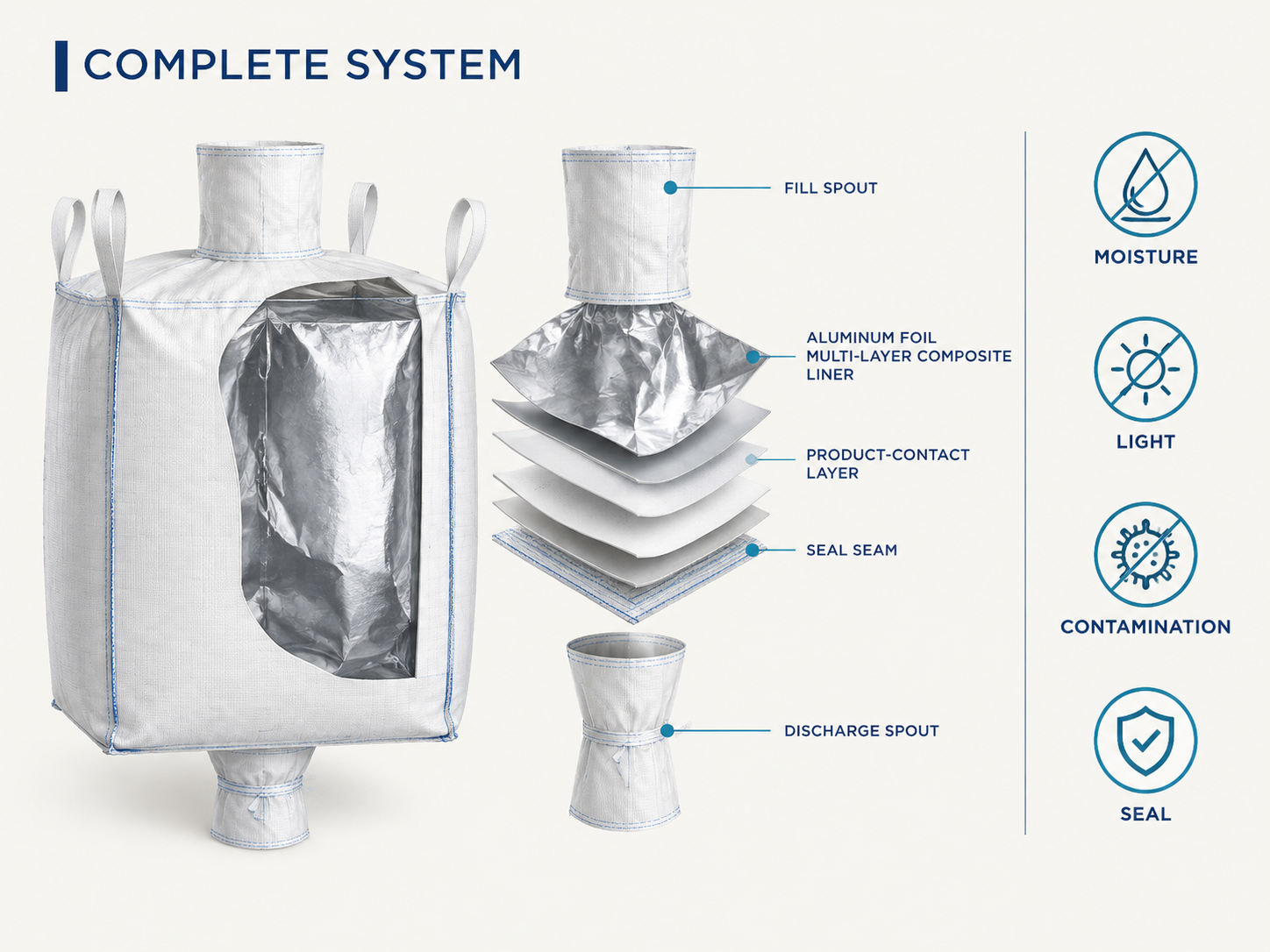
An aluminum foil liner is normally a multi-layer flexible laminate. Depending on the design, it may include a product-contact sealant, tie layers, the foil layer, a support film and an outer layer. The outer FIBC, liner attachment, spouts, closures and packing are also part of the delivered system. FIBCA's design guidance treats cargo, bag, liner, filling, discharge, handling and storage as connected questions, and its terminology distinguishes the liner and spout features that need to be described in the drawing.
Ask the supplier to describe the complete construction rather than quoting only "aluminum foil" or a single thickness. The specification should identify:
| System element | What the quotation or drawing should state |
|---|---|
| Outer FIBC | Bag style, body construction, dimensions, intended fill weight and lifting arrangement |
| Liner body | Form-fit, lay-flat or other geometry; finished dimensions and tolerances |
| Product-contact layer | Material and grade of the layer that will contact the powder |
| Foil layer | Foil grade or nominal thickness and its position in the laminate |
| Support and tie layers | Layer order and materials used to build the laminate |
| Sealant | Sealing surface, sealant material and recommended closure method |
| Spouts and openings | Fill and discharge dimensions, lengths, closures and any liner-to-bag connection |
| Fixing | Tabs, glue points, corner fixing, top fixing or another agreed attachment method |
| Packing | How the finished liner is protected, identified and packed for shipment |
The same nominal liner thickness does not make two laminates interchangeable. A different sealant, foil grade, layer order or support film can change handling, barrier and sealing behavior. The product-contact layer also needs its own review because it is the surface the powder will actually touch. General FIBC standards can address design, material and type-test requirements, but they do not approve a particular liner for a particular battery powder.
FIBC World's public product information shows that form-fit liners can be customized with PE, EVOH barrier film, aluminum foil composite film or anti-static film, and with tabs or glue points for positioning. Those are product-direction options, not a project approval. The final combination must be confirmed against the powder, outer bag and filling line.
Write Moisture and Oxygen Requirements as Testable Criteria
Moisture control is more than the word "waterproof." For a moisture-sensitive battery or new-energy powder, the useful requirement describes what must be protected, for how long, under which conditions and how the result will be checked.
WVTR means water vapor transmission rate. OTR means oxygen transmission rate. A result is only comparable when the method, temperature, relative humidity, units, test area, duration and tested specimen are known. Intertek describes ASTM F1249 as a method for measuring water-vapor transmission through barrier films under selected conditions. ASTM D3985 is used for oxygen transmission testing.
A flat-film result does not automatically describe the finished liner. Moisture and oxygen can also enter through seams, seal edges, fill-spout closures, discharge closures, folds, pinholes and handling damage. Thin foil can contain pinholes, and flexing or creasing during converting and use can affect barrier performance.
For the RFQ, state:
the required WVTR or OTR target, if the product team has one;
the test method and conditions;
whether the result must describe the flat laminate, a finished liner, a seam or a complete package;
the storage and transport period the result is meant to represent;
the filling environment, including dry-room dew point or relative humidity where applicable; and
how the buyer will verify the finished package before production.
If the material is filled in a dry room or controlled-humidity booth, record the dew point or relative humidity, the time the liner is open, the time before sealing and the condition of the receiving environment. A desiccant can be part of a packaging strategy, but it is not a substitute for a controlled closure or a qualified laminate. If desiccant or nitrogen flushing is proposed, define the quantity, placement, equipment and acceptance method.
Do not accept a headline such as "high barrier" or "zero moisture" without a test scope. A useful quotation says what was tested, how it was tested and whether the result applies to the finished liner the buyer will receive.
Treat Light Protection as a System Property
Aluminum foil is opaque when the foil layer is continuous, but light protection is still a property of the complete package. Light can reach the product through an inspection window, a clear tape, an uncoated seam, a damaged area, a pinhole or an open closure. Labels and printing can also affect how the finished liner is inspected.
Separate two questions that are often mixed together:
Does the outer FIBC have UV stabilization for the bag itself?
Does the complete liner system protect the product from the light exposure that matters to the powder?
The first does not automatically answer the second. If the product is light-sensitive, state the exposure conditions and the acceptance requirement. Ask the supplier to identify any clear or uncoated areas and to explain how the finished liner will be inspected. The sample trial should include the same spouts, closures and attachment features as the production design.
For a broader comparison of foil and PE directions, see the existing guide to PE and aluminum foil FIBC liners. This article assumes that a foil-containing direction is being evaluated and focuses on the battery-powder specification.
Design Filling, Sealing and Discharge as One Interface
The closure is often created during filling, not during film manufacture. A good laminate with an inconsistent seal is still an unreliable package. Powder in the seal area can prevent a continuous bond, and a visibly closed opening is not necessarily a leak-free closure.
Ask the supplier to confirm the proposed sealing method and a practical operating window:
sealing equipment type;
sealing temperature range;
dwell time;
pressure;
cooling or handling time before the seal is loaded;
acceptable seal appearance; and
the method used to check seal strength and integrity.
Seal strength can be measured using a recognized method such as ASTM F88, but seal strength alone does not prove that the closure is leak-free.The buyer and supplier should agree how the finished seal will be inspected and what will be recorded. The trial should use the actual powder where possible, because dust or contamination in the seal zone is part of the real process.
The filling and discharge interfaces need the same attention. Record the outer bag dimensions, fill-spout diameter and length, discharge-spout diameter and length, closure type, liner attachment method and the equipment that will connect to each opening. FIBCA safe-handling guidance notes that liners should be properly attached or secured so they do not come out during discharge, and that filling and discharge closures should follow the manufacturer's instructions.
A form-fit liner can reduce folds, movement and trapped material, but it is not automatically the right geometry for every bag. The liner must be designed around the actual outer FIBC, including baffles, spouts and attachment points. The existing FIBC liner fit and interface guide explains the measurements to collect before ordering.
If vacuum or nitrogen flushing is proposed, confirm that the liner, spouts, seals and filling equipment can support the process. Do not add a gas-flush step to a quotation without a trial that represents the production line and the operator's actual procedure.

Build Contamination Control Into the Specification
For battery and new-energy powders, contamination control is not only a property of the film. It is a chain of controls from laminate conversion to the moment the powder enters the liner.
Potential contamination sources include:
cut edges and slitting dust;
film or laminate debris;
ink, adhesive or coating on the wrong surface;
tabs, cords, labels and spout components;
fibers or dust from the outer FIBC;
pallets, cartons and packing materials;
gloves, tools and the filling environment; and
creases, scratches or handling damage that create a trap or a pathway.
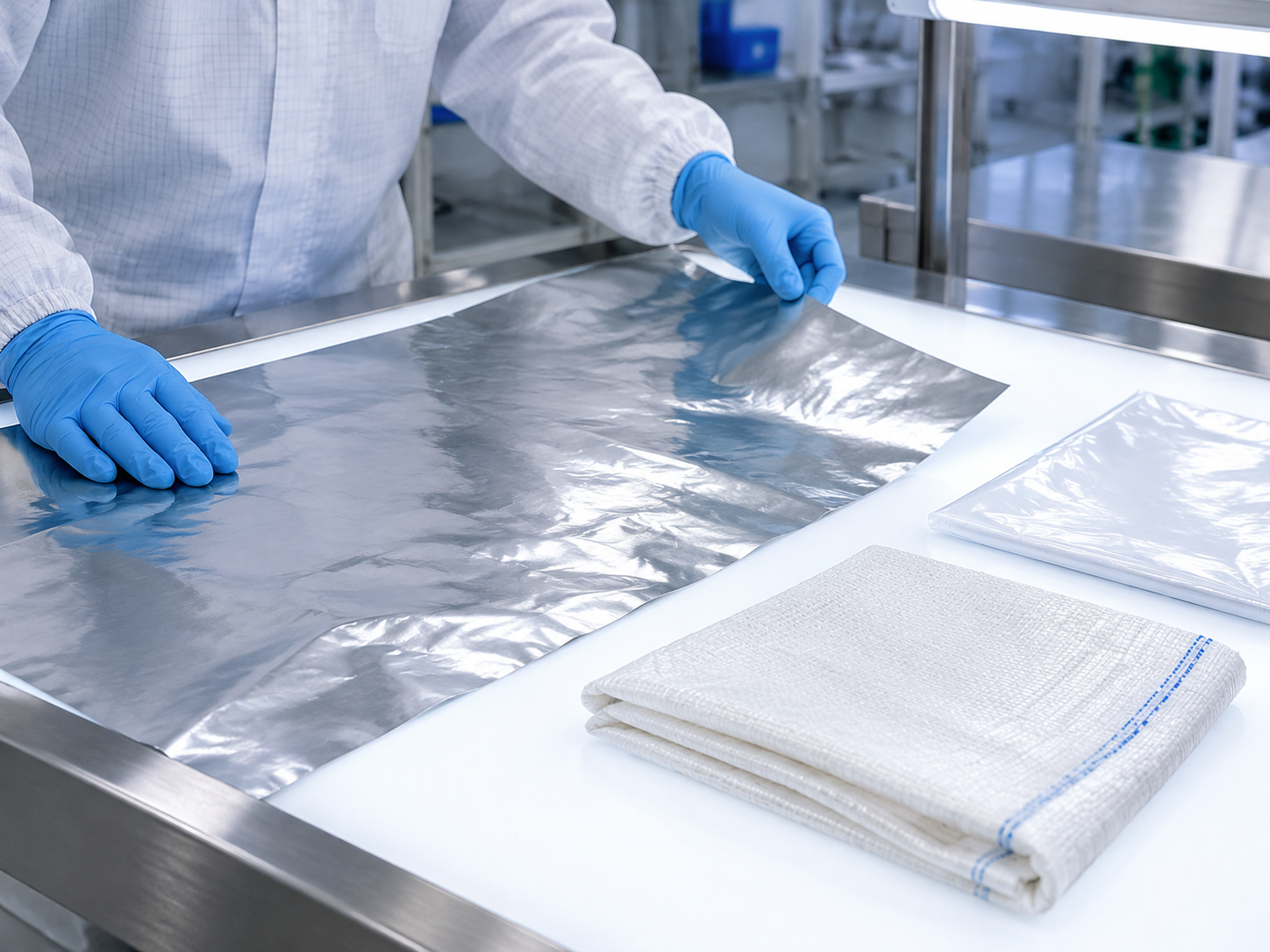
Ask the supplier to describe how the product-contact surface is protected during conversion, printing, spout making, inspection, folding and packing. Ask whether the finished liner is individually protected, how it is identified, and how the packing is opened at the buyer's site without introducing debris.
The term "battery-grade" is not a universal standard. A supplier should define what it means in that quotation: a material declaration, a cleanliness inspection, a foreign-matter control, a lot record, a clean-conversion area or another agreed requirement. A general "food-grade" statement does not answer battery-material contamination requirements, and a general "dust-free" claim does not define an acceptance test.
The quality plan should also cover change control. Ask how the supplier will notify the buyer if the foil grade, sealant, adhesive, tie layers, liner dimensions, spout design, attachment method or production source changes. Keep the approved drawing, material structure, sample reference and trial record together so a repeat order can be compared with the approved version.
Separate Static Safety From Barrier Performance
An aluminum layer may sound conductive, but that does not automatically make an FIBC Type C or Type D, and it does not by itself establish suitability for a combustible dust, flammable atmosphere or other classified area. Static performance depends on the complete system, including the outer bag, liner construction, grounding path, filling and discharge arrangement, and site handling procedure.
Start with the material's safety data sheet and the site's hazard assessment. If the powder is combustible, static-sensitive or handled in an area with specific electrical requirements, ask for a joint review by the packaging supplier, process engineer and EHS team. Confirm:
the required FIBC static classification, if any;
whether the proposed liner is compatible with that system;
how the bag and equipment are grounded or bonded;
how the liner is positioned and closed during filling;
what happens during discharge; and
what test evidence and operating instructions apply.
FIBCA's static-protective FIBC guidance advises buyers to check with the manufacturer that the correct liner is fitted for the intended application. It is not a system approval for a particular powder or site.Do not accept an "anti-static foil" label as a substitute for a complete review.
Qualify the Complete System With a Representative Trial
A data sheet and a sample seal are inputs. The buyer still needs a trial of the complete liner in the intended outer bag, using representative powder and equipment.
| Trial stage | What to verify |
|---|---|
| Drawing review | Laminate, dimensions, spouts, attachment and closure match the approved drawing |
| Fit check | Liner sits correctly inside the outer FIBC without uncontrolled folds or tension |
| Filling trial | Liner remains positioned, displaced air can escape and the filling equipment does not damage the film |
| Sealing trial | The agreed equipment produces a consistent seal within the stated window |
| Storage and transport check | The filled package withstands representative stacking, movement and storage conditions |
| Discharge trial | The liner does not obstruct the outlet, shift excessively or retain unacceptable material |
| Documentation | Results, photographs, settings, sample references and approvers are recorded |
Define acceptance criteria before the trial. "Looks acceptable" is not a criterion for a battery-material project. The buyer and supplier should agree what will be measured, how it will be inspected and who will approve the result. Where the product is sensitive to moisture or oxygen, the trial should include the agreed storage condition and the agreed verification method, not only a visual check after filling.
Keep retained samples of the approved laminate and finished liner. Record the outer bag drawing, liner drawing, material structure, spout dimensions, attachment method, sealing settings and packing method. A successful trial does not replace a barrier test, a static assessment or a regulatory review; it connects those inputs to the actual package.
Use an RFQ and Quote Comparison Checklist
To make aluminum foil FIBC quotations comparable, send the same information to every supplier:
| RFQ item | Information to provide |
|---|---|
| Powder | Product name, form, bulk density, particle size and safety data sheet revision |
| Protection target | Moisture, oxygen or light requirement, storage duration and acceptable product condition |
| Filling environment | Dry-room dew point or relative humidity, filling temperature and time before sealing |
| Outer FIBC | Bag style, dimensions, fill weight, lifting arrangement and drawing or photographs |
| Liner design | Form-fit or other geometry, attachment method, fill and discharge spouts |
| Laminate | Product-contact layer, foil layer, sealant, support layers and total construction |
| Barrier evidence | Required WVTR or OTR target, test method, conditions and tested specimen |
| Closure | Sealing equipment, proposed sealing window and seal inspection method |
| Contamination control | Product-contact protection, foreign-matter inspection, packing and lot traceability |
| Static and hazards | Site assessment, required FIBC classification and any grounding requirement |
| Trial | Sample quantity, representative powder, test conditions, acceptance criteria and approver |
| Commercial | Order quantity, destination, required date, packing method and quotation validity |
When comparing quotes, do not compare only the price per liner. Compare the construction, finished-liner evidence, closure, contamination controls, trial scope, change control, packing and commercial validity. A lower quote that excludes a required test, uses a different laminate or leaves the closure undefined is not a like-for-like offer.
For a project-specific review, FIBC World's public form-fit FIBC liner page and aluminum foil bag category provide the starting product context.The next step is to confirm the actual available structure and sample arrangement.
Red Flags in a Supplier Quotation
Review the quotation carefully if it:
refers only to "aluminum foil" without identifying the complete laminate;
gives a WVTR or OTR number without method, conditions, units or specimen details;
presents a flat-film result as though it were finished-liner performance;
promises "zero moisture," "absolute barrier" or "no contamination" without a defined test;
uses "battery-grade" without defining the requirement;
claims anti-static or Type C/Type D suitability without reviewing the complete system;
provides no sealing window, seal inspection method or closure procedure;
does not identify the product-contact layer, attachment method or packing protection;
offers no lot traceability or change-notification process; or
excludes sample approval, testing or clean packing from the commercial comparison.
These are not automatic reasons to reject a supplier. They are reasons to stop treating the quotation as complete until the missing point is defined.
Conclusion
An aluminum foil FIBC for battery and new-energy powders is a system, not a material label. Start with the powder and its exposure path. Specify the complete laminate, product-contact surface, dimensions, spouts, attachment, closure and packing. Write moisture, oxygen and light requirements as testable criteria. Control contamination at every product-contact point, assess static safety separately, and qualify the finished system with a representative trial.
The goal is not to collect the longest list of claims. It is to create a specification that a supplier can quote, a quality team can inspect and a repeat order can reproduce.
To review a battery or new-energy powder application, send FIBC World the product details and safety data sheet revision, bulk density, intended fill weight, outer bag dimensions, filling and discharge equipment, moisture and light requirements, static or hazardous-area information, storage conditions, destination and order quantity. Request confirmation of the available aluminum foil composite structure, sample arrangement, MOQ and lead time before placing an order. You can contact FIBC World with the specification and the problem the packaging needs to solve.
Related News
Other news you might be interested in
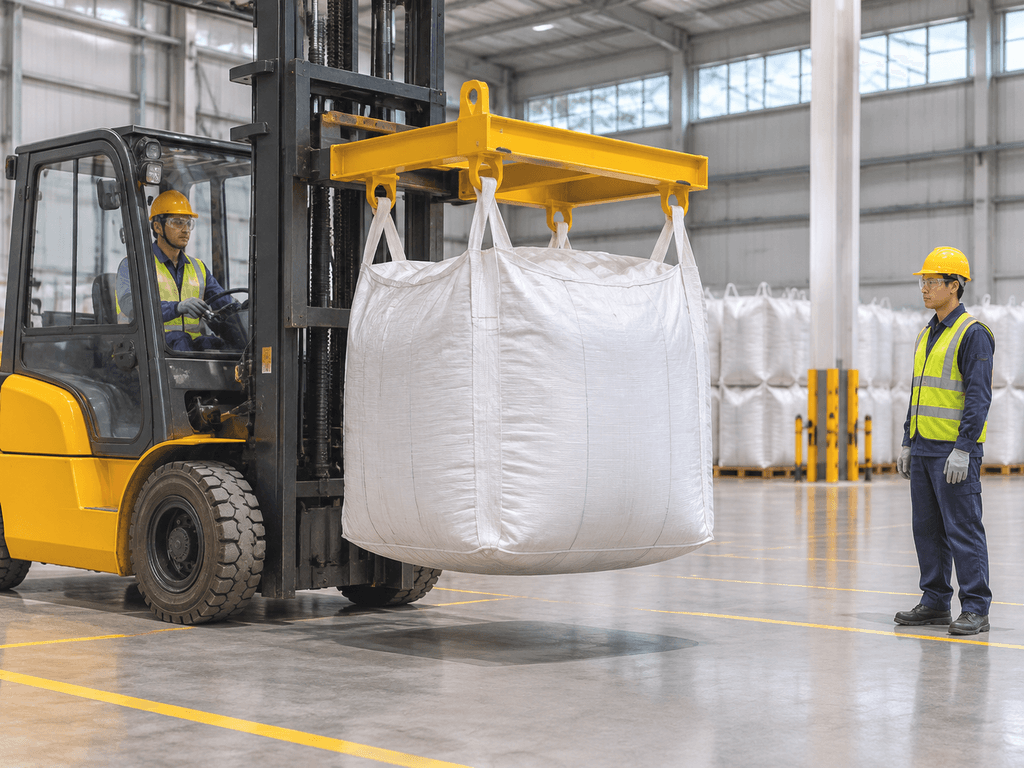
FIBC Bag Handling and Safety: Best Practices for Safe Use
Proper FIBC handling is closely connected with operator safety, bag integrity and efficient bulk-material movement. An FIBC is a system of components rather than simply a woven fabric container. Lifting loops or sleeves, seams, fabric, closures, filling arrangements, discharge components and, where applicable, liners all contribute to how the bag performs during use.

Recyclable FIBC: Mono-material PP, with liner and ventilated type
When a buyer asks, "Is this FIBC recyclable?", the answer depends on which part of the bag is being discussed, where it will be used and what recycling route is actually available. A woven PP bag with a PE liner, a paper label, a polyester thread and a foil barrier is not the same product as a predominantly mono-material PP bag. Even a mono-material bag is not automatically recycled at scale if collection, cleaning and sorting are missing.This guide separates three questions that are often mixed together: what the bag is made of, what the bag is designed to do, and what evidence supports the claim. It is a buyer checklist, not a legal opinion or a certification statement.
Want to know more?
Get in touch with us for more information about our services and products.