
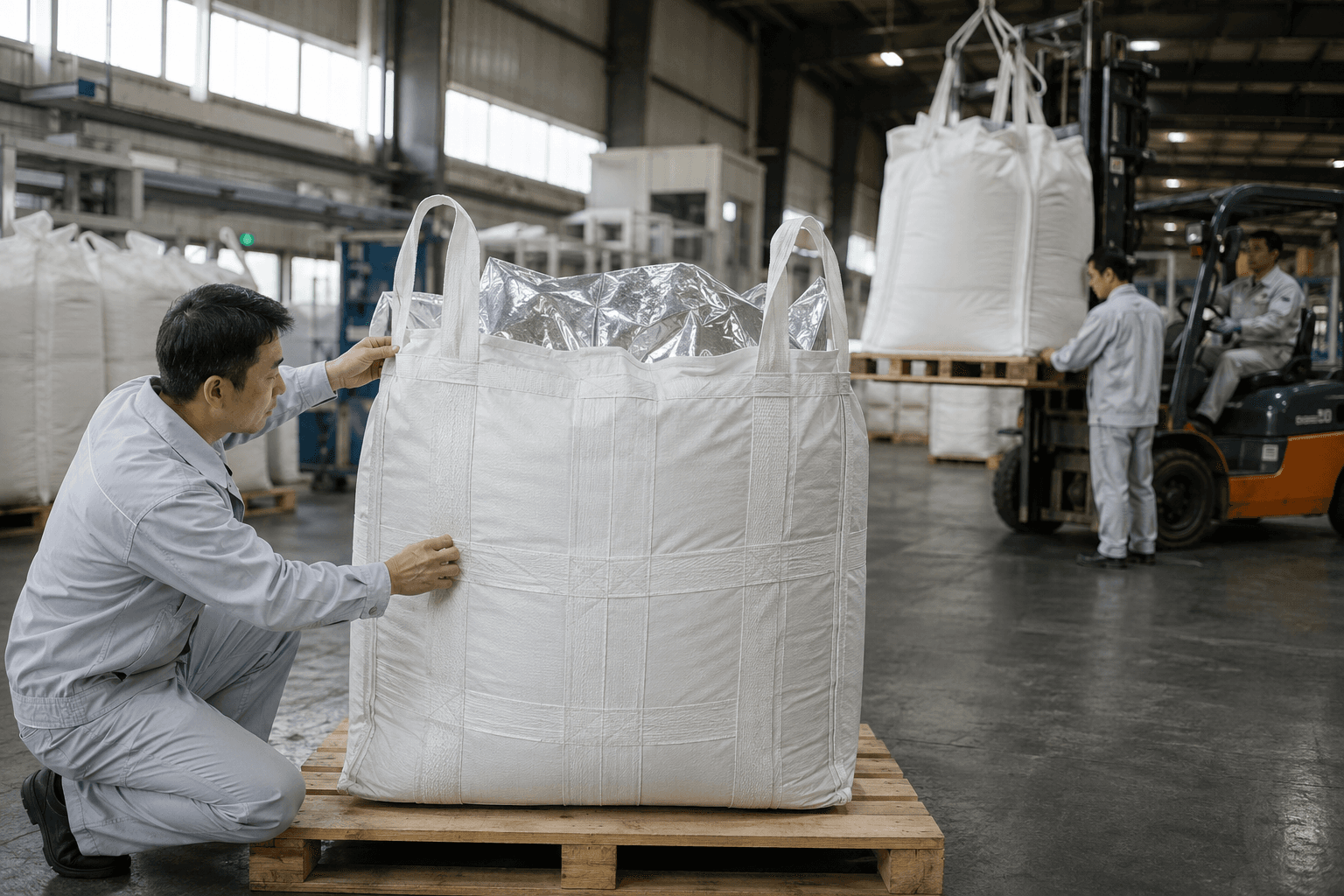
Optimize Bulk Material Handling with Custom FIBC Solutions: A Guide to Moisture-Proof and Heavy-Duty Packaging

Dayang Yang
AuthorWith experience in FIBC bulk bag manufacturing and export sales, we operate our own production facility with stable large-scale capacity. We are specialists in bulk bags, conductive FIBCs, food-grade FIBCs, UN certified bags, and customized flexible intermediate bulk containers for industrial packaging and bulk material transportation solutions.
The Hidden Costs of Inefficient Bulk Packaging
Every time a bulk bag fails during transport or storage, the financial impact ripples across your operation. Material spoilage from moisture ingress doesn’t just waste product — it erodes margins, disrupts production schedules, and damages relationships with downstream customers. For procurement managers overseeing industrial bulk packaging, the difference between a standard bag and an engineered Flexible Intermediate Bulk Container can mean tens of thousands in recovered revenue annually.
Industries handling hygroscopic chemicals, battery-grade powders, and high-value minerals have moved beyond commodity packaging. They specify moisture-proof bulk packaging with integrated barriers because the cost of replacement and disposal far exceeds the incremental investment in a properly designed FIBC bag. This shift isn’t limited to high-tech sectors. Even traditional distribution channels — paper bag dealers serving industrial clusters like Andheri West in Mumbai — are migrating customers toward jumbo bags that slash handling time and eliminate multi-layer packaging waste. Operators who ignored these packaging pitfalls learned the hard way that reactive purchasing is the most expensive procurement strategy.
The math is straightforward. A heavy-duty PP container bag with moisture barrier technology might cost more per unit, but when it prevents a 500 kg load of nylon granules from hardening into an unusable block, the ROI becomes undeniable. Factor in reduced handling time with forklift bulk bag designs and fewer rejected shipments, and the packaging line item transforms from a cost center into a margin protector.
Key Challenges in Bulk Material Packaging
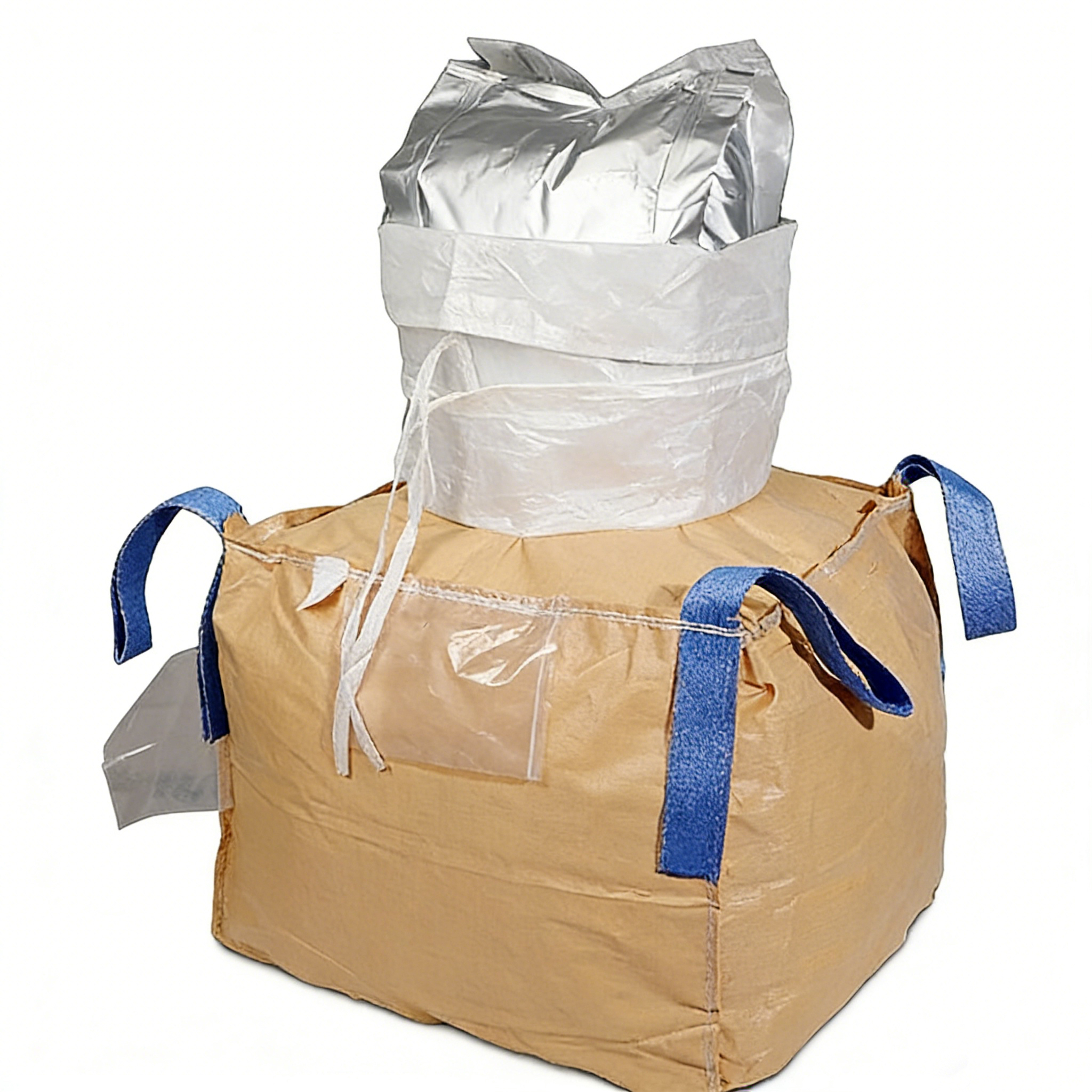
Not all materials punish poor packaging equally. Some degrade quietly over weeks; others react within hours of exposure. Understanding your material’s sensitivity profile is the first step toward specifying the right bulk material handling packaging.
Moisture and oxidation sensitivity tops the list for lithium battery powders, nylon granules, and fine chemical powders. Once moisture penetrates a standard woven PP bag, hygroscopic materials cake, clump, or initiate slow chemical reactions that compromise batch consistency. An aluminum lined FIBC with an oxygen barrier bulk bag construction arrests both degradation pathways. For cathode materials used in lithium battery production, even trace oxidation can shift electrochemical performance — making anti-oxidation packaging a non-negotiable specification rather than a premium option.
Light sensitivity introduces another layer of complexity. Lithium battery cathode material packaging and certain specialty chemicals degrade under UV or ambient light exposure. Light-proof FIBC for lithium powder applications incorporate opaque inner layers that block transmission without adding excessive weight to the bag structure.
Load capacity and handling dynamics determine whether your packaging integrates smoothly into existing logistics or creates bottlenecks. A cross reinforced jumbo bag rated for 1.5 to 2.5 tonnes must perform consistently whether lifted by a forklift bulk bag configuration or an overhead bulk bag setup with lifting loop bulk bag attachments. Inner lifting loop bulk bag designs offer clean sidewalls that resist snagging in automated filling lines, while soft pallet lifting sling systems reduce stress concentrations at lift points. Custom FIBC bags engineered with these specifications directly address the moisture and static challenges that derail high-volume operations.
Static and flame retardancy requirements become critical when handling combustible dusts or solvent-laden powders. Anti-static bulk packaging with Type C or Type D construction safely dissipates charge buildup, while flame retardant packaging options provide an additional safeguard for operations where ignition risks cannot be engineered out of the process.
Our Comprehensive FIBC Portfolio: Engineered for Performance
Generic bulk bags fail at the margins — literally. Tears at seam junctions, delamination of barrier layers, and inconsistent safe working loads (SWL) all trace back to manufacturing shortcuts. The solutions below are designed to eliminate these failure modes through material selection and construction discipline.
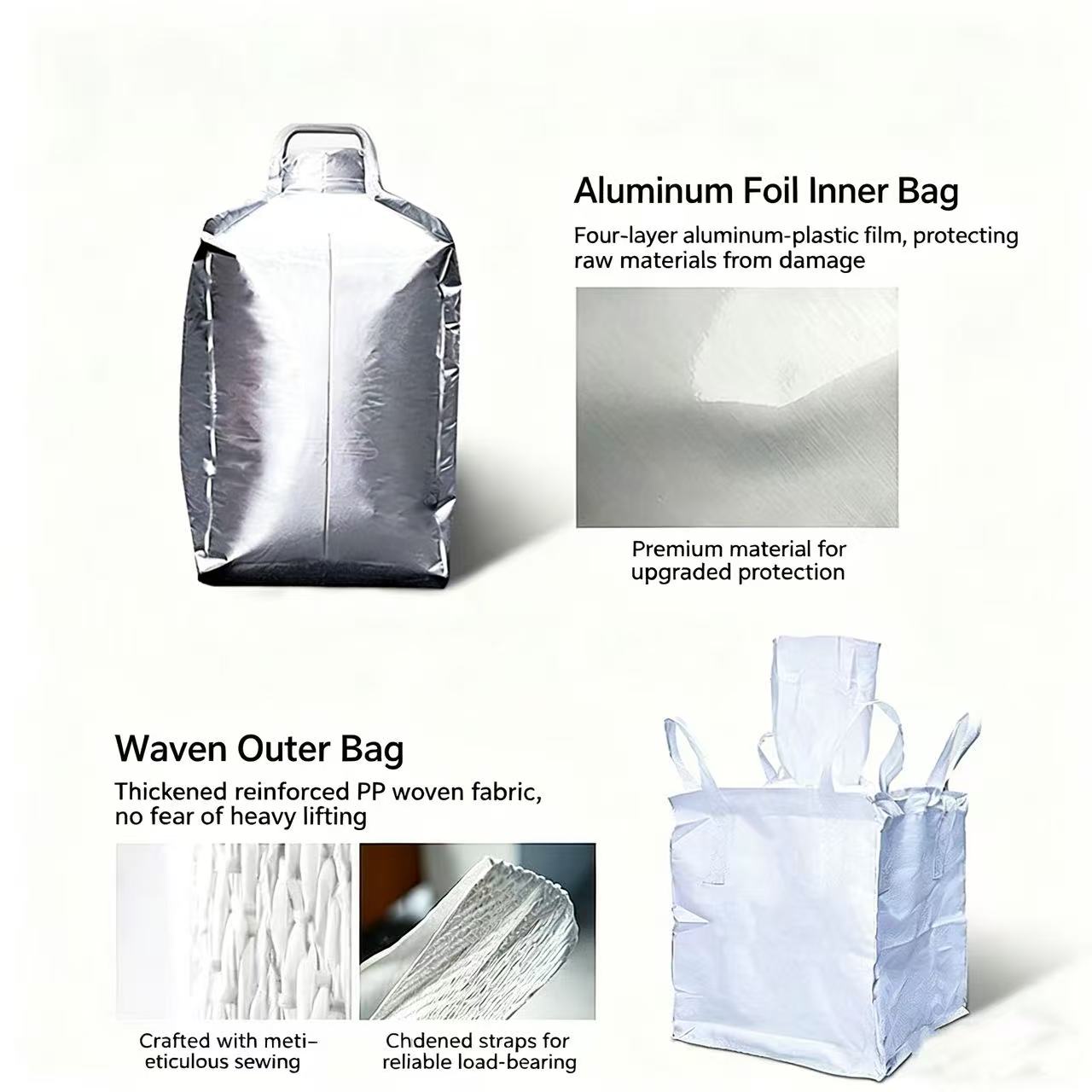
Soft Pallet Lifting Slings and Cross Reinforced Jumbo Bags form the backbone of heavy-lift industrial packaging. Constructed from virgin PP with cross-reinforced bottoms, these PP woven bulk bags handle 1.5–2.5 ton SWL without the creep deformation that plagues recycled-material alternatives. Double-thread overlock sewing at all seam junctions distributes load stress evenly — a detail that matters when a bag is suspended 10 meters above a factory floor or swung into a ship’s hold. Our custom white PP FIBC bags with thickened wear-resistant design and customizable sizing provide the durability industrial operations require.
For lithium battery powder packaging and other moisture-sensitive applications, the 1–2 Ton Battery Powder FIBC with Aluminum Foil Liner delivers dual-layer protection. The outer PP woven shell provides structural integrity; the inner aluminum foil liner bulk bag layer creates a continuous moisture, oxygen, and light barrier. This 3-side seal aluminum foil bag construction eliminates the edge-creasing failures common in laminated films. For operations packaging lithium powder, the light-proof FIBC configuration adds anti-moisture and oxygen barrier performance that preserves cathode material integrity throughout the supply chain.
Operations handling minerals, recycled plastics, or construction aggregates benefit from PP FIBC Jumbo Bags in 1 Ton Black. These mineral bulk packaging workhorses combine moisture-proof and dust-proof construction with UV-stabilized fabric that resists radiation-induced embrittlement during outdoor storage. The 1-ton black bulk bag configuration suits applications from plastic pellet packaging to mineral concentrates where opacity and durability matter.
Aluminum Foil Laminated 3-Side Seal Bags extend barrier performance to food-grade and high-purity chemical applications. Custom printing on the outer layer and precision heat-sealing on all three sides ensure barrier integrity while supporting brand identification in transit. For nylon granules packaging and feed bulk bags, the formed inner belly bag option provides an additional contoured liner that prevents material from lodging in corner folds during discharge.
Social Proof and ROI: Real Results from Our Clients
Mumbai’s Andheri West industrial belt houses some of India’s most cost-conscious chemical distributors. When several operations switched from stitched paper bags to our moisture-barrier FIBC bags, they documented a 30% reduction in material waste within the first quarter. The savings came from eliminating clumped returns — not from theoretical calculations, but from actual invoice reconciliation.
A different set of metrics emerged from a mineral processing facility that adopted cross reinforced jumbo bags with engineered lifting loop bulk bag configurations. Loading efficiency improved by 40% because operators no longer had to double-check bag integrity before each lift or slow down to navigate awkward sling placements. When you multiply that time savings across hundreds of lifts per shift, the labor cost reduction alone justified the transition.
The total cost of ownership argument grows stronger when you account for reusability. A factory-direct FIBC with reinforced seams and quality PP resin can complete multiple trips before retirement — provided the construction holds up to repeated filling, lifting, and discharge cycles. Per-trip packaging cost calculations often favor these reusable industrial bulk packaging solutions over single-use alternatives, even before factoring in the avoided costs of spillage and cleanup.
Get Started: Request a Custom FIBC Consultation
Every material has a sensitivity fingerprint, and every handling environment imposes its own constraints. We begin every consultation by understanding your material type, moisture sensitivity, required SWL, and handling equipment — whether you’re loading via forklift bulk bag attachments, overhead cranes, or automated filling stations.
From that baseline, our engineers specify the appropriate PP woven bulk bags or aluminum lined FIBC construction, including discharge spout dimensions, filling spout configuration, and lifting loop bulk bag placement — whether standard corner loops, cross-corner designs, or inner lifting loop bulk bag layouts for clean-sidewall applications. We provide sample bags for your real-world evaluation so you can validate performance before committing to production volumes.
Standard sizes ship with no minimum order quantity, and factory-direct pricing keeps your per-unit costs predictable as volumes scale. Whether you’re packaging plastic pellets, lithium battery cathode materials, nylon granules, minerals, or feed bulk bags — the bag design follows the material, not the other way around.
Contact our engineering team today to discuss your bulk packaging specifications and receive a custom recommendation. Start your consultation — eliminate waste and improve efficiency now.
Related News
Other news you might be interested in
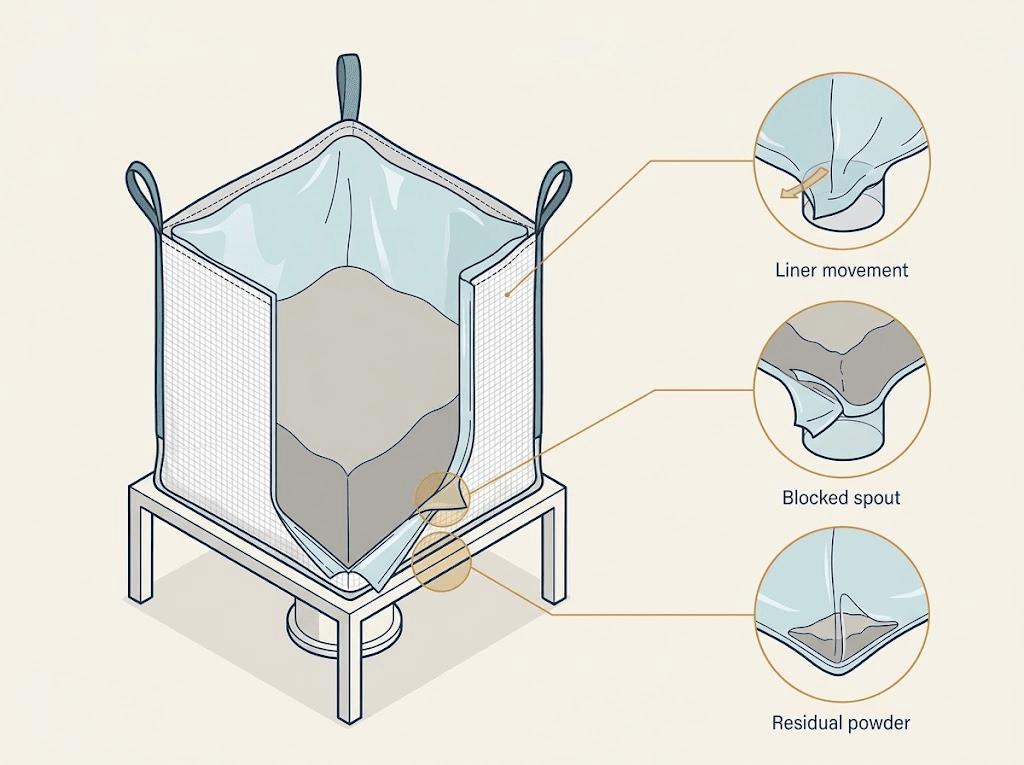
FIBC Liner Discharge Problems: A Buyer’s Checklist for Liner Movement, Blocked Spouts and Residual Powder
A lined bulk bag reaches the production line, but the powder stops flowing before the bag is empty. The liner moves towards the outlet, material remains in the bottom corners, or operators need repeated assistance to finish unloading.For buyers ordering FIBC liners, the useful question is: what information will help the packaging supplier and equipment provider identify the cause and agree on a better specification?Start by reviewing the material, liner, outer bag and discharge equipment together. Liner fit, folds, outlet configuration and product flow characteristics can all affect emptying performance.
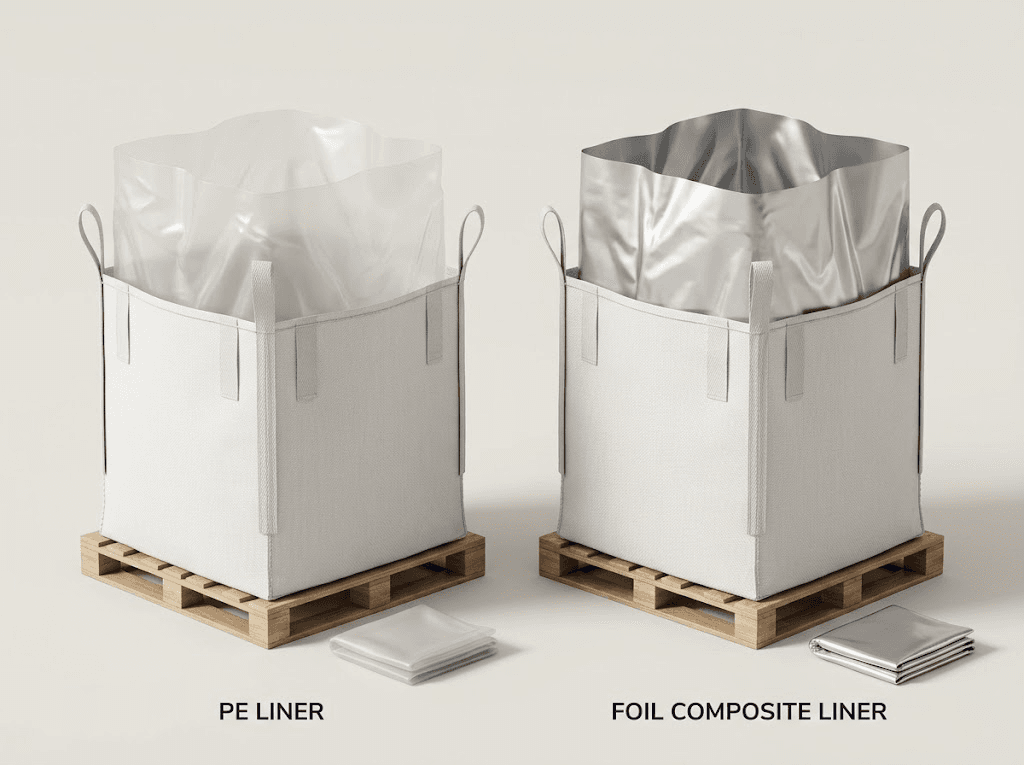
PE vs Aluminum Foil FIBC Liners for Moisture-Sensitive Powders: A Buyer’s Checklist
Choosing a liner for a moisture-sensitive powder starts with a practical question: what protection does the material need throughout filling, transport, storage and discharge?A request for “moisture proof bulk bags” gives a supplier a starting point, but it does not define an acceptable package. A PE liner may meet the requirement. An aluminum foil composite liner may be worth evaluating when the product needs a stronger moisture barrier, oxygen protection or light protection. The decision should follow the actual material specification, closure arrangement and trial results.This checklist helps buyers compare the options and prepare an enquiry for FIBC liners without relying on a material name alone.
Want to know more?
Get in touch with us for more information about our services and products.