
A Baffle Bag Is Not a Standard FIBC with Baffles Sewn In

Dayang Yang
AuthorWith experience in FIBC bulk bag manufacturing and export sales, we operate our own production facility with stable large-scale capacity. We are specialists in bulk bags, conductive FIBCs, food-grade FIBCs, UN certified bags, and customized flexible intermediate bulk containers for industrial packaging and bulk material transportation solutions.
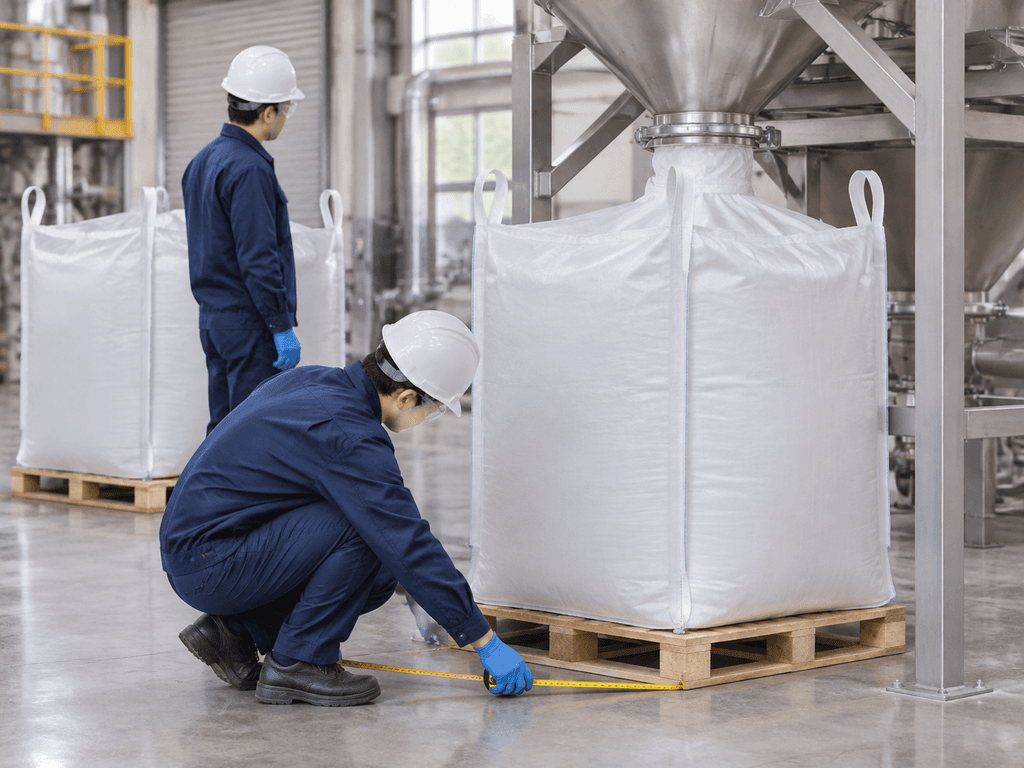
Two FIBC quotations can list the same empty-bag dimensions, the same nominal fill weight and the same liner thickness. To a buyer comparing line items, the bags look interchangeable. To the filling line, they are not.
A standard FIBC and a baffle bag can share a similar silhouette when empty. Once product enters the bag, the internal restraints change how the body expands, how the liner unfolds and how the filled package meets the filling head and discharge station. The difference is not an extra piece of fabric; it is a different internal geometry and a different set of interfaces.
That distinction matters as liner selection moves away from "how many microns of PE?" and toward a more useful question: which barrier function is required, and what bag geometry lets that function survive filling, transport and discharge? A baffle bag is one of the clearest examples of why those questions cannot be answered separately.
The baffles change the bag before the liner is added
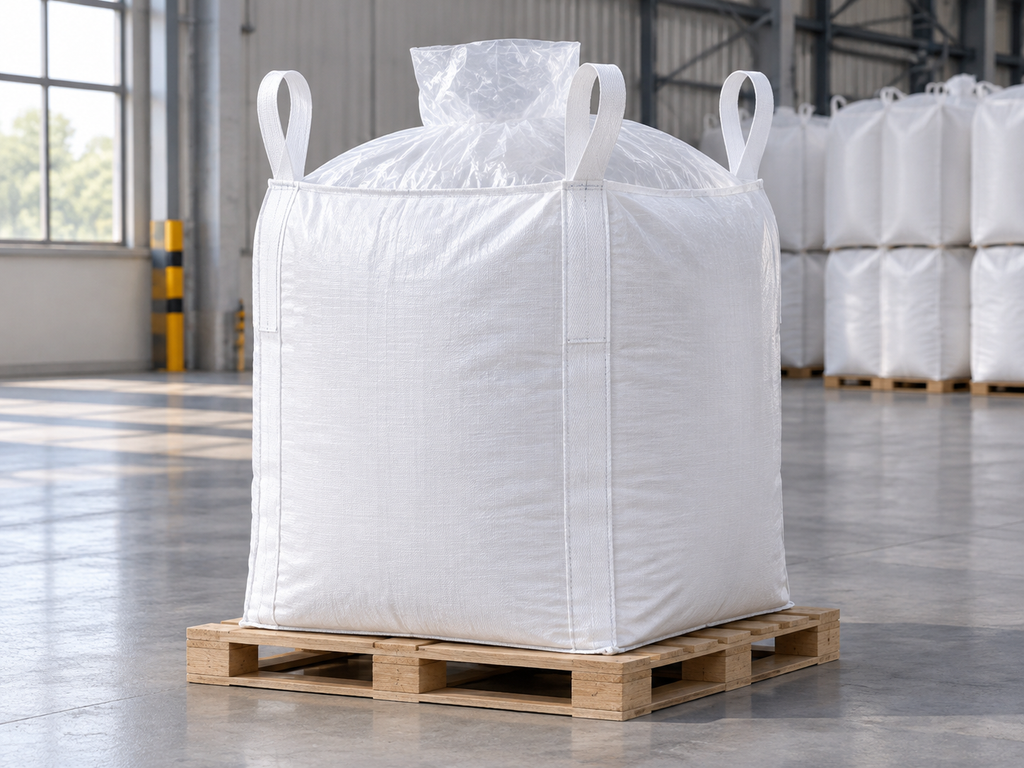
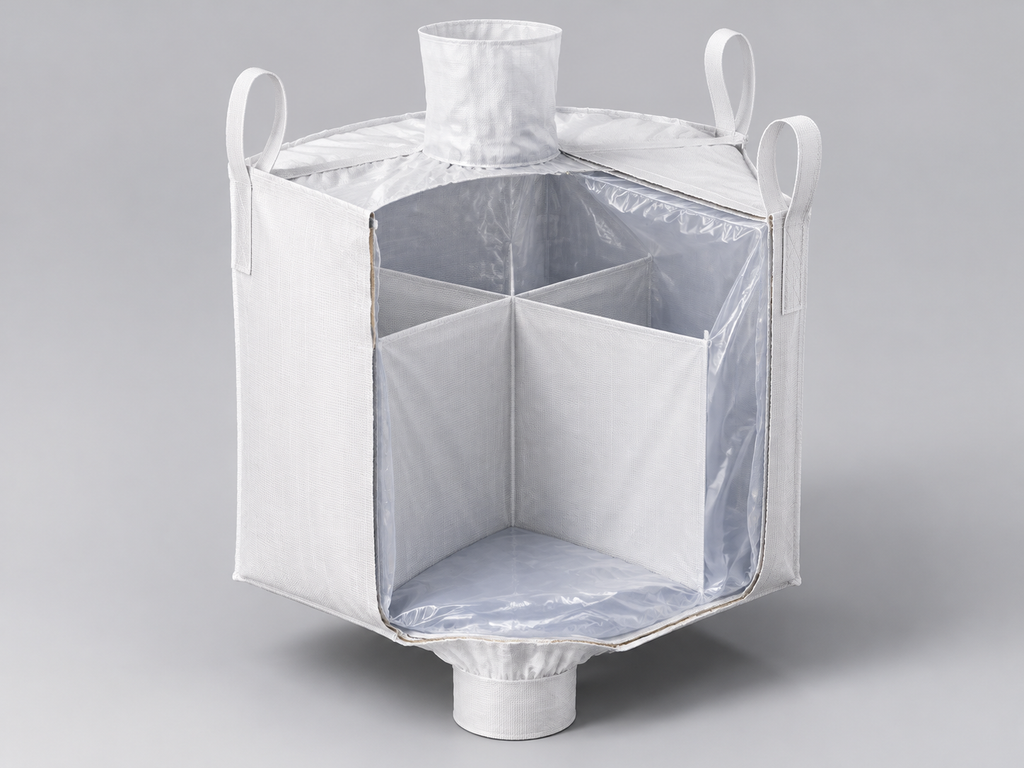
Whether the specification calls it a baffle FIBC, a Q-bag or a form-stable bag, the design uses internal fabric panels, ties or a related restraint system to limit outward bulging. The bag keeps a more regular, squarer footprint instead of becoming a round, pillow-shaped load .
That is accurate but incomplete. The baffles change how the bag carries load and how it moves during filling. They create internal edges, attachment zones and changes in panel tension. They also alter the usable internal space and the shape the liner must follow.
A baffle is not a single base bag construction. Baffled FIBCs can be built on four-panel, U-panel or circular bodies, and the layout can differ between suppliers. "Baffle bag" describes a family of shape-controlled designs, not one universal pattern. Baffle panels can be added to a standard-style body, but that does not make the result a drop-in equivalent. The panels have to be integrated with the body construction, seam layout, spout positions, liner attachments and target filled shape. Two bags with the same nominal length, width and height can therefore have different internal clearances, corner geometry and filled heights.
This is why an empty-bag drawing is not enough. A bag that measures 90 x 90 x 110 cm when flat does not necessarily present the same footprint, top plane or usable volume after it is filled. The outside may look familiar while the internal path available to the liner has changed.
The practical point: specify the filled bag, not only the empty bag. A baffle bag is defined by its behaviour under load, not by the presence of panels in a photograph.
The liner follows the path the bag gives it
A bulk bag liner is not a rigid inner container. It is a flexible film that moves toward the path of least resistance. In a standard FIBC, that path is usually a relatively simple expansion from the centre outward. In a baffle bag, it is interrupted by internal restraints, seams and re-entrant corners.
This is where many liner problems begin. A lay-flat PE liner may sit neatly in an empty bag and still fold against a baffle during filling. Film can gather in a corner, hang away from the bag wall, be pinched between fabric layers or be pulled toward one side of the filling spout. The liner may look present, but it is no longer following the geometry the bag was designed to create.
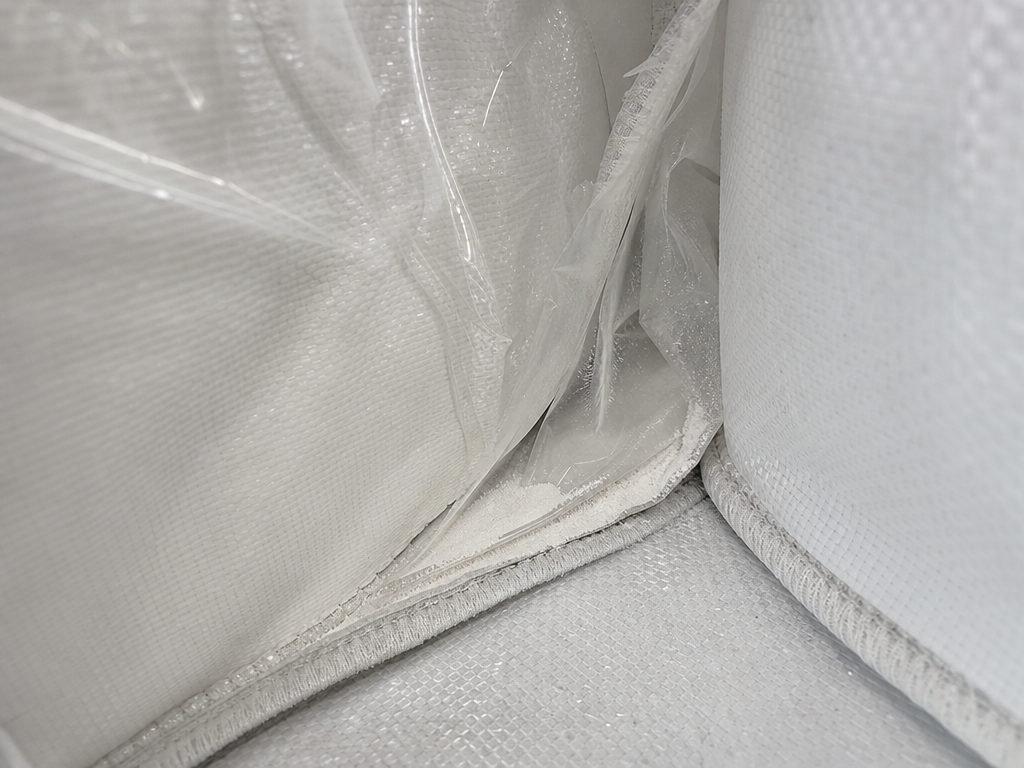
The consequences are not cosmetic. A fold can trap fine powder, create a pocket where air cannot escape or form a bridge that slows discharge. A liner pulled tight across a corner can be thinned or creased. A liner that is too loose can move during filling and obscure the spout or outlet. In a high-value powder application, a small residual heel can matter more than the difference between two film quotations.
Supplier guidance for food and ingredient FIBCs makes a similar point: ordinary PE liners are not always a good match for the folds in baffle or Q-bag constructions, and a form-fit or otherwise adapted liner may need to be considered. That does not mean every baffle bag requires a form-fit liner. It means the liner's finished geometry, opening positions and fixing method have to be designed around the baffle layout rather than copied from a standard bag. Form-fit is a manufacturing approach, not a performance guarantee. The buyer should ask for the liner drawing and the outer-bag drawing as a matched pair.
Attachment deserves the same attention. A liner may be supplied loose, tied at selected points, glued, fixed at the top or secured near the discharge outlet. If it is fixed at the top but free at the bottom, product movement may pull it downward. If it is fixed too tightly near the outlet, it may tension and tear or prevent clean collapse. There is no universal arrangement; there is only one checked against the bag, product and discharge method.
FIBCA safe-handling guidance says liners should be properly attached or secured so they do not come out during discharge, with handling carried out under the manufacturer's instructions and the site's safe operating procedure. That is a safety baseline, not a complete design method. The design question is where the liner should be held, where it may move and what happens to those fixing points when the bag is emptied.
The practical point: a liner is not a bag inside a bag. It is part of the bag's forming geometry, and its path has to be designed with the baffles rather than added after them.
Barrier performance is lost at the folds, seams and spouts
The industry conversation about liners is moving beyond "add another PE layer." Moisture-sensitive, oxygen-sensitive and high-value products may need a barrier structure, but a barrier film is only one part of the finished liner. The rest of the package determines whether the film's data survives contact with the bag.
WVTR and OTR results are usually reported for a flat film or laminate under defined test conditions. A finished FIBC liner also contains seams, welds, spout roots, closures, folds and areas where the film is bent or compressed. Those features can create pinholes, incomplete seals, crease lines or local paths for moisture and oxygen. A high-barrier film cannot compensate for a seal contaminated with powder or a fold forced into a tight radius.
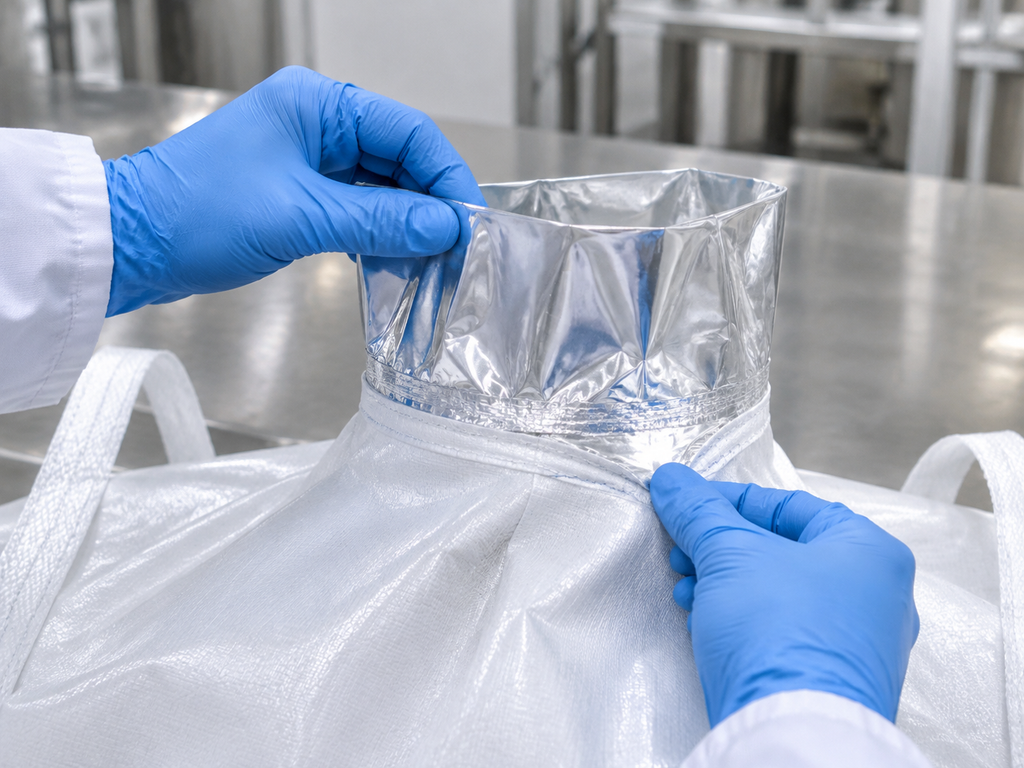
The baffle bag makes this risk easier to see. The liner is asked to follow internal edges and corners, then flex as the bag fills, settles, is lifted and is discharged. A foil-containing laminate may be especially sensitive to repeated creasing and pinholes; other barrier structures have their own handling limits. The relevant question is not only "what is the film's WVTR?" but "what happens to the finished liner at the baffle corner, the spout root and the closure?"
Residual material is part of the same problem. If powder remains in a fold after discharge, the product stays in contact with the liner for longer and the next handling step becomes less predictable. For a hygroscopic material, a small heel can be a moisture-exposure point and a source of cross-batch contamination.
This is the practical meaning of "barrier function plus bag-type adaptation." The barrier is a property of the finished liner in its actual bag, with its actual seams, openings and handling path. A flat-film report is useful; it is not the same as a finished-liner qualification.
The practical point: barrier performance is a finished-system property. The bag geometry can preserve it or destroy it.
The filling line sees a different bag
On a manual line, an experienced operator can sometimes compensate for a liner that folds or a spout that is slightly off-centre. On an automated or semi-automated line, there is much less room for that compensation. The bag has to present itself consistently to the filling head.
The interface includes more than the nominal spout diameter. It includes the outside diameter of the filling tube, the insertion depth, the clamp or seal arrangement, the amount and timing of pre-inflation, the position of the lifting loops, the length of the liner neck and the space available for closing or heat-sealing the liner. A baffle bag that stands squarely on a pallet may still be difficult to fill if the top plane does not present the liner neck in the expected position.
The square shape can be an advantage. A baffled bag is less likely to roll or slump into an irregular footprint, which can help with pallet stability, container utilisation and repeatable placement. But the same restraint that keeps the bag square can make the top opening less forgiving. If the liner is not centred, if the baffle seams pull the top panel or if the liner is trapped against an internal edge, the filling head may not get the clean, repeatable connection it needs.
Pre-inflation can help the liner unfold, but it is not a cure-all. The air has to go somewhere, and the liner has to expand without ballooning into a fold or blocking the product path. The right procedure depends on the bag, liner and filling equipment, which is why a setting copied from another bag is not a specification.
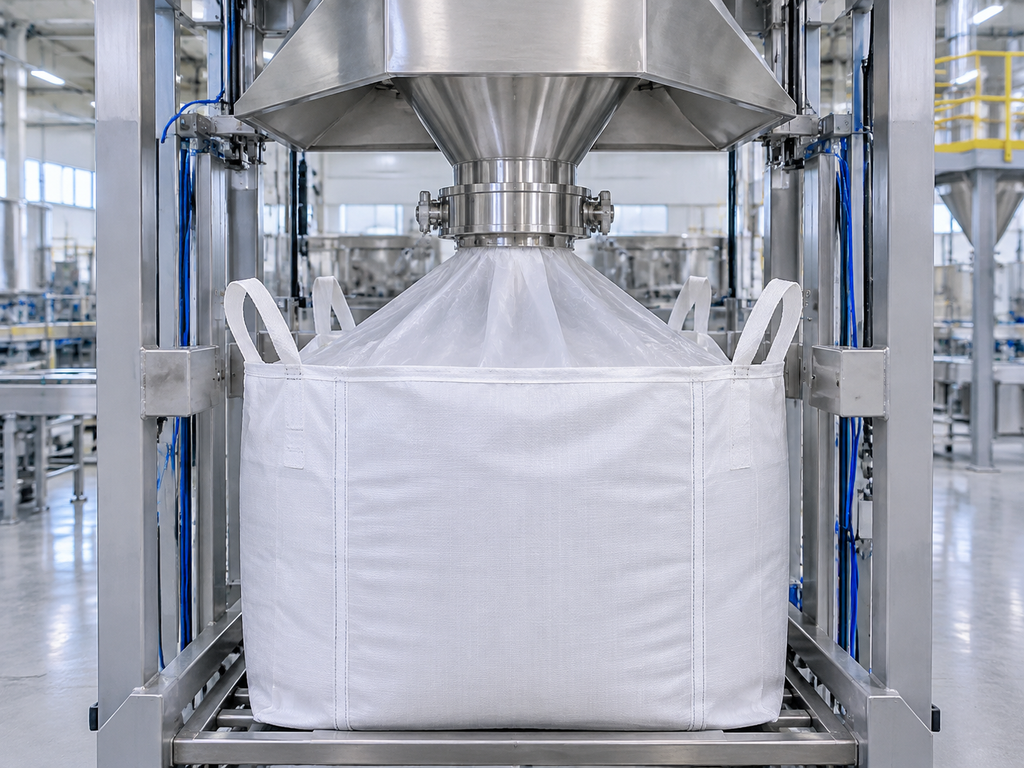
Discharge is the other half of the same interface. The baffles help the bag keep its shape as it empties, but the liner still has to collapse in a controlled way. If it is free to fall toward the outlet, it may bunch or block the flow. If it is fixed too rigidly, it may tension, tear or hold product against the bag wall. The spout, liner outlet, receiving hopper and operator access all need to be considered together.
The practical point: a bag that stands square on the pallet can still be wrong at the filling head. Squareness is not the same as interface control.
Stackability is not a baffle feature
Baffles can improve the regularity of the filled footprint, but they do not prove that the bag can be stacked to a particular height, for a particular product or journey. Stackability depends on the design and rated load, safety factor, bulk density, flow behaviour, filled height, stacking pattern, storage time, vibration and friction between bags.
Two boundaries also matter. A baffle is a shape-control feature; it does not by itself provide anti-static performance, and a baffle bag is not automatically a UN-marked package for dangerous goods. Those are separate design, test and marking questions. ISO 21898:2024 sets out requirements for non-dangerous-goods FIBCs, including materials, construction, design, type testing and marking, but it is not a liner barrier standard and does not turn a baffle into an anti-static or dangerous-goods solution.
The practical point: baffles can change the shape of the load. They do not replace the evidence needed for safe stacking, electrostatic suitability or dangerous-goods approval.
Specify the filled system, not the catalogue description
The most useful change a buyer can make is to stop accepting a quotation that describes only the empty bag. The table below shows how a familiar phrase leaves the critical part of the system undefined.
| What the quotation says | What it leaves undefined | What the filled-system specification should add |
|---|---|---|
| "1,000 kg baffle bag" | Actual fill weight, bulk density, filled height and footprint, usable volume, stacking plan | Target weight, material behaviour, filled envelope, rated load and handling route |
| "100 micron PE liner" | Finished liner shape, barrier structure, seams, spout, closure and fixing method | Liner drawing, film structure, opening positions, seal method and attachment points |
| "Standard filling spout" | Filler tube diameter, insertion depth, clamp, inflation and sealing space | Filling equipment details, liner neck dimensions and a drawing of the connected arrangement |
| "Standard discharge spout" | Liner outlet, receiving hopper, operator access and closure sequence | Outlet dimensions, liner retention method and the actual discharge arrangement |
| "Same as the last order" | Bag construction, baffle layout, drawing revision, material lot and liner fixation | Approved drawings, revision numbers, sample reference and change-control record |
The table is not a request for more paperwork. Each missing item changes the geometry or the interface. A liner that is correct for one baffle layout may be wrong for another even when both are described as "1,000 kg baffle bags."
For a project review, the useful package is a matched set: outer-bag drawing, liner drawing, filling-head details, discharge arrangement, product data and target filled envelope. FIBC World's form-fit liner page shows the kind of shaped construction that may be relevant, while the liner fit and interface guide explains the measurements that should sit behind the drawing. Neither replaces a project-specific review.
Qualify the design with a trial that can fail
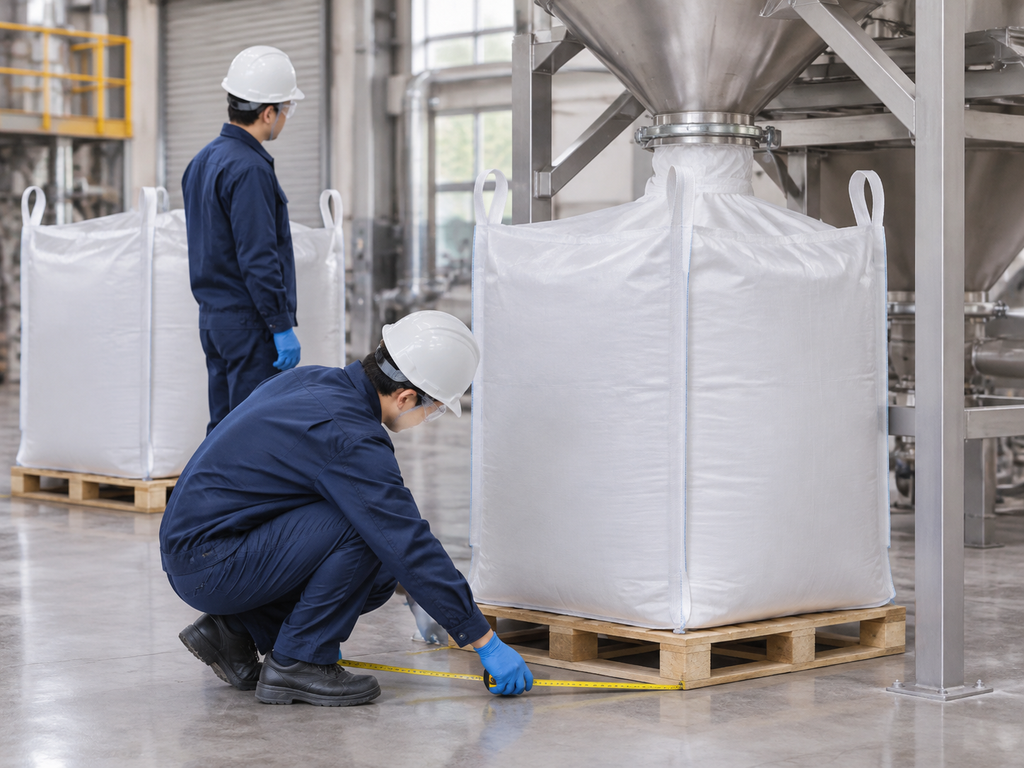
The final check is not an empty-bag inspection. It is a trial of the complete system under conditions close enough to production to expose a mismatch.
Use the actual material, or a representative sample with the same flow behaviour. Use the intended bag and liner, actual filling head, target fill weight and receiving equipment for discharge. Record the drawing revisions, material batch, equipment settings and the people who accepted the result.
The trial should answer questions that a catalogue cannot:
Does the liner unfold into the baffle corners without gathering, pinching or pulling away from the spout?
Can air escape at a rate that allows the target fill weight to be reached without excessive ballooning or product backup?
Does the liner neck remain centred and accessible, and does the filled bag sit predictably on the pallet?
Does the discharge outlet stay accessible, and does the liner collapse without bridging or retaining an unacceptable heel?
A trial that only confirms the bag looks square is not a qualification. The useful trial is designed to find the point where the liner path, baffle geometry or filling interface stops working. If the bag, liner, spout, fixing method or equipment changes, the previous result may no longer describe the new system.
The practical point: the trial should expose a mismatch, not confirm a catalogue description.
Conclusion
A baffle bag is not a standard FIBC with a few extra panels. The baffles change the bag's internal load path, filled geometry and the route the liner must follow. They also change what the filling line sees and what the discharge station has to handle. A liner specified only by thickness, and a barrier specified only by a flat-film number, leave those changes undefined.
The better purchasing question is not "Is this a baffle bag?" It is "What is the filled geometry, how is the liner controlled inside it, how is the barrier completed at the seams and spouts, and how will the whole arrangement be qualified on our line?"
To review a project, send FIBC World the material and target fill weight, the outer-bag and liner drawings, the filling-head and discharge details, the expected transport and stacking conditions, and any current failure such as liner movement, trapped powder, spout misalignment or residual material. The first useful output should be a defined filled-system specification and a trial plan, not an assurance that one catalogue bag will behave the same way in every line.
Explore the form-fit FIBC liner range and contact FIBC World with the details of the actual bag, product and equipment.
Related News
Other news you might be interested in
FIBC Bag Handling and Safety: Best Practices for Safe Use
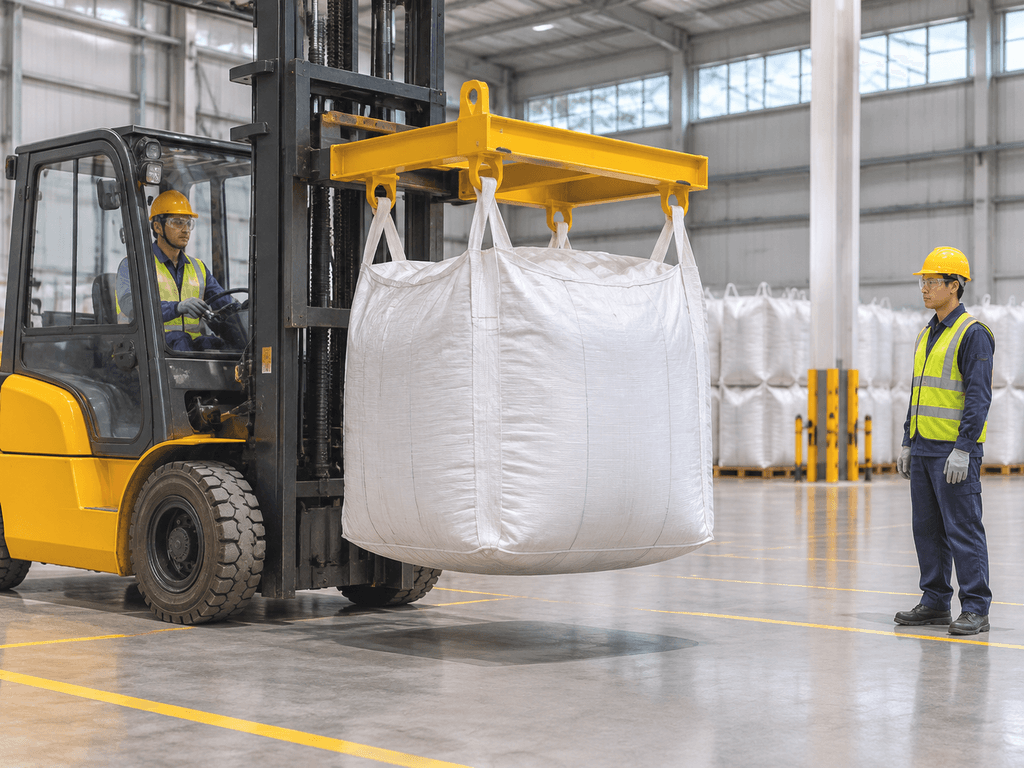
Proper FIBC handling is closely connected with operator safety, bag integrity and efficient bulk-material movement. An FIBC is a system of components rather than simply a woven fabric container. Lifting loops or sleeves, seams, fabric, closures, filling arrangements, discharge components and, where applicable, liners all contribute to how the bag performs during use.

Recyclable FIBC: Mono-material PP, with liner and ventilated type
When a buyer asks, "Is this FIBC recyclable?", the answer depends on which part of the bag is being discussed, where it will be used and what recycling route is actually available. A woven PP bag with a PE liner, a paper label, a polyester thread and a foil barrier is not the same product as a predominantly mono-material PP bag. Even a mono-material bag is not automatically recycled at scale if collection, cleaning and sorting are missing.This guide separates three questions that are often mixed together: what the bag is made of, what the bag is designed to do, and what evidence supports the claim. It is a buyer checklist, not a legal opinion or a certification statement.
Want to know more?
Get in touch with us for more information about our services and products.