
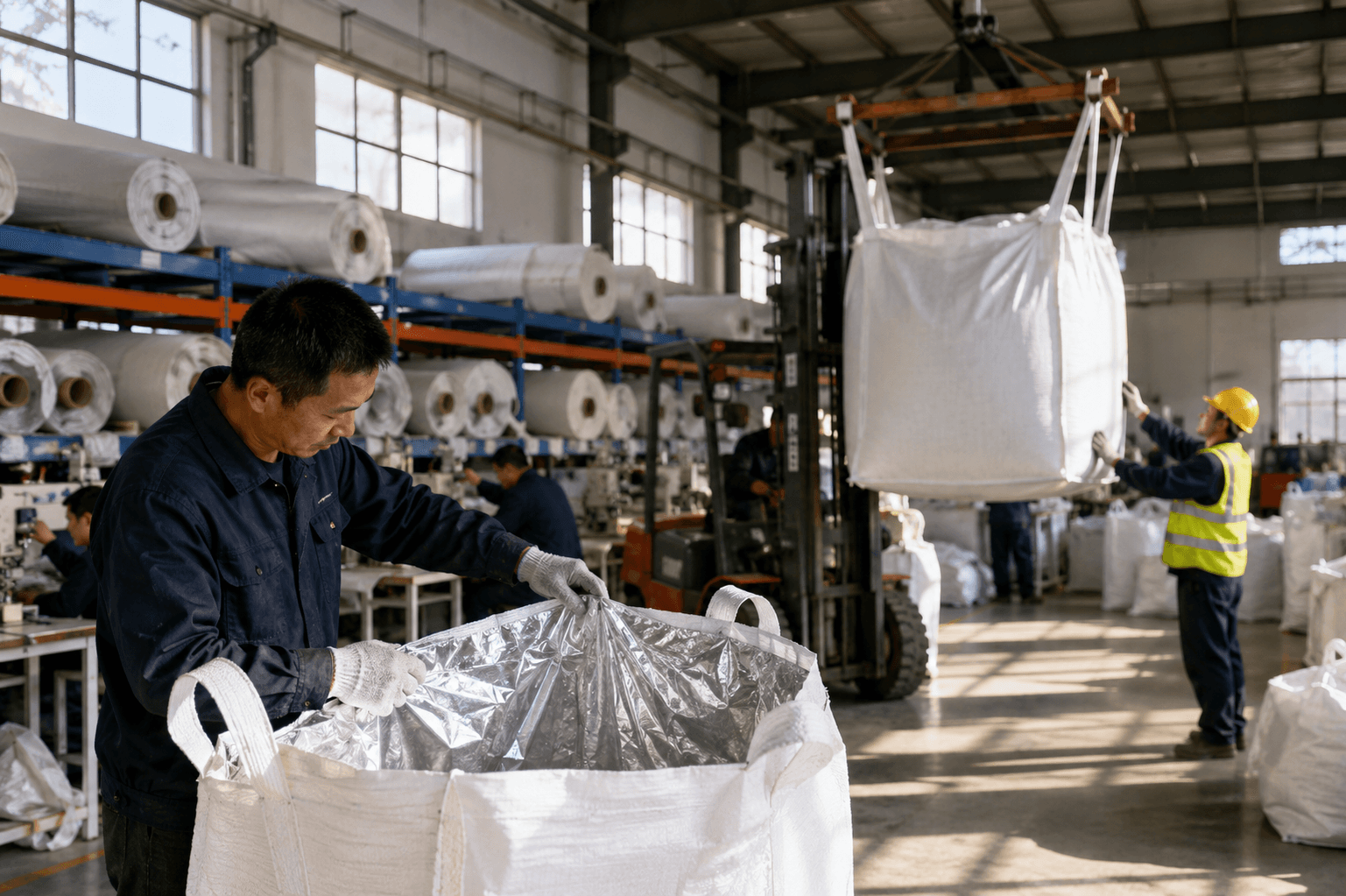
How Custom FIBC Bags Solve Moisture and Static Challenges in Industrial Bulk Packaging

Dayang Yang
AuthorWith experience in FIBC bulk bag manufacturing and export sales, we operate our own production facility with stable large-scale capacity. We are specialists in bulk bags, conductive FIBCs, food-grade FIBCs, UN certified bags, and customized flexible intermediate bulk containers for industrial packaging and bulk material transportation solutions.
How Custom FIBC Bags Solve Moisture and Static Challenges in Industrial Bulk Packaging
The High Cost of Inefficient Bulk Packaging
Every bulk bag failure—moisture damage, static discharge, or unstable handling—rips into your margins. Standard PP woven bulk bags often fall short, risking product degradation, safety incidents, and costly downtime. One importer switched to custom FIBC bags engineered with moisture barrier liners and precision lifting features and turned a recurring liability into a $300,000 ROI—proving the right design is a profit center, not an expense.
Matching the Bag to Your Material's Unique Needs
Moisture-sensitive powders like nylon granules or chemical intermediates clump and spoil in generic bags. An aluminum foil liner bulk bag or aluminum-plastic inner bag creates a robust moisture barrier FIBC that blocks vapor transmission. Static-sensitive materials—such as lithium battery cathode powders—require anti-static bulk packaging with conductive thread and grounding tabs to eliminate spark risk. Light-proof FIBC designs protect photo-reactive resins, while breathable bulk bags allow off-gassing feed or biomass to stabilize without ballooning. The right match isn't optional—it's essential for safe, efficient handling.
Design Features That Drive Performance and Safety
Performance is built into every detail. An inner lifting loop bulk bag improves center-of-gravity stability during crane or forklift moves, reducing dangerous sway. Integrated filling spouts and controllable discharge spouts minimize dust, speed cycle times, and cut cleanup. For heavy-duty loads up to 2 tons, a cross reinforced jumbo bag with overhead bulk bag configuration maintains SWL under repeated lifting. When fines are a concern, a formed inner belly bag forms a secondary containment envelope that stops leakage, protecting workers and floors.
Real-World ROI from Specialized FIBC Solutions
An importer of high-purity minerals adopted factory-direct FIBC bags with custom foil liners and inner lifting loops—and achieved 10X throughput growth, zero moisture rejections, and safer handling. Another producer using moisture barrier FIBC for plastic pellets eliminated inter-bag damage and cut packaging costs by 20% just by switching to a purpose-built design. With the poly-woven industrial packaging market accelerating, application-specific heavy-duty PP container bags are capturing share while competitors still fight preventable waste.
Why Custom FIBC Bags Are the Smarter Long-Term Investment
Off-the-shelf bulk bags treat every material generically—exposing you to oxygen degradation, static ignition, and seam rupture from forklift handling. Custom FIBC bags close these gaps with layered engineering: oxygen barrier bulk bag properties for reactive metals, flame retardant packaging for combustible environments, and aluminum foil laminated bags that shield against moisture, UV, and gas transmission. Partner with a supplier that understands your load geometry, flow characteristics, and safety codes, and you're not just buying a bag—you're preventing downtime, claims, and brand damage.
Get a Custom FIBC Solution Built for Your Operation
If your current packaging can't reliably prevent moisture, static, or handling losses, stop settling for one-size-fits-all. Evaluate where product waste or safety incidents originate, then match those points to a design engineered for your material. Whether you need a single trial bag or a full-scale supply of heavy-duty PP container bags, start with your specific challenges. Request your custom solution today and turn packaging from a cost center into a competitive advantage.
Related News
Other news you might be interested in
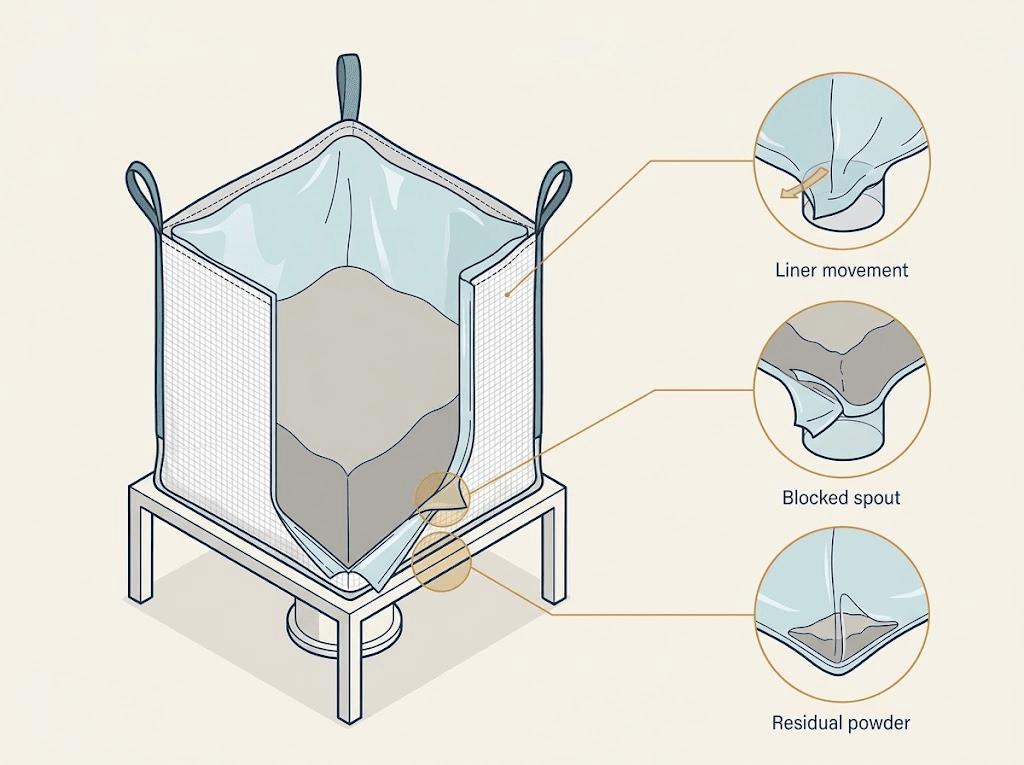
FIBC Liner Discharge Problems: A Buyer’s Checklist for Liner Movement, Blocked Spouts and Residual Powder
A lined bulk bag reaches the production line, but the powder stops flowing before the bag is empty. The liner moves towards the outlet, material remains in the bottom corners, or operators need repeated assistance to finish unloading.For buyers ordering FIBC liners, the useful question is: what information will help the packaging supplier and equipment provider identify the cause and agree on a better specification?Start by reviewing the material, liner, outer bag and discharge equipment together. Liner fit, folds, outlet configuration and product flow characteristics can all affect emptying performance.
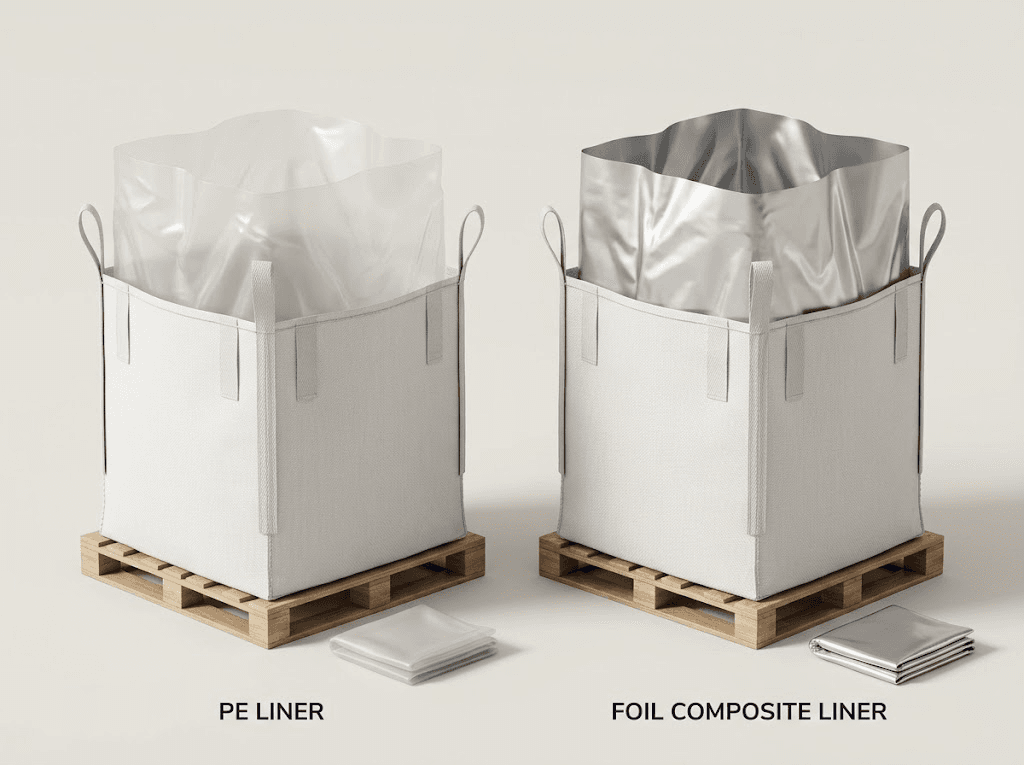
PE vs Aluminum Foil FIBC Liners for Moisture-Sensitive Powders: A Buyer’s Checklist
Choosing a liner for a moisture-sensitive powder starts with a practical question: what protection does the material need throughout filling, transport, storage and discharge?A request for “moisture proof bulk bags” gives a supplier a starting point, but it does not define an acceptable package. A PE liner may meet the requirement. An aluminum foil composite liner may be worth evaluating when the product needs a stronger moisture barrier, oxygen protection or light protection. The decision should follow the actual material specification, closure arrangement and trial results.This checklist helps buyers compare the options and prepare an enquiry for FIBC liners without relying on a material name alone.
Want to know more?
Get in touch with us for more information about our services and products.