
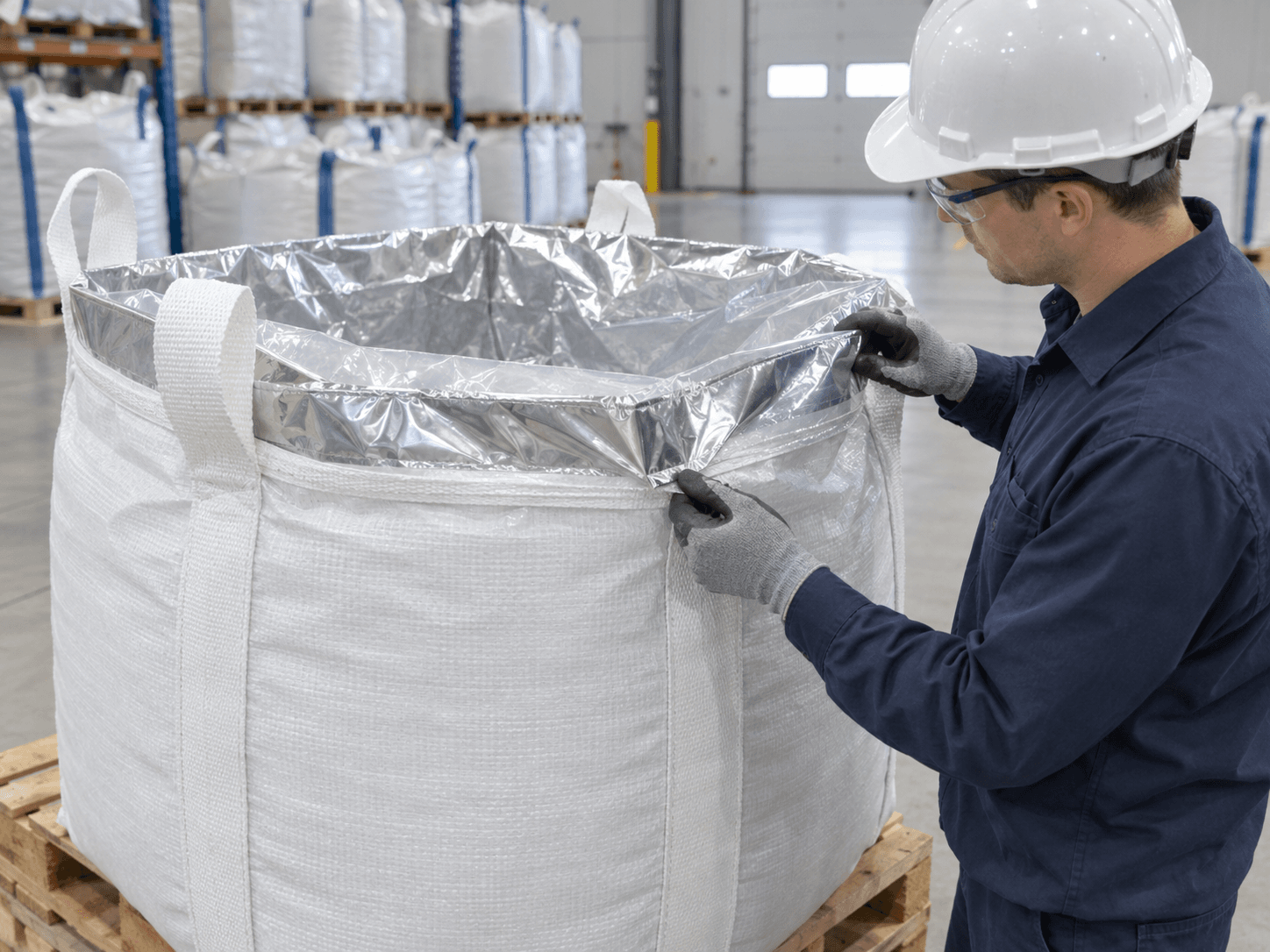
How to Evaluate Aluminum Foil FIBC Liners: Barrier Data, Sealing and Trial Checklist

Dayang Yang
AuthorWith experience in FIBC bulk bag manufacturing and export sales, we operate our own production facility with stable large-scale capacity. We are specialists in bulk bags, conductive FIBCs, food-grade FIBCs, UN certified bags, and customized flexible intermediate bulk containers for industrial packaging and bulk material transportation solutions.
The aluminum foil FIBC lining looks like a simple upgrade on the quotation. Suppliers can describe it as high barrier, moisture resistant, or oxygen resistant. These words do not answer the buyer's real question: Will the finished lining protect the product during filling, transportation, storage, and unloading?
This problem cannot be solved with the word 'foil' or an impressive obstacle number. It requires a review of the entire laminated board, testing conditions behind the data, seams and closures, sealing processes, and representative tests.
This checklist is applicable to packaging engineers, procurement teams, and quality teams for evaluating moisture sensitive powders, particles, and other dry bulk materials of aluminum foil FIBC liners. It explains what is required, how to compare supplier claims, and what evidence to retain for duplicate orders.
Buyer's answers to questions regarding this list
Is the quoted 'aluminum foil lining' a complete laminated board or just a material description?
Can the results of WVTR or OTR be compared with those of another supplier?
Is the data describing a flat film sample or a finished pad?
What are the effects of pinholes, curved cracks, seams, and nozzles on packaging?
Can our filling and sealing equipment produce reliable seals?
What should sample testing prove before production?
What documents and samples should be retained for duplicate orders?
Starting from the complete laminated board
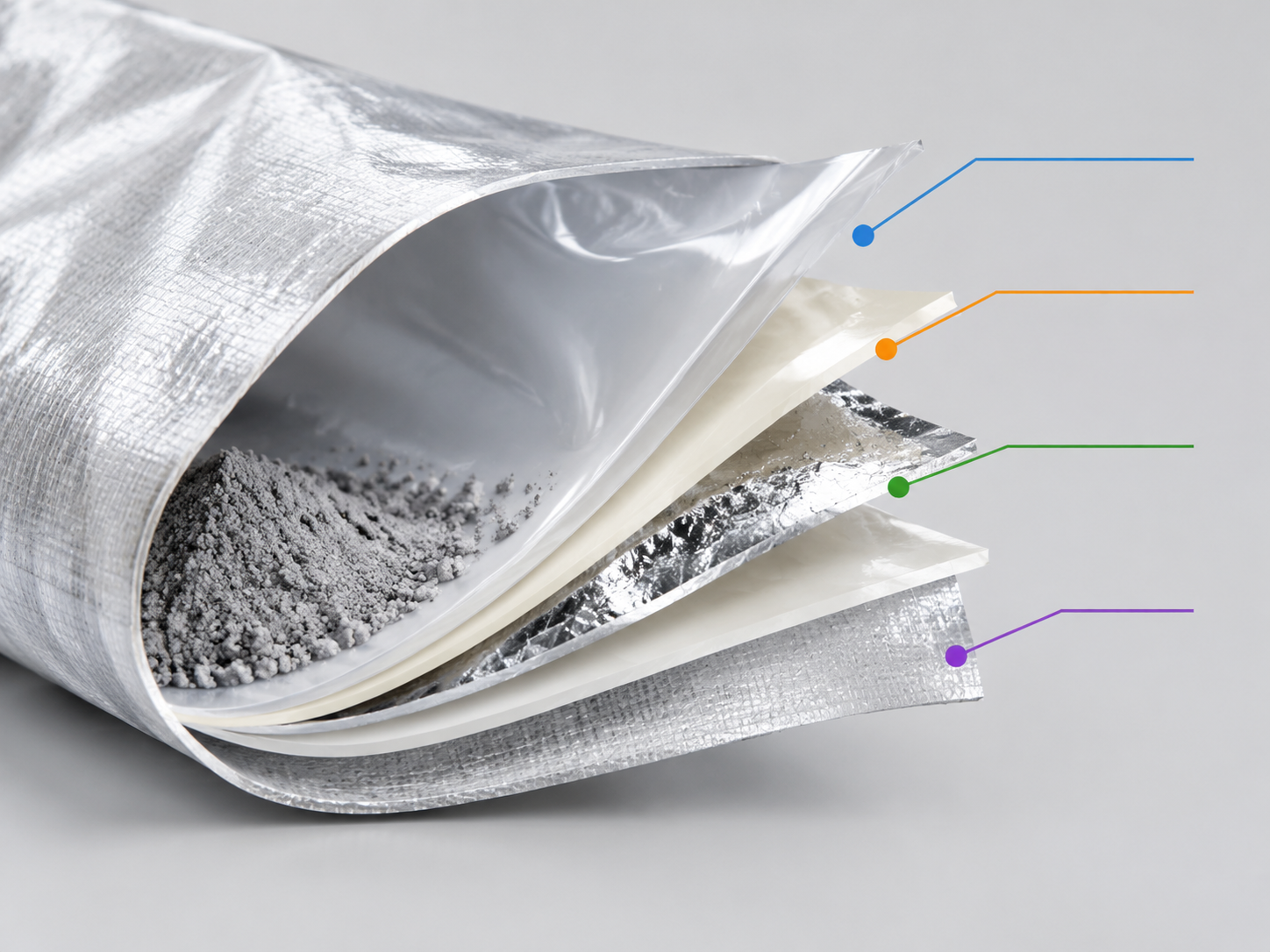
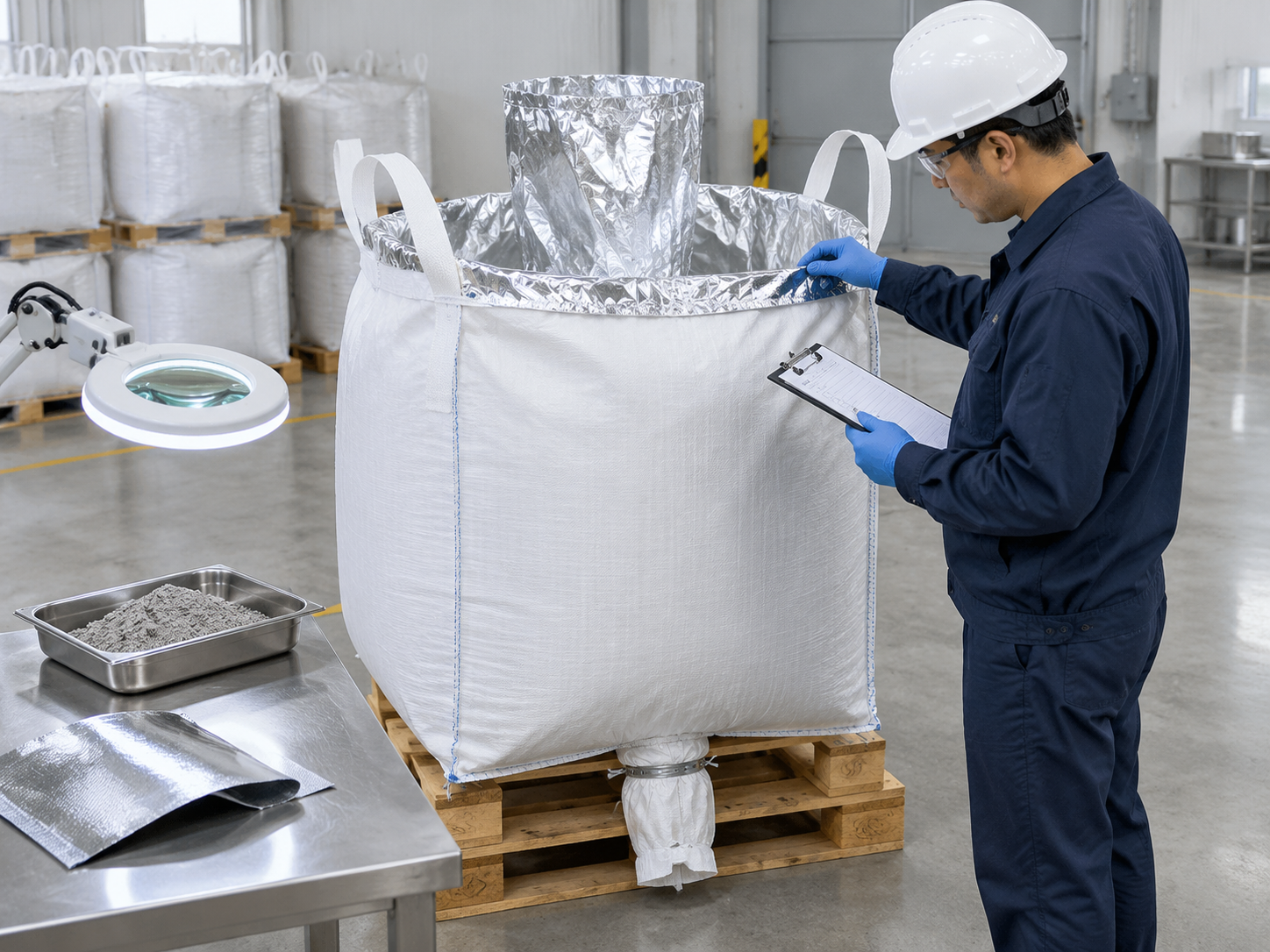
Aluminum foil lining is usually a multi-layer flexible laminated board. The foil is a functional layer, not the entire packaging. According to the design, the structure may include internal sealants, connecting layers, foils, support membranes, and outer layers.
Require suppliers to determine the complete structure, rather than just citing "aluminum foil" or a single thickness. The specifications should include:
Sequence and nominal thickness of laminated board
Foil grade or nominal foil thickness
Internal sealant and external support materials
Total thickness and basis weight (if relevant)
Lining size, shape, and nozzle layout
Available connection and closure methods
Therefore, the two liners known as "aluminum foil" can have different moisture, oxygen, piercing, and sealing behaviors. A low WVTR of one structure is not approved for another structure.
FIBC World's aluminum foil FIBC lining series provides an overview of multi-layer foil lining structures. The final structure, dimensions, and performance evidence of the project still need to be confirmed in the quotation and samples.
Read barrier data as a test report instead of a title

WVTR refers to the water vapor transmission rate. It describes the amount of water vapor passing through a material under specific conditions. OTR refers to oxygen permeability, which is related when a product is sensitive to oxygen.
Numbers without testing conditions are not comparable specifications. When reviewing supplier barrier data, please use the following table.
| Item to request | Why it matters |
|---|---|
| Property reported | Confirm whether the result is WVTR, OTR or another measure |
| Test method | Different methods and specimen types may not produce directly comparable results |
| Temperature and relative humidity | Barrier results depend on the test environment |
| Units | g/m²/day and g/100 in²/day are not interchangeable without conversion |
| Tested specimen | Flat film, laminate, finished liner, seam or complete package |
| Test area and duration | These affect interpretation and repeatability |
| Laboratory and report date | Confirm the source, age and traceability of the data |
| Material structure tested | Verify that the report matches the proposed production structure |
ASTM F1249 is a recognized method for using modulated infrared sensors for moisture resistance data of flexible films. Intertek describes the test as measuring the transmittance through a barrier film under selected temperature and humidity conditions. [1] This is useful evidence for the film, but it does not describe the finished lining or its sealing components.
OTR data can be reported using ASTM D3985 or other agreed upon methods. Like WVTR, the buyer should inspect the testing conditions, units, samples, and material structure. two
If one supplier reports g/m ²/day and the other supplier reports g/100 square inches/day, convert both results to the same unit and confirm that comparable conditions were used for both. One square meter contains approximately 1550 square inches, so the result in g/100 square inches per day is multiplied by approximately 15.5 to represent each square meter. Conversion will not correct different testing conditions.
Inquire about the content not covered by the barrier number
The flat film WVTR results do not include every part of the finished lining. Water and oxygen can also enter through the following pathways:
Seam and sealing edge
The filling and discharging ports are closed
Folding or creasing area
Pinholes or curved cracks on the foil layer
Handle damage before or during filling
Thin aluminum foil may contain pinholes, and bending or wrinkling during conversion and use can increase the risk of breakage. The technical literature on foil packaging discusses these impacts and the importance of a complete lamination and sealing system. three
This will not make the foil liner unsuitable. This means that there should be evidence or testing of completed buildings after the movie report. Inquire with the supplier:
Is the sample in the report taken from the same laminated board intended for production?
Have seams, nozzles, or closures been tested?
What evidence does the finished pad have?
How to control pinholes, creases, and handling damage?
What kind of incoming inspection is recommended?
If the supplier has not completed the pad data, sample testing becomes more important, not less. Do not use film data sheets to answer questions about closed or filled bags.
Verify the sealed window
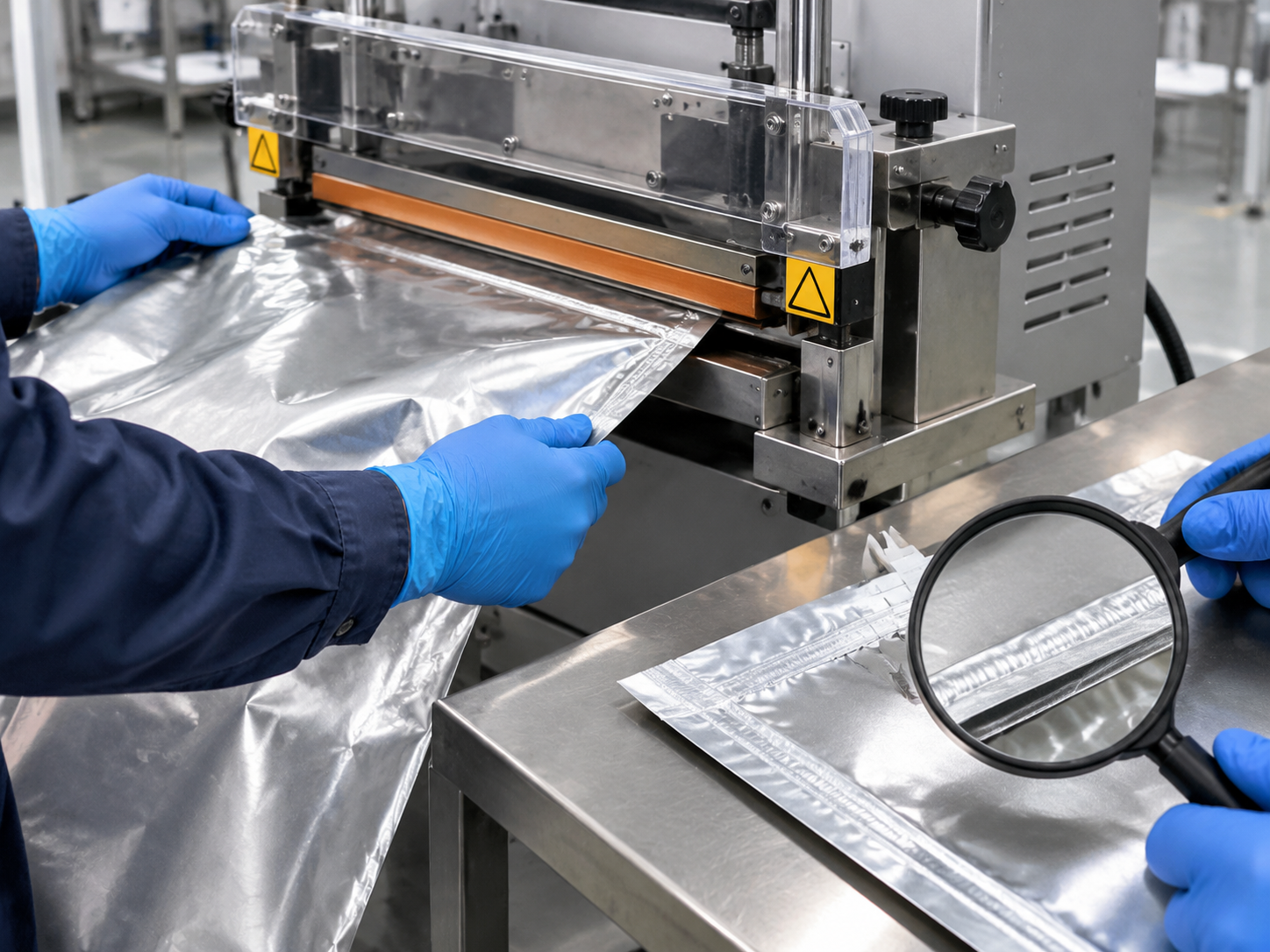
The closure is usually the weakest part of the high barrier lining, as it is formed during the packaging process rather than the film manufacturing process. A good film with inconsistent sealing is still an unreliable packaging.
Inquire about suggested sealing methods and practical sealing windows:
Sealing temperature range
Stay time
Pressure
Cooling or processing time before sealing component loading
Recommended device type
Acceptable sealing appearance
Sealing strength and integrity inspection
The sealing strength can be evaluated using recognized methods such as ASTM F88, which measures the force required to separate the sealing surface under controlled conditions. [4] Merely relying on the sealing strength cannot prove that the seal is leak free. The buyer and supplier should also reach an agreement on how to check the integrity of the seal.
The experiment should include actual powder or granular products as much as possible. Dust or product contamination in sealed areas can hinder reliable bonding. Check if the lining can be cleaned or positioned to keep the sealing area unobstructed.
For each proposed seal, record:
Material structure and lining sample reference.
Sealing equipment and settings.
Seal appearance before and after processing.
Strength and failure mode of the tested seal.
Leakage or integrity inspection during use.
Accepted production operation window.
Do not approve seals from individual handmade samples unless they represent production equipment and processes.
Run a trial version of the complete software package for testing purposes
Barrier reports and sealing tests are inputs. The buyer still needs to use representative filling and processing conditions to test the complete lining in the expected outer bag.
| Trial stage | What to verify |
|---|---|
| Design review | Laminate structure, dimensions, spouts, attachment and closure match the approved drawing |
| Fit check | Liner sits correctly inside the outer FIBC without excess folds or tension |
| Filling trial | Liner remains positioned, displaced air can escape and the filling equipment does not damage the film |
| Sealing trial | The agreed equipment produces a consistent seal within the stated window |
| Storage and transport check | The filled package withstands representative stacking, movement and storage conditions |
| Discharge trial | Liner does not obstruct the outlet, shift excessively or retain unacceptable material |
| Documentation | Results, photographs, settings, sample references and approvers are recorded |
The FIBCA guidelines require the pads to be properly connected or secured so that they do not come off during discharge, and to be sealed according to the manufacturer's instructions. [5] Therefore, attachment and ending should be part of the experiment, not an afterthought.
For products that are sensitive to moisture, it is necessary to agree in advance on how to evaluate moisture-proof measures. Visual inspection after storage may not be sufficient. The product and quality teams should determine acceptable conditions and evaluation methods.
Review supplier change control
Only when the approved structure and process remain unchanged, can duplicate orders be comparable. Inquire with the supplier on how to control the following changes:
Grade or thickness of foil
Sealing compound, adhesive or connecting layer
Total laminated structure
Lining size or nozzle design
Sealing suggestion
Production equipment or laminating source
Require notification and review of any changes that affect approved specifications prior to shipment. Put the approved drawings, material structures, sample references, and test results together.
For incoming inspection, reach a consensus on the content to be inspected for each batch. Based on the risk, this may include dimensions, visual defects, laminated structure, sample sealing, packaging labeling, and traceability retention of samples.
Prepare an inquiry form for aluminum foil lining
Use this information to make foil lined bulk bag quotations comparable:
| RFQ item | Information to provide |
|---|---|
| Product | Material name, form, sensitivity and any relevant restrictions |
| Protection target | Moisture, oxygen or light requirement and acceptable product condition |
| Storage and transport | Duration, temperature, humidity and handling conditions where known |
| Outer FIBC | Dimensions, fill weight, baffles, filling spout and discharge outlet |
| Liner design | Form-fit or lay-flat preference, attachment method and closure requirement |
| Barrier data | Required WVTR or OTR target and agreed test conditions |
| Sealing | Available equipment, current settings and who will approve the seal |
| Trial | Sample quantity, test conditions, acceptance criteria and approver |
| Commercial | Order quantity, destination, required date and repeat-order expectations |
If the buyer does not have a WVTR or OTR target, please have the product or quality team define one from the protection requirements. Don't choose a supplier just because their data sheet uses the target.
For a more comprehensive comparison of PE and foil composite material options, please refer to our PE and foil FIBC lining guide. This article focuses on the evaluation of foil lining after selecting material direction.
Danger signals in supplier quotations
If the following situations occur, please carefully review the quotation:
Provide barrier numbers without units, testing methods, or conditions
Only referring to 'aluminum foil', without a complete laminated structure
When reporting on a movie performance, it feels like it's a completed linear performance
Do not provide sealed windows or sealing integrity methods
Promise "zero moisture" or "absolute barrier" without the need for explicit testing
Unrecognized samples, drawings, or production specifications
Not providing change control or batch traceability processes
A technically powerful quote should be able to make similar comparisons, replicate experiments, and confidently place repeat orders.
Conclusion
Evaluating aluminum foil FIBC liners is not a matter of selecting the lowest WVTR title. Starting from the complete laminated board, verify that barrier data is generated under comparable conditions, review the completed seams and closures, validate the sealing process, and test the entire packaging with the expected product.
Retain approved construction, sample, and test records as references for production and repeat orders. This type of document is often more valuable than another common statement, which is that shipping is a "high barrier"
View FIBC World's aluminum foil FIBC lining series, and then contact FIBC World to learn more about your product details, storage conditions, barrier targets, sealing equipment, and sample requirements. Before placing an order, it is required to confirm the available structure, sample arrangement, minimum order quantity, and delivery cycle.
Related News
Other news you might be interested in
Do Fertilizer Bulk Bags Need Liners? A Buyer’s Checklist for Moisture, Caking and Discharge
Fertilizer bulk bags are often quoted with a liner as though the liner were a standard safety feature. It should not be treated that way. The useful question is not simply “Does a fertilizer bag need a liner?” It is “What protection does this fertilizer need, through this route, in this bag, with this filling and discharge system?”The answer affects more than material cost. A fertilizer bag liner changes how the bag is filled, closed, handled and emptied. It can reduce moisture ingress and dust leakage, but it can also trap air, shift during discharge or create a closure problem if the complete design is not checked.
FIBC Liner Discharge Problems: A Buyer’s Checklist for Liner Movement, Blocked Spouts and Residual Powder
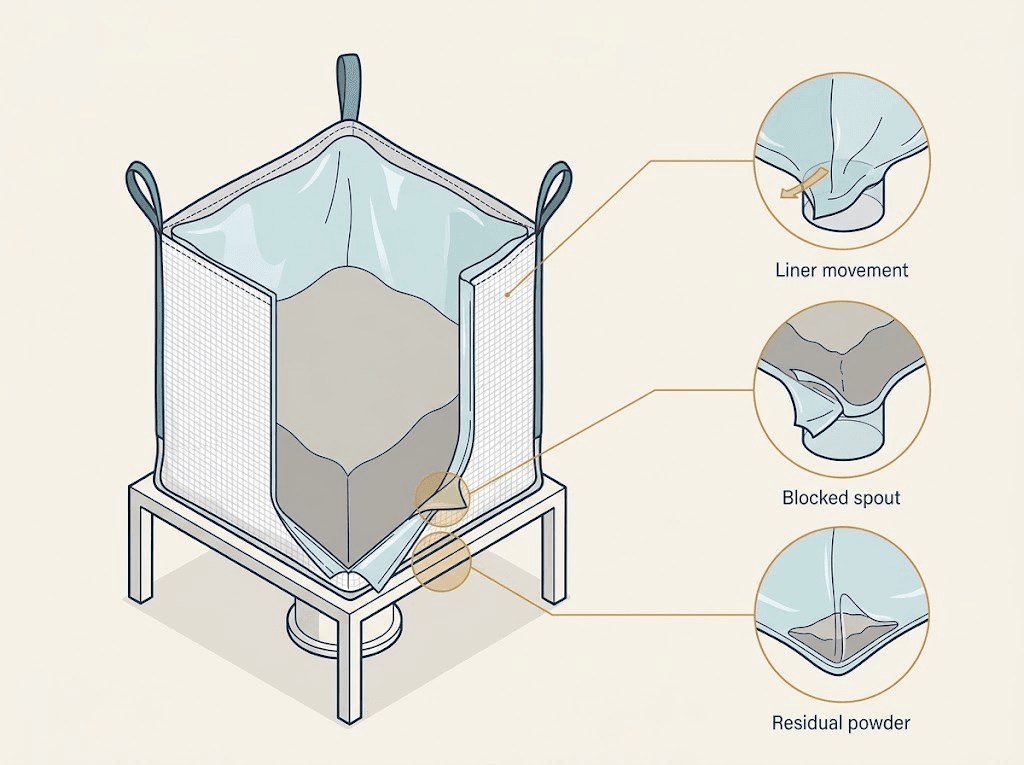
A lined bulk bag reaches the production line, but the powder stops flowing before the bag is empty. The liner moves towards the outlet, material remains in the bottom corners, or operators need repeated assistance to finish unloading.For buyers ordering FIBC liners, the useful question is: what information will help the packaging supplier and equipment provider identify the cause and agree on a better specification?Start by reviewing the material, liner, outer bag and discharge equipment together. Liner fit, folds, outlet configuration and product flow characteristics can all affect emptying performance.
Want to know more?
Get in touch with us for more information about our services and products.