

Plastic Pellet FIBCs for EU-Bound Shipments: A Containment Checklist for Filling, Closing, Handling and Discharge

Dayang Yang
AuthorWith experience in FIBC bulk bag manufacturing and export sales, we operate our own production facility with stable large-scale capacity. We are specialists in bulk bags, conductive FIBCs, food-grade FIBCs, UN certified bags, and customized flexible intermediate bulk containers for industrial packaging and bulk material transportation solutions.
If you ship plastic pellets to the EU, what must your FIBC do differently, and what should be confirmed before the first container is loaded?
The practical answer is not simply "buy a stronger bag." Pellets can escape during filling, through an incomplete closure, from a damaged seam or liner, during container loading, or at the discharge station. A package can look clean when it leaves the filling line and still release pellets later because the bag, liner and operating procedure were never reviewed as one containment system. Effective pellet loss prevention therefore starts before the bag is selected.
Regulation (EU) 2025/2365 makes that system view more important. It establishes EU-wide rules to prevent plastic pellet losses across the supply chain. The regulation entered into force on 16 December 2025. Its main operational obligations apply from 17 December 2027, while requirements for shippers and maritime transport apply from 17 December 2028.
For an FIBC buyer, the useful question is therefore:
Can this complete bag-and-liner system prevent, contain and clean up pellet losses during our actual filling, closing, handling, storage, shipment and discharge process?
This article is a purchasing and technical checklist, not a legal opinion or a product certification. The responsible EU operator, shipper, carrier or compliance adviser should confirm how the regulation applies to a particular shipment.
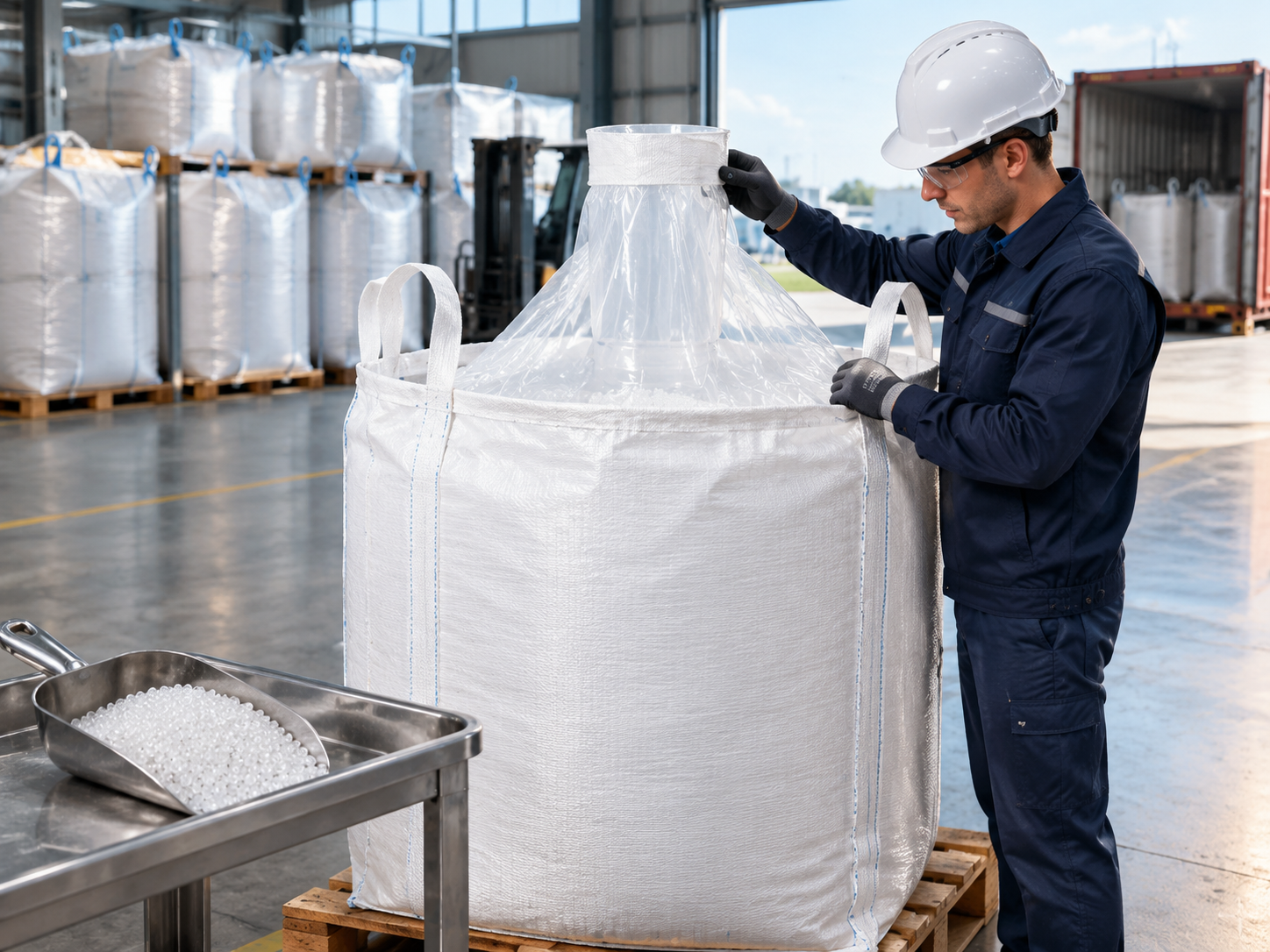
What the EU pellet regulation changes for FIBC buyers
Regulation (EU) 2025/2365 applies to a wider group than a factory that fills bags. The official summary identifies operators that handled five tonnes or more of plastic pellets in the previous calendar year, installations that clean pellet containers and tanks, EU and non-EU carriers transporting pellets in the EU, and shippers, operators, agents and masters of seagoing vessels loading or calling at EU ports.
The regulation follows a clear order of priority: prevent, contain and clean up pellet losses. It also places specific requirements around packaging and transport. According to the official summary:
shippers must ensure robust packaging, provide transport information and submit special stowage requests;
packaging must display a warning and a pictogram;
road, rail and inland waterway carriers must ensure vehicles and containers are pellet-free before departure, close loading and unloading systems when leaving facilities, and limit losses during transport and at transfer points;
vessel operators, agents and masters must secure pellet containers and stow them below deck or in sheltered positions.
Those requirements do not mean that an FIBC can carry a generic "EU compliant" label. They mean the packaging must support the obligations of the parties handling and shipping the pellets. The buyer still needs to define the pellet, the package, the filling and discharge process, the route and the evidence expected from the supplier.
This distinction matters in quotations. A supplier can state that a bag was designed with coated fabric, sift-resistant seams or a fitted liner. That statement may be useful, but it does not by itself prove that the complete package will contain a specific pellet grade through a specific handling and transport route.
Where plastic pellets escape
Pellet loss is rarely one failure. It is a chain of possible events. The first step is to map every place where pellets, dust or fines can leave the controlled process.
| Process stage | Possible loss point | What to check |
|---|---|---|
| Filling | Spillage at the spout, overfilling, dust carry-over, pellets trapped in the top opening | Filling head fit, fill rate, venting, target weight, spout length, operator procedure |
| Closing | Incomplete tie, folds in the spout, pellets on the sealing surface, liner caught in the closure | Closure design, clean contact surfaces, liner-to-outer-spout alignment, closure check |
| Bag body and seams | Damaged coating, open seam, stitch-line gaps, abrasion or punctures | Fabric and coating, seam construction, handling damage, inspection points |
| Liner | Liner movement, liner seam, trapped pellets between liner and bag, outlet misalignment | Liner material, fit, fixing method, top and bottom openings |
| Storage and handling | Dragging, forklift contact, sharp edges, over-stacking, UV or weather exposure | Lifting procedure, contact points, stacking limit, storage condition |
| Container loading | Dirty floor, previous cargo residue, protruding nails, damaged doors, poor load plan | Container inspection, protective lining, loading sequence, final sweep |
| Transport | Vibration, compression, closure movement, chafing | Package trial, closure security, pallet or dunnage, carrier procedure |
| Discharge | Uncontrolled flow, free fall, liner movement, residual pellets, incomplete emptying | Receiving hopper connection, flow control, liner fixation, clean-up method |

The list is deliberately broader than the bag. A coated FIBC may reduce migration through the woven body, but it cannot correct an open spout or a discharge procedure that releases pellets onto the floor. A liner may separate the pellets from the outer bag, but it can also shift, fold or create a new opening problem if it is not designed for the bag.
For this reason, "sift-proof FIBC" is a useful starting term but not a complete purchasing specification. FIBCA describes sift-resistant construction as a construction that provides resistance to product sifting with very fine materials, typically using coated fabric and filler cord in the sew lines. A sift-resistant FIBC may therefore reduce a known loss path, but it remains a construction description rather than a guarantee of zero leakage under every condition. Our existing article Sift-Proof Is Not Leak-Proof explains how to locate a leak path after filling.
Start with the pellet and shipment profile
"Plastic pellets" is not enough information to select an FIBC. PE, PP, PVC, engineering plastics, masterbatch and recycled pellets can differ in shape, size, bulk density, flow behaviour, fines content, moisture sensitivity and static behaviour.
Record the following before discussing the bag construction:
resin type, grade and supplier;
pellet shape and nominal size;
fines or dust content and whether the material can generate dust during filling;
bulk density and target fill weight;
filling temperature and any risk of condensation;
flow behaviour, particularly whether the pellets can bridge, stick or discharge unevenly;
moisture sensitivity or contamination requirements;
static behaviour and the site's hazardous-area assessment;
required safe working load and whether the bag is single-trip or reusable;
destination, transport mode, expected transit time and transfer points;
storage condition before and after shipment; and
the receiving hopper, discharge equipment and acceptable residual quantity.
Fines deserve separate attention. A bag that contains large pellets successfully may still release a fine fraction through a seam, closure or damaged coating. If the buyer's specification includes a dust or fines limit, the trial should use material that represents the normal fines content rather than a cleaned sample that is easier to handle.
Static behaviour also cannot be inferred from the product name. A static-protective FIBC and its liner should be reviewed as a compatible system when the material or surrounding atmosphere creates a static hazard. Do not assume that adding a liner or changing the outer bag leaves the electrical behaviour unchanged.
Finally, record who is responsible for each step. The filling company, shipper, forwarder, container operator and receiving site may have different procedures. A bag specification cannot repair an unclear handover between them.
Specify the complete containment system
A comparable FIBC quotation should describe the outer bag, seam construction, liner, filling interface, closure, discharge interface, handling features and marking as one system. The current FIBC World custom guide uses the same logic: bag style, lifting system, filling and discharge openings, liner and seam details, and labels should be reviewed before the final drawing.
1. Outer FIBC and body construction
Start with the required working load, dimensions, filling method, discharge method and handling route. U-panel, four-panel, tubular and baffled designs distribute shape and load differently. A baffled or Q-bag may improve stacking and container utilization, but the internal geometry also affects liner fit and discharge.
Ask for:
the finished bag drawing and agreed tolerances;
the fabric and coating or lamination specification;
the intended safe working load and safety factor;
single-trip or reusable status;
lifting-loop arrangement and the equipment that will use it;
the fill and discharge opening positions; and
any printing or warning area.
The product page for FIBC World's bottom discharge FIBC lists 500 kg to 2,000 kg working loads, 5:1 single-trip and 6:1 reusable options, sift-proof stitching and compatible liners. These are available product directions to confirm for a project, not a blanket recommendation for every pellet grade.
2. Seams and coating
Seams require explicit attention because they create a line of stitch holes and join different panels, patches and reinforcements. A sift-resistant seam may use a filler cord or felt, but the performance depends on the seam type, material, execution and the complete handling condition.
Put the seam requirement on the drawing. Ask which seams use sift-resistant construction, how seam ends and corner junctions are finished, and whether the same treatment continues around belt attachments and reinforced patches. "Sift-proof seams" without a drawing or inspection criterion is difficult to compare between suppliers.
Coated or laminated fabric can reduce open areas in the woven body. It does not automatically seal closures, protect the coating from abrasion or remove the need for a liner where the buyer requires a separate contact layer. Inspect the body at the corners, base and handling-contact zones after the trial, not only on a flat sample.
3. Liner, or no liner
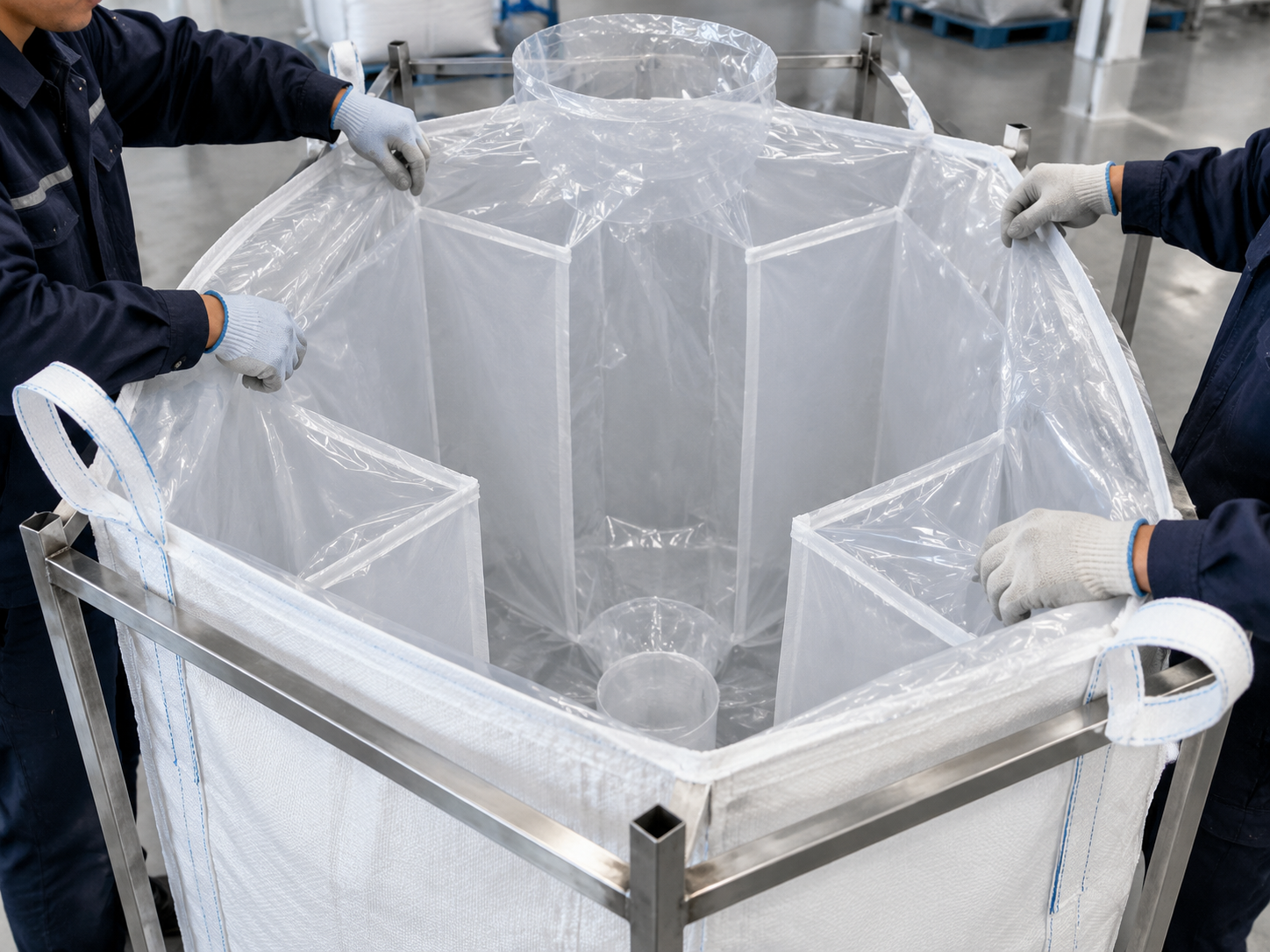
A liner may be appropriate when the buyer needs a separate product-contact layer, moisture protection, cleaner containment or easier discharge. FIBC World's form-fit liner is designed to follow the outer bag shape and can be supplied with PE, EVOH barrier film, aluminum foil composite film or anti-static options. Fixing tabs, glue points, corner fixing and top fixing can be discussed to help control liner movement.
Do not select a liner only because the quotation says "PE liner" or "form-fit liner." Confirm:
the liner material and structure;
the finished dimensions and fit inside the specified outer bag;
the liner top and bottom opening dimensions;
how the liner aligns with the outer filling and discharge spouts;
the fixing method and number of fixing points;
whether the liner is compatible with any static-protective requirement;
whether the liner can be inspected and positioned before filling; and
how the liner will behave during discharge and cleaning.
A loose liner can move, twist or trap pellets. A fitted liner can reduce folds and residue, but it still needs a project drawing and a representative trial. The FIBC liner fit and interface guide explains the dimensions to collect before ordering.
4. Filling interface and top closure
The filling spout and closure should match the filling equipment and the operator's procedure. Confirm the spout diameter and length, the filling head or lance dimensions, the available headspace and the method used to control dust.
Avoid filling beyond the agreed weight or fill height. Overfilling can stress seams, distort the bag, leave insufficient freeboard for closing and increase the chance of pellets being trapped in the closure. A bag that looks full at the filler may bulge further after settling.
Before closing, remove pellets from the surfaces that must meet. Check that the liner is not caught in the outer spout and that the closure is made in the approved sequence. FIBCA safe-handling guidance says the fill spout or duffle should be closed according to the manufacturer's instructions . A closure that depends on a knot, tie, cord lock or folded spout must be treated as part of the package, not as an accessory outside the specification.
5. Bottom discharge and flow control
A discharge spout can support controlled emptying when it is designed to connect to the receiving equipment and the closure is operated correctly. The FIBC World bottom-spout page describes double tie strings, petal or star protection and optional integrated liners. It also lists plastic pellets and polymer granules among the applications. These features can help with controlled flow and protection of the outlet, but the final arrangement still depends on the bag, liner, product and receiving hopper.
Ask how the discharge spout will be:
closed during filling and transport;
protected from abrasion and contamination;
connected to the hopper, chute or receiving system;
opened without uncontrolled release;
checked for liner movement and residual material; and
cleaned or inspected before reuse.
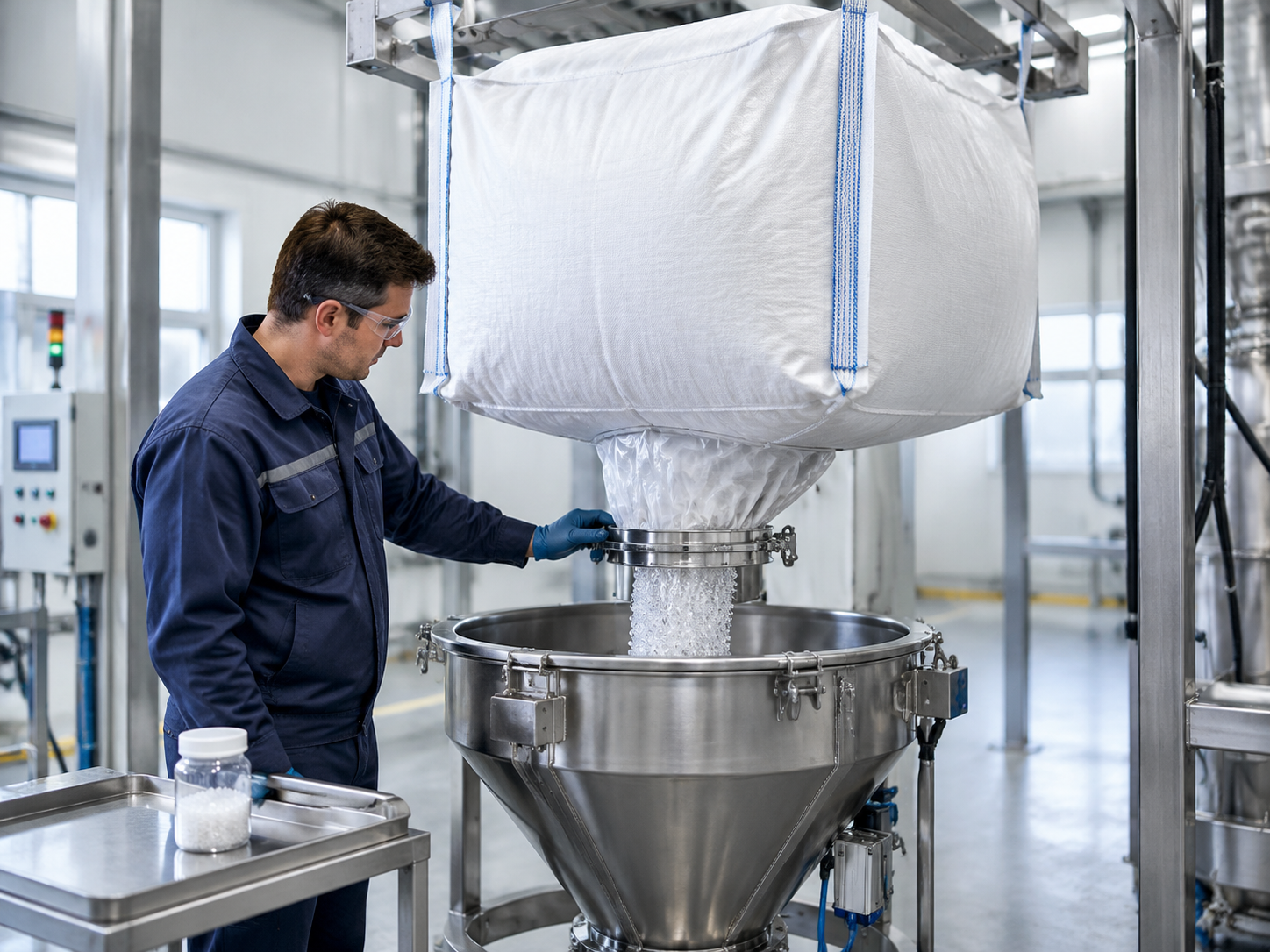
The discharge station should include a defined method for catching or cleaning any material released during connection and final emptying. A closed connection reduces loss, but it does not replace an inspection of the bag and the surrounding area.
6. Warning, pictogram and transport information
The EU summary states that packaging must display a warning and a pictogram. Do not use a generic warning or assume that an existing handling mark satisfies the current requirement.
Obtain the approved wording, symbol, size, contrast, placement and durability requirement from the buyer or compliance team. Add the approved artwork to the bag drawing and confirm that it remains legible after printing, packing, transport and, where applicable, cleaning or reuse. The shipper should also provide the required transport information and stowage instructions for the shipment.
Control handling and container loading
Pellet loss often happens between the filling line and the vessel. The bag may be correct, but the route can still damage it or leave pellets behind.
At the filling site
Inspect the empty bag and liner before use.
Confirm the bag and liner revision against the approved drawing.
Lift the bag with the specified equipment and do not drag it across rough floors.
Keep forklift tines, clamps, hooks and nearby equipment away from the bag body and spouts.
Do not stand or work under a suspended bag.
Keep the filling area clean and collect spilled pellets rather than washing them toward drains.
Record the bag lot, liner lot and filling line if the buyer requires traceability.
During container loading
Inspect the container floor, walls and doors for pellets, debris, nails, sharp edges and moisture.
Clean the container before loading and confirm that the previous cargo has not left pellet residue.
Use dunnage or a protective liner where the load plan requires it.
Check that bags are not compressed against door hardware, protruding fittings or each other in a way that damages seams or spouts.
Follow the approved stacking and load-securing plan.
Sweep or collect pellets that fall during loading.
Close and secure the container according to the carrier's and shipper's instructions.
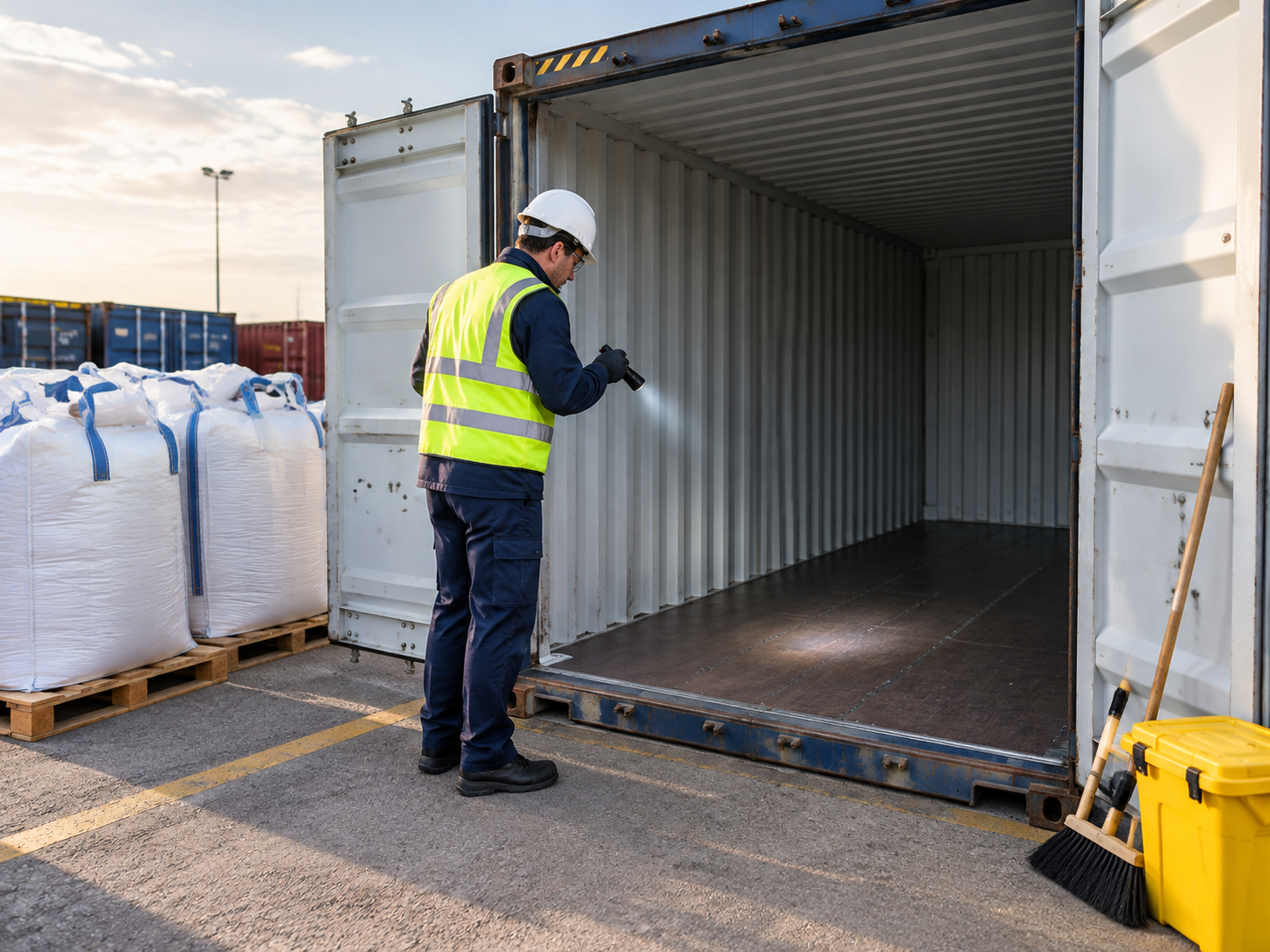
The EU summary states that road, rail and inland waterway carriers must ensure vehicles and containers are pellet-free before departure and close loading and unloading systems when leaving facilities . The buyer should confirm how this responsibility is documented between the filling site, haulier and container operator.
Run a pre-shipment containment trial
A drawing review and a visual check of an empty bag are not enough. Test the bag and liner as the buyer will receive them, using representative pellets and the intended filling, closing, handling and discharge methods.
A practical trial can follow these stages:
Drawing check. Confirm the bag, liner, seams, spouts, closures, fixing points, printing and revision.
Empty fit check. Confirm that the liner can be positioned and fixed without twisting, stretching or blocking an opening.
Filling check. Use representative pellets, including the normal fines fraction where relevant. Record fill weight, fill time, dust and any pellets trapped in the top opening.
Closure check. Close the bag using the production method. Photograph the top closure and confirm that no liner or pellets are caught in the closure.
Handling check. Lift, move and stack the filled bag using the approved procedure. Inspect the bag body, seams, loops, base and closures afterward.
Transport check. Where appropriate, use an agreed vibration, road or handling simulation to reproduce the expected distribution environment.
Container-loading check. Confirm that the bag fits the load plan without harmful compression or contact.
Discharge check. Connect the spout to the receiving equipment and observe flow control, liner movement, spillage and residual pellets.
Define acceptance criteria before the trial. Depending on the project, these may include:
no visible pellet escape at the fill spout, top closure, body, seams, base or discharge outlet;
no pellets between the liner and the outer bag;
no closure movement or liner displacement after handling;
no damage to the coating, seams or spout;
no uncontrolled release during discharge;
discharge time and residual quantity within the agreed limit; and
legible and correctly positioned warning and identification marks.
Record the pellet grade, bag and liner sample references, equipment, fill weight, operator, date, observations and photographs. Keep the approved drawing, material structure and trial record together so a repeat order can be compared with the approved version. A successful handling trial does not replace a design verification, static assessment, regulatory review or customer-specific test requirement.
RFQ checklist for EU-bound plastic pellet FIBCs
Use the same FIBC RFQ information for every supplier so the quotations describe the same package.
| RFQ item | Information to provide |
|---|---|
| Pellet | Resin type, grade, shape, size, bulk density, fines or dust, moisture and static behaviour |
| Shipment | Destination, route, transit time, transfer points, storage and expected handling |
| Outer FIBC | Bag style, dimensions, working load, safety factor, single-trip or reusable requirement |
| Fabric and seams | Coated or uncoated fabric, seam construction, sift-resistant requirement and inspection points |
| Liner | Material, structure, dimensions, fit, openings, fixing method and static compatibility |
| Filling | Equipment, spout dimensions, fill rate, target weight, venting and dust control |
| Top closure | Closure type, tie or cord arrangement, liner-to-spout relationship and closing procedure |
| Discharge | Outlet type, spout dimensions, receiving equipment, flow control and clean-up method |
| Handling | Lifting equipment, stacking plan, container loading and expected transport condition |
| Marking | Required warning, pictogram, identification, printing position and durability |
| Evidence | Drawing, sample, material declaration, trial plan, inspection record and change-control requirement |
| Commercial | Quantity, destination, packing method, sample timing, required delivery date and quotation validity |
When comparing quotations, do not compare only the bag price. Compare the body construction, seam specification, liner fit, closure, discharge arrangement, warning artwork, trial scope, inspection evidence and commercial assumptions. A lower quote that leaves an opening or closure undefined is not a like-for-like offer.
Red flags in a quotation or specification
Review the proposal carefully if it:
uses "EU compliant" or "pellet regulation compliant" without identifying the exact packaging scope and supporting evidence;
says "sift-proof" without describing the fabric, coating, seam construction or inspection requirement;
offers a liner without confirming its fit, fixing method and alignment with the spouts;
does not show the filling spout, top closure, discharge outlet and liner relationship on a drawing;
does not define how the bag will be closed or how pellets will be kept out of the closure;
treats the warning and pictogram as a generic handling label;
does not ask for the receiving hopper or discharge procedure;
has no representative trial or acceptance criteria; or
has no change-control process for the fabric, liner, seam, spout, artwork or production site.
These points are not automatic reasons to reject a supplier. They are reasons to stop treating the quotation as complete until the missing information is defined.
Conclusion
An FIBC for EU-bound plastic pellets is not just a container with a certain load rating. It is one part of a containment system that includes the pellet profile, bag body, seams, liner, filling spout, top closure, lifting method, container loading, transport route and discharge station.
The most useful purchasing sequence is to map the loss points first, define the complete package on an approval drawing, test it with representative pellets and equipment, and record what was accepted. Do not rely on a single word such as "sift-proof," "coated" or "compliant" to carry the whole specification.
Regulation (EU) 2025/2365 raises the standard for prevention, containment and clean-up across the pellet supply chain. The main operational obligations apply from 17 December 2027, and the requirements for shippers and maritime transport apply from 17 December 2028. That timeline leaves room to define the package properly, but not to leave the bag, liner and closure decisions until the first export order.
To review a plastic pellet application, send FIBC World the pellet grade and bulk density, fines or dust information, fill weight, bag dimensions, filling equipment, closure method, discharge hopper details, container route, destination, required warning artwork and target delivery date. The final construction should be confirmed through an approval drawing and a representative containment trial.
Related News
Other news you might be interested in

FIBC Bag Handling and Safety: Best Practices for Safe Use
Proper FIBC handling is closely connected with operator safety, bag integrity and efficient bulk-material movement. An FIBC is a system of components rather than simply a woven fabric container. Lifting loops or sleeves, seams, fabric, closures, filling arrangements, discharge components and, where applicable, liners all contribute to how the bag performs during use.

Recyclable FIBC: Mono-material PP, with liner and ventilated type
When a buyer asks, "Is this FIBC recyclable?", the answer depends on which part of the bag is being discussed, where it will be used and what recycling route is actually available. A woven PP bag with a PE liner, a paper label, a polyester thread and a foil barrier is not the same product as a predominantly mono-material PP bag. Even a mono-material bag is not automatically recycled at scale if collection, cleaning and sorting are missing.This guide separates three questions that are often mixed together: what the bag is made of, what the bag is designed to do, and what evidence supports the claim. It is a buyer checklist, not a legal opinion or a certification statement.
Want to know more?
Get in touch with us for more information about our services and products.