

FIBC Landed Cost in a High-Freight, Volatile-Resin Market: How to Compare FOB and CIF Bulk Bag Quotes

Dayang Yang
AuthorWith experience in FIBC bulk bag manufacturing and export sales, we operate our own production facility with stable large-scale capacity. We are specialists in bulk bags, conductive FIBCs, food-grade FIBCs, UN certified bags, and customized flexible intermediate bulk containers for industrial packaging and bulk material transportation solutions.
When buyers compare FIBC quotations, the first number on the page is often the least useful. Two suppliers can offer the same nominal bag size and the same filling capacity, yet quote different products, different packing methods, different freight assumptions and different price-validity periods.
That difference matters more when resin and freight are moving. In late October 2026, third-party polymer assessments showed PP prices increasing across several Asian, European, Turkish and Latin American markets. In the same period, Drewry’s World Container Index rose to USD 4,585 per 40 ft container, its highest level in 15 weeks. These figures are market indicators, not FIBC World prices or a forecast. They show why a bulk bag quotation should be evaluated as a delivered packaging system, not as an isolated price per bag.
The practical question is not simply “Which FIBC quote is cheaper?” It is:
Which quotation provides the required bag and liner specification, at the lowest total cost per filled tonne, with clear freight and price assumptions, acceptable delivery risk and verifiable quality?
This guide explains how procurement, operations and packaging teams can compare FOB and CIF bulk bag quotes on that basis.

Why the Lowest Price per Bag Can Be the Highest Landed Cost
A lower FIBC price may reflect a genuine efficiency advantage. It may also reflect a different specification or a cost that has been moved outside the quotation.
Common examples include:
a lighter fabric or different coating;
a thinner or simpler liner;
fewer attachment points or a different closure;
no printing or a lower print specification;
loose packing instead of a compact or protected packing method;
a slower freight route or a different transshipment plan;
a shorter price-validity period;
excluded destination charges, duties or inland delivery; or
documents or tests that are not included.
None of these automatically makes a quote unsuitable. The buyer’s task is to identify the difference before comparing the total.
Lock the Specification Before Comparing Price
An FIBC quotation is only comparable when both suppliers are quoting the same product. Record the following before asking for a final price.
| Specification item | What the quotation should state |
|---|---|
| Outer bag | Bag style, body construction, dimensions and target fill weight |
| Fabric and coating | Material, fabric construction, coating and any UV requirement |
| Liner | Standard, form-fit or other structure; film type; thickness or construction; attachment method |
| Filling interface | Open top, duffle, spout or other filling arrangement, including dimensions |
| Discharge interface | Flat bottom, spout or full-open outlet, including dimensions and closure |
| Lifting | Loop type, quantity, configuration and intended handling method |
| Seams and protection | Seam construction, sift-proof requirement, dust control or other protection |
| Printing | Number of colors, print area, artwork responsibility and label requirements |
| Packing | Bale, carton, pallet or other method, including units per package |
| Quantity | Trial, first order, repeat-order volume and any size mix |
| Destination | Country, port or place, final delivery point and required Incoterm |
| Documents | Drawing, sample record, test reports or other agreed documentation |
For a meaningful comparison, use the same wording in every RFQ. If a supplier proposes a different construction, ask for the reason and treat it as a separate option. Do not compare a standard loose liner with a form-fit liner, or an uncoated bag with a coated bag, unless the difference is part of the purchasing decision.
Fill weight and safe working load are also different concepts. A bag may be described as a “1,000 kg FIBC” while the intended fill weight, design load and lifting conditions still need separate confirmation. The buyer should state the actual product weight per bag and the handling method, not only a nominal size.
Our guide to standard versus form-fit FIBC liners explains how liner geometry can change both performance and cost. The liner fit and interface guide covers the measurements that should be fixed before a supplier can quote the same system.
Calculate FIBC Landed Cost per Filled Tonne
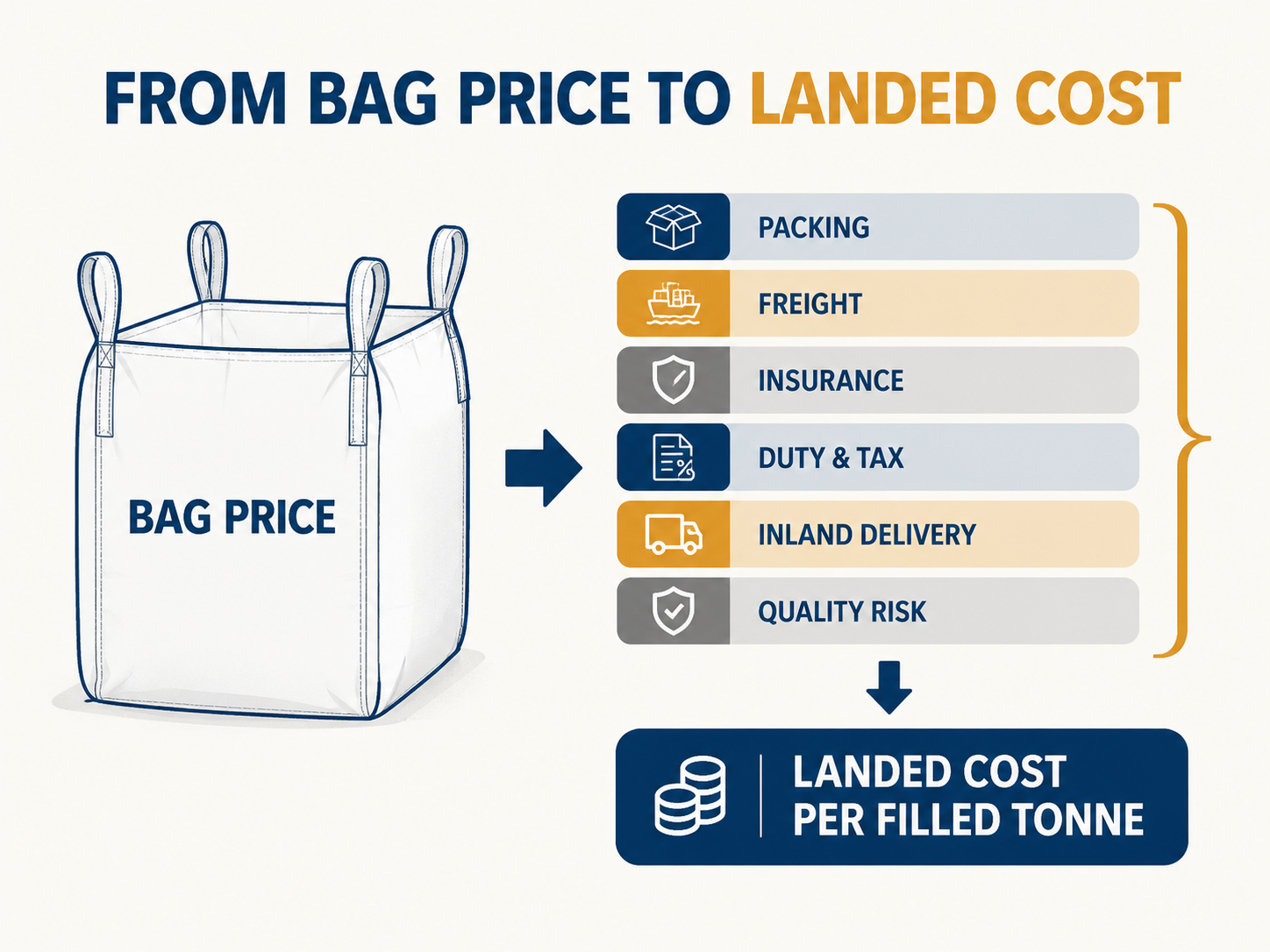
The lowest price per empty bag is not always the lowest cost per tonne of product delivered. A simple landed-cost model makes the comparison clearer:
Landed cost per bag
= quoted bag price
packing and palletization
origin handling and export charges not included in the bag price
ocean freight and applicable surcharges
insurance
destination port or terminal charges
customs duty and import taxes
inland delivery
financing, inspection and administration costs
an allowance for agreed quality or claim risk
Then calculate:
Landed cost per filled tonne = landed cost per bag ÷ net fill weight in tonnes
For example, if the net fill weight is 1,000 kg, a difference of USD 0.50 per bag is USD 0.50 per tonne. If a 40 ft container carries 400 bags and one quote is USD 500 more expensive for the container, that is USD 1.25 per bag before any difference in duties or destination charges.
These figures are illustrative. The purpose is to show why buyers should use the same unit of measurement across all quotations. A quote with a lower bag price can lose its advantage after packing, freight and destination costs are included.
Also separate the bag price from the freight cost per bag. A compact packing method may reduce the number of containers required, but it may also affect handling, protection or unloading. The lowest freight figure is not automatically the lowest total cost.
Compare FOB, CIF and DDP on the Same Basis
FOB and CIF are not two names for the same delivered price. They allocate cost, risk and obligations differently. Under the ICC’s Incoterms® 2020 rules, the named port or place in the quotation is part of the commercial term and must be checked carefully.
| Term | What the quote generally covers | What the buyer should verify |
|---|---|---|
| FOB | The supplier’s price up to the named port of shipment, including the export stage defined by the rule | Named port, export clearance, origin charges, loading arrangements and the separate ocean-freight estimate |
| CIF | The supplier arranges and pays the main carriage and insurance to the named destination port | Named destination port, routing, transit time, insurance scope, surcharges and all charges after arrival |
| DDP | Delivery to a named destination place with import clearance arranged by the seller, if offered | Importer of record, duty and tax treatment, customs requirements, final delivery and exclusions |
CIF does not mean that the supplier carries every risk until the container reaches the buyer’s warehouse. Under CIF, risk generally passes when the goods are on board the vessel at the port of shipment; it is not the same as the seller’s obligation to arrange carriage and insurance. Buyers should not infer door-to-door protection from a CIF quotation.
For containerized shipments, also ask your freight forwarder whether FOB is the right handover term for the actual booking arrangement, or whether another Incoterms® rule better matches where the container is handed over. The correct term depends on the transaction, not on habit.
A lower CIF quote can result from a different route, a longer transit time, a different transshipment plan, a different insurance arrangement or surcharges that are excluded. These points belong in the comparison, not in a footnote discovered after the order is placed.
Put Container Loading into the Cost Comparison
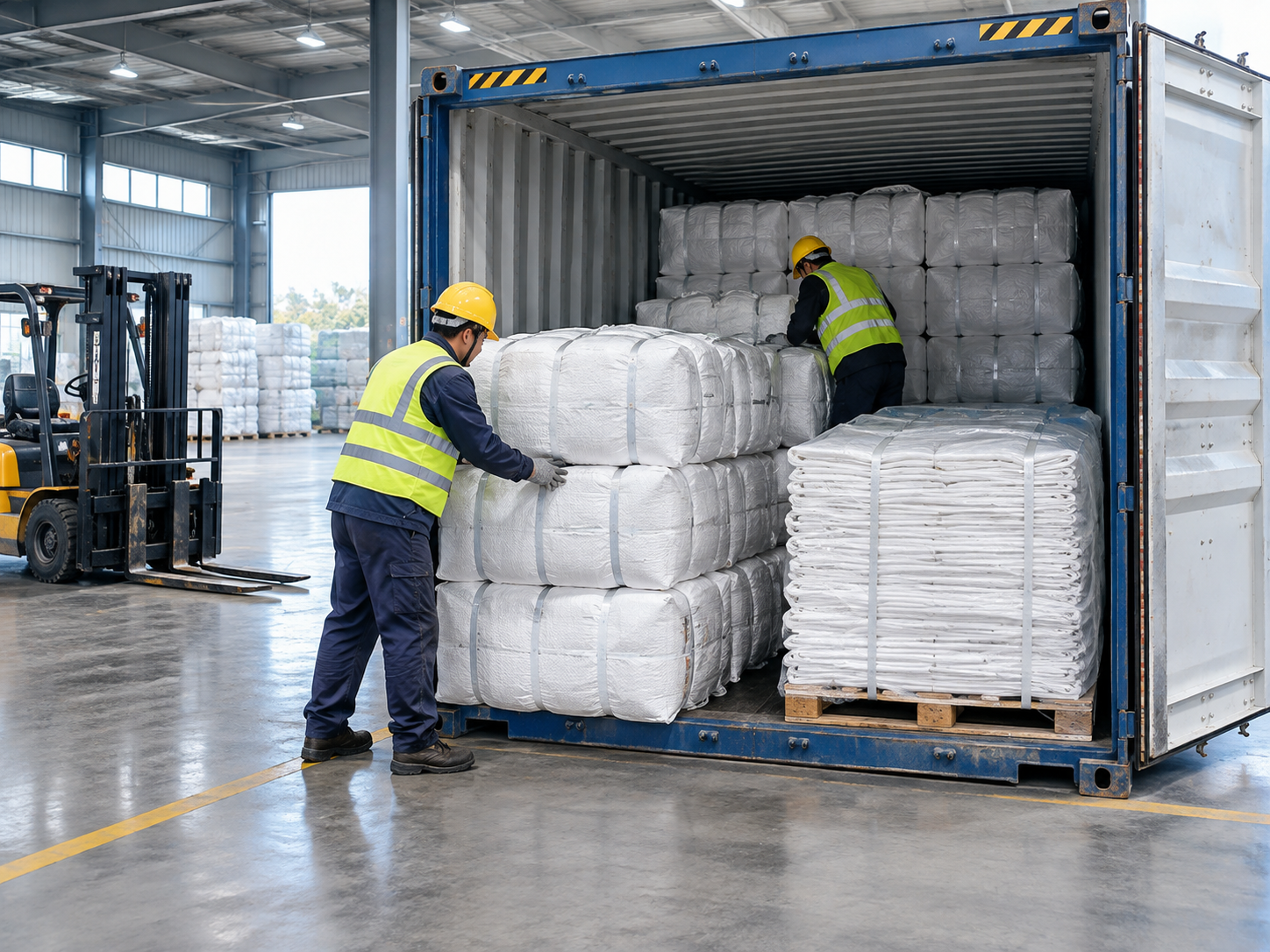
FIBCs are bulky, even when empty. The packing method can therefore change the effective freight cost per bag.
Ask each supplier to state:
whether bags are supplied loose, baled, compressed, packed in cartons or palletized;
the number of bags per package;
the package dimensions and gross weight;
the estimated number of bags per 20 ft or 40 ft container;
whether the estimate is based on a confirmed loading plan;
how the packing protects liners, spouts and printing;
how the receiving site will unload and handle the packages; and
any minimum or mixed-order effect on loading efficiency.
A supplier may quote a lower bag price but require more container space, more handling labor or a less convenient receiving process. Another supplier may charge more per bag but fit more bags into the same container. The buyer should compare the total delivered cost per filled tonne, not only the price on the bag invoice.
For high-value powders or food ingredients, also consider the cost of one failed liner. A small saving per bag is not useful if the packing method increases creasing, contamination risk or handling damage. The sift-proof versus leak-proof article explains why “leak-proof” needs to be translated into a specific failure point and test discussion.
Make Resin and Freight Volatility Visible in the Quote
When PP prices and ocean freight are changing, a single unit price without assumptions is difficult to compare. A professional quotation should make the variable parts visible.
Resin assumptions
Ask the supplier:
Which PP grade, region and delivery basis are reflected in the price?
Is the price fixed for a stated period or linked to an index?
If linked, which published assessment is used, on what date, and how often can it change?
Is the adjustment based on the full resin price or only a defined component of the bag?
Is there a cap, floor, trigger threshold or formula?
What evidence will be supplied when the adjustment is applied?
An index-linked clause is not automatically better or worse than a fixed price. What matters is that the mechanism is written down before the order, is based on a verifiable reference and does not turn into an unexplained surcharge.
Freight assumptions
Ask which of the following are included:
base ocean freight;
origin and destination terminal charges;
documentation and customs-clearance fees;
bunker, currency, peak-season, congestion or routing surcharges that apply to the booking;
insurance;
inland delivery; and
any known port or security-related cost.
Not every surcharge applies to every route or booking. The buyer should require the supplier or forwarder to identify the assumptions used, the validity period and the circumstances that would trigger a revised freight charge.
Currency and validity
State the quotation currency, exchange-rate assumption and validity date. If the price is valid for only a short period, the buyer should know that before comparing it with a longer fixed offer. A longer validity period may include a risk premium; a shorter one may require faster approval. Neither is automatically the better commercial choice.
Treat Quality and Compliance as Part of Landed Cost

The lowest-priced bulk bag can become expensive if it creates a production stoppage, a rejected load, a customer claim or a replacement shipment.
Review the quality scope alongside the commercial terms:
Does the liner stay in position during filling and discharge?
Is the closure compatible with the filling equipment?
Is the discharge outlet suitable for the receiving system?
Are the lifting loops and handling method matched to the site?
Is the bag designed for the actual fill weight and transport conditions?
Are food-contact, dangerous-goods, anti-static or other required claims supported by the correct documents?
Is the sample approval drawing the same revision as the quotation?
Are batch identification and change-control requirements defined?
If barrier performance is a major cost driver, compare the whole liner construction rather than the word “foil.” Our guide to evaluating aluminum foil FIBC liners explains how to review barrier data, sealing and trial evidence. For handling equipment, the guide to 1-loop, 2-loop and 4-loop FIBCs covers why loop count alone does not define a safe lifting arrangement.
Do not accept a generic certificate, test report or “food-grade” statement as proof for a different bag design. The evidence should match the quoted materials, construction and intended use.
Use a Quote Comparison Scorecard
A structured scorecard prevents a low unit price from hiding a different specification or a missing cost.
| Comparison item | Quote A | Quote B | Required evidence or note |
|---|---|---|---|
| Bag style and dimensions | Drawing or written specification | ||
| Fabric, coating and liner | Material and component details | ||
| Filling and discharge interfaces | Dimensions and equipment fit | ||
| Lifting arrangement | Loop type and handling method | ||
| Printing and labels | Artwork and label specification | ||
| Packing method | Package dimensions and units per pack | ||
| Units per container | Loading assumption | ||
| Incoterm and named port/place | Exact commercial term | ||
| Freight and surcharges included | Written assumptions | ||
| Insurance and destination costs | Scope and exclusions | ||
| Duties, taxes and inland delivery | Responsibility and estimate | ||
| Quote currency and validity | Date and exchange-rate basis | ||
| Sample and approval process | Drawing revision and acceptance criteria | ||
| Lead time and shipment plan | Production and transit assumptions | ||
| Quality and compliance documents | Product-specific evidence | ||
| Landed cost per filled tonne | Calculated on the same basis |
The final column is important. A scorecard without evidence simply turns assumptions into a neat table.
What to Send for a Comparable FIBC Quote
To receive a quotation that can be compared properly, send:
Product name, form and bulk density.
Intended fill weight per bag.
Bag dimensions and preferred bag style.
Required fabric, coating, UV or sift-proof requirement.
Liner type, construction and attachment method.
Filling and discharge equipment details or photographs.
Lifting and handling method.
Printing, label and document requirements.
Packing preference and any receiving constraints.
Destination port or place and required Incoterm.
Trial, first-order and annual quantity.
Required shipment date and quotation validity period.
If a detail is unknown, say so rather than using a generic value. A supplier should confirm the open points before treating a quotation as final.
Conclusion
FIBC landed cost is not the same as the lowest FOB price. The useful comparison is the delivered cost per filled tonne for a defined bag-and-liner system, supported by clear packing, freight, currency, validity and quality assumptions.
When resin and freight markets are volatile, the quotation process should make those variables visible. Buyers who compare only the first price per bag may choose a lower headline number while accepting a different specification, a slower route, a shorter validity period or a higher risk of liner and handling problems.
Start with the specification, calculate the full landed cost, compare FOB, CIF and any DDP option on the same basis, and keep quality evidence attached to the commercial decision.
To review a custom FIBC or liner requirement, send FIBC World the product details, fill weight, bag and liner specification, filling and discharge arrangement, destination, quantity and required Incoterm. You can review the FIBC product range and custom options, then contact FIBC World for a specification-based quotation. Confirm the current material availability, packing method, MOQ, lead time and quotation validity before placing an order.
This guide is commercial and educational, not legal, tax, customs or freight-forwarding advice. The applicable contract, Incoterms® rule, carrier terms and import requirements control the actual transaction.
Related News
Other news you might be interested in

FIBC Bag Handling and Safety: Best Practices for Safe Use
Proper FIBC handling is closely connected with operator safety, bag integrity and efficient bulk-material movement. An FIBC is a system of components rather than simply a woven fabric container. Lifting loops or sleeves, seams, fabric, closures, filling arrangements, discharge components and, where applicable, liners all contribute to how the bag performs during use.

Recyclable FIBC: Mono-material PP, with liner and ventilated type
When a buyer asks, "Is this FIBC recyclable?", the answer depends on which part of the bag is being discussed, where it will be used and what recycling route is actually available. A woven PP bag with a PE liner, a paper label, a polyester thread and a foil barrier is not the same product as a predominantly mono-material PP bag. Even a mono-material bag is not automatically recycled at scale if collection, cleaning and sorting are missing.This guide separates three questions that are often mixed together: what the bag is made of, what the bag is designed to do, and what evidence supports the claim. It is a buyer checklist, not a legal opinion or a certification statement.
Want to know more?
Get in touch with us for more information about our services and products.