
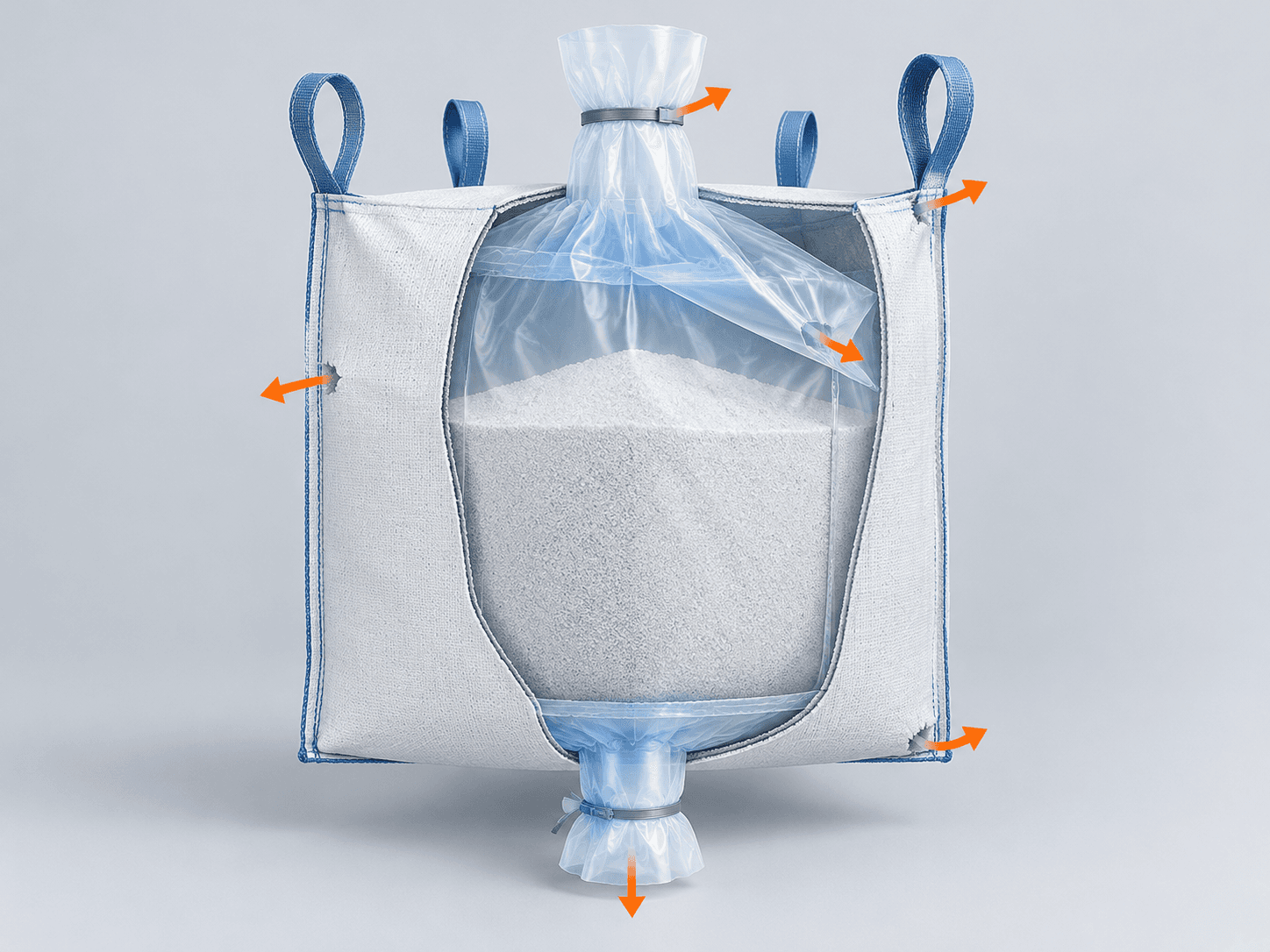
Sift-Proof Is Not Leak-Proof: Where Fine Powders Escape an FIBC After Filling

Dayang Yang
AuthorWith experience in FIBC bulk bag manufacturing and export sales, we operate our own production facility with stable large-scale capacity. We are specialists in bulk bags, conductive FIBCs, food-grade FIBCs, UN certified bags, and customized flexible intermediate bulk containers for industrial packaging and bulk material transportation solutions.
The bag looks clean at the filler. By the time it reaches the warehouse, a fine dust line has appeared along a seam, around the discharge closure, or between the liner and the outer bag. The usual response is to ask for a "sift-proof bag." That phrase is useful, but it does not tell the packaging team where the powder is escaping.
For a packaging engineer or quality manager, the more useful questions are:
Where does the powder first become visible?
Is it present immediately after filling, or only after vibration, stacking or transport?
Is it coming through the bag body, a seam, a closure or the liner?
Does it happen on every bag or only one production lot?
Has the powder, liner, bag construction, fill rate, closure method or transport route changed recently?
Those questions turn a vague leakage complaint into evidence. They also prevent a common mistake: adding more layers to a bag before establishing where the existing package is failing.
What "sift-proof" actually describes
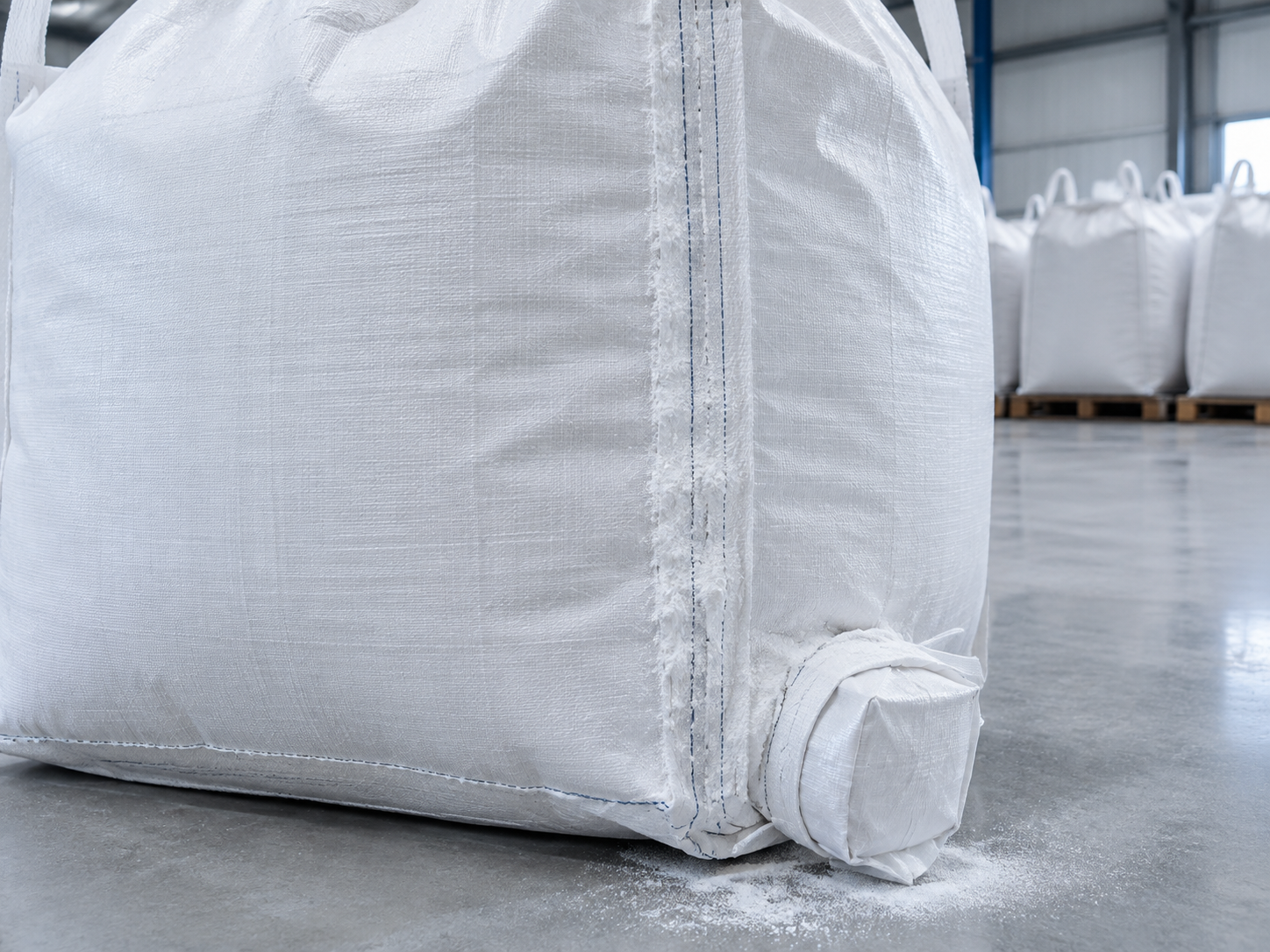
FIBCA defines sift-resistant construction as a construction that provides resistance to product sifting when very fine materials are packed in an FIBC. It is also called "sift-proof" construction, and typically uses coated fabric and filler cord in the sew lines . The definition is important because it describes a construction approach, not a universal zero-leakage rating.
That distinction matters in three ways.
First, a coated fabric closes many of the small openings between woven tapes. It can reduce migration through the bag body, but it does not automatically seal the seams, the spouts or the liner. Second, a filler cord or felt can occupy gaps around stitch holes, but its effectiveness depends on the seam design and how it is sewn . Third, a liner can separate the powder from the woven outer bag, but the liner itself has seams, folds, a fill opening, a discharge opening and attachment points.
ISO 21898:2024 specifies materials, construction and design requirements, type tests and marking requirements for FIBCs intended to contain non-dangerous solid materials in powder, granular or paste form . That is an important baseline for the bag. It does not remove the need to define a product-specific containment trial and acceptance criteria for a particular powder, filling process and route.
In practical terms, "sift-proof" should be read as:
A construction intended to reduce fine-particle migration through known paths under defined conditions.
It should not be read as:
A bag that will contain every powder under every filling, handling and transport condition without leakage.
For a comparison of sift-resistant felt piping and plastic liners, see our existing technical note on zero-leakage seam options. This article takes a different starting point: locating the leak path after filling.
Start with the powder, not the bag label
"Fine powder" is not a sufficient specification. Two powders with the same average particle size can behave very differently in an FIBC.
A useful material profile includes:
the particle-size distribution, not only a single average value;
the fines fraction, because a small percentage of very fine particles can dominate dust behaviour;
particle shape, surface condition and tendency to agglomerate;
bulk density and how it changes after settling or vibration;
moisture content and temperature at filling;
flow behaviour, aeration and dustiness during filling;
abrasiveness and chemical compatibility with the contact materials;
electrostatic properties and the surrounding process environment.
As particle size decreases, inter-particle forces can become more important relative to gravity, increasing cohesion and changing flow behaviour . That does not mean every fine powder behaves the same way. It does mean the trial should use the real material, including its fines, rather than a coarse substitute that is easier to handle.
The filling process also changes the starting condition. A high filling rate can entrain air and create internal pressure while the bag is being loaded. The powder may be fluidized at the filler and settle later. A bag that looks stable immediately after filling may develop a different internal pressure, liner position or seam load after the air has escaped.
Record the material and process data before discussing construction. Without them, "sift-proof" becomes a word on a quotation rather than an engineering requirement.
Where fine powders escape after filling
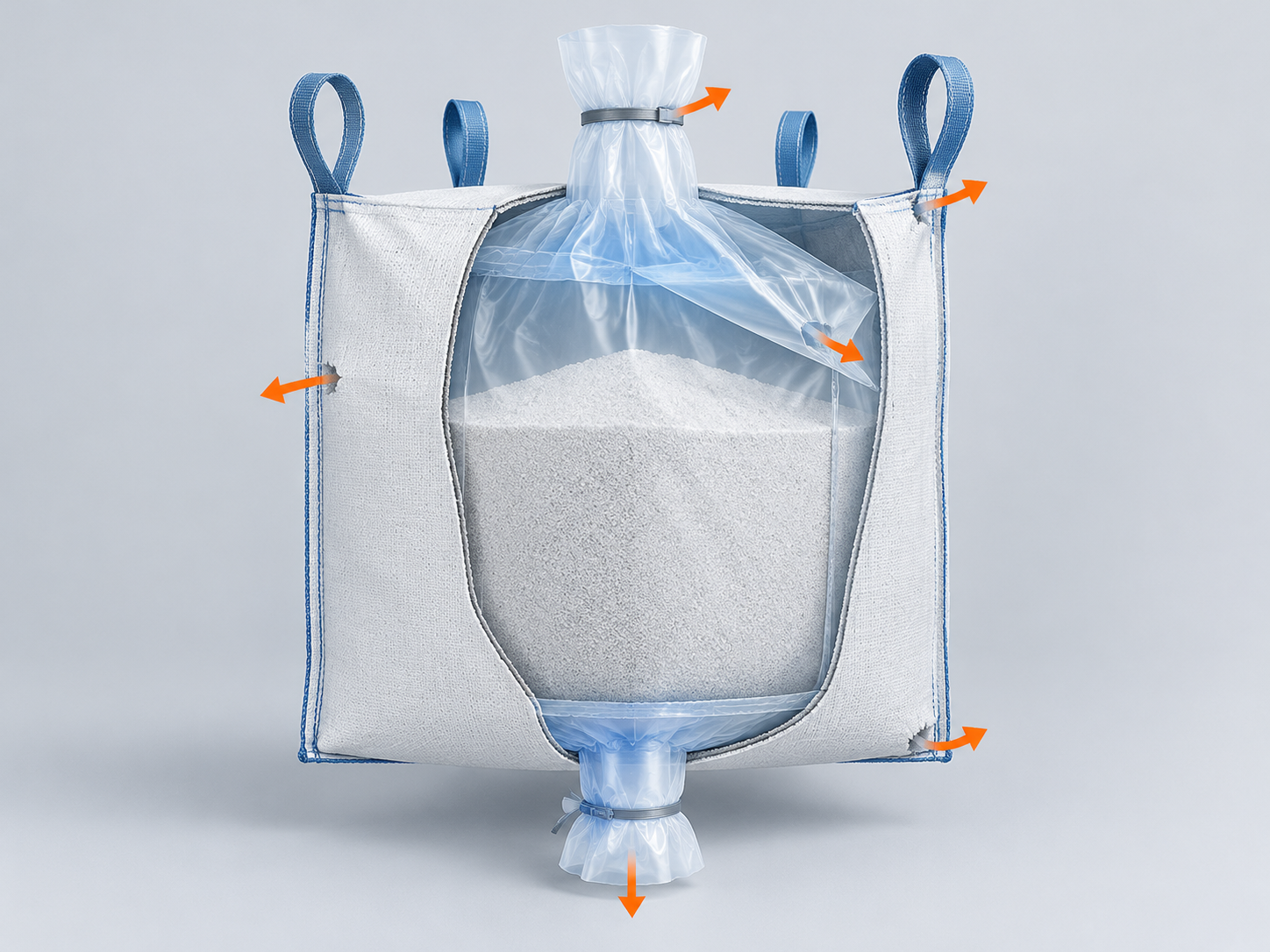
Fine-powder leakage is rarely a single failure point. It is a set of possible paths, and the evidence is often visible before a bag needs to be cut open.
| Location | What you may see | What it can indicate | What to examine |
|---|---|---|---|
| Bag body | A diffuse dust haze, especially on the outside of an uncoated bag | Migration through the woven structure or damage to a coating | Fabric type, coating continuity, abrasion and pinholes |
| Seams and stitch lines | Powder along a seam, at seam ends or around reinforced patches | A path through needle holes or an incomplete seam closure | Seam construction, filler cord or felt, stitch condition and seam continuity |
| Fill spout or top closure | Powder around the neck, tie area or duffle | Product trapped during filling, an incomplete closure or liner material in the closure | Closure method, operator procedure, liner extension and powder on the sealing surfaces |
| Discharge spout | Dust around the outlet, tie, cord lock or valve | A closure that is not fully seated, a damaged spout or a liner outlet that does not fit | Spout condition, closure design, liner-to-spout alignment and discharge procedure |
| Liner | Powder between the liner and the outer bag, inside a fold or around a liner seam | A liner breach, an open liner closure or a path around the liner | Liner seams, fit, attachment, fill and discharge openings, and closure |
| Handling points | Scuffs, pinholes, abrasion or tears near loops, corners or the base | Forklift contact, stacking damage or repeated flexing | Handling route, contact points, base protection and inspection records |
The location of the powder is the first diagnostic clue. A diffuse haze on an uncoated body suggests a different path from a concentrated line of powder at a seam end or a ring of dust around a discharge closure.
The bag body
An uncoated woven bag is intentionally breathable. The gaps between tapes can be useful for products that need airflow, but they are not a containment barrier for a fine powder. Coated or laminated fabric reduces those openings and is commonly used for sift-resistant construction .
Coating is not a guarantee against damage. Creasing, abrasion, flexing and contact with sharp equipment can compromise the coating. A coating that is intact in the sample may also be damaged during filling or handling. Inspect the body after the same movement the bag will see in service, not only on a flat sample.
Seams and stitch lines
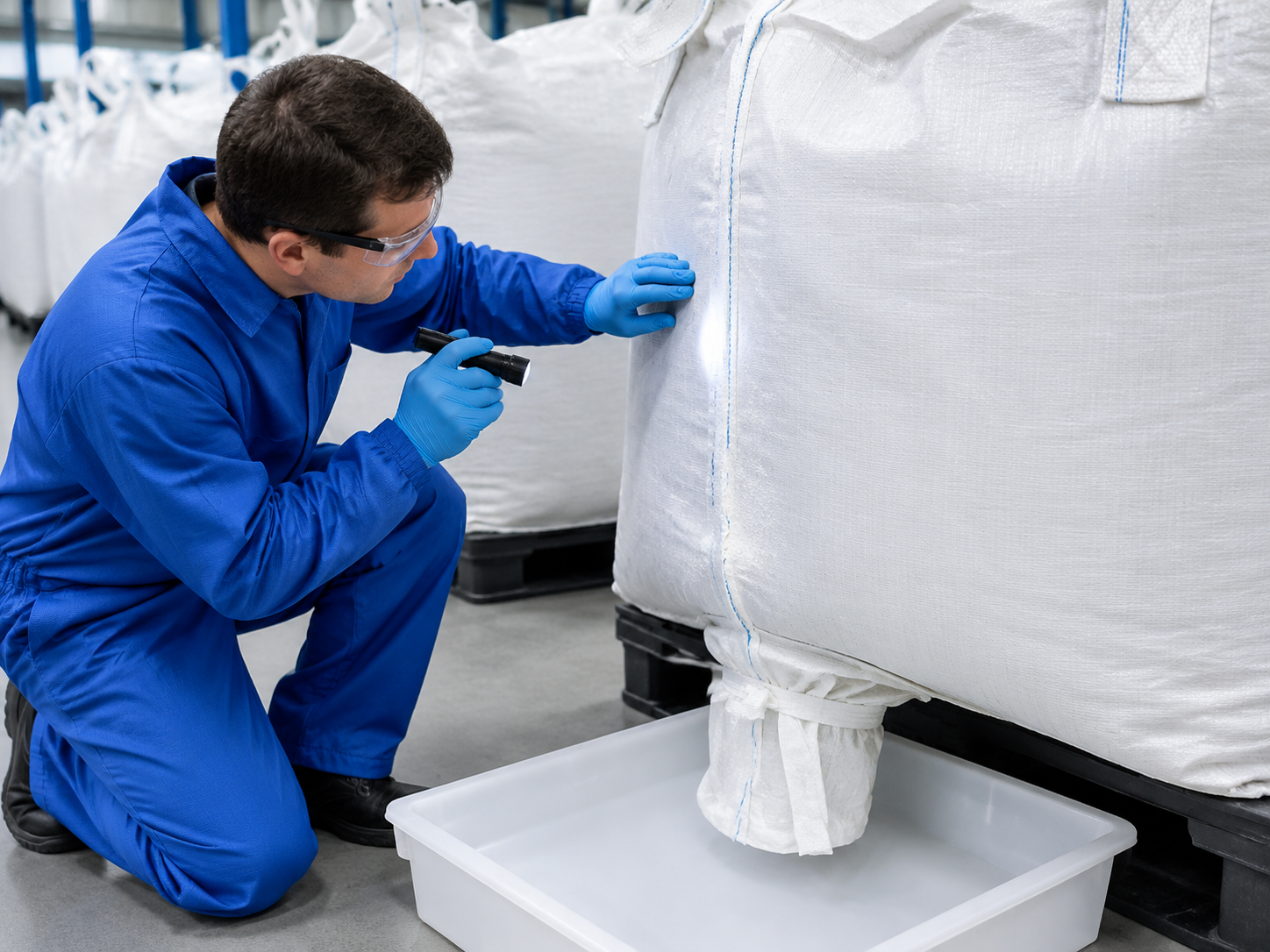
A sewn seam joins panels and carries load. It also creates a line of needle holes. A filler cord or felt can fill or block the path around those holes and is a common part of sift-resistant construction .
The critical details are not captured by the words "sift-proof seam" alone. The buyer should know the seam type, whether a filler cord or felt is used, how it is positioned, and what inspection is performed. Seam ends, corner junctions, belt patches and attachment points deserve particular attention because they interrupt the continuity of the construction.
A seam can also be clean on a new bag and leak after the bag has been filled. Load, vibration and repeated flexing can change the local geometry around the stitch line. The trial should therefore inspect the seam after filling and after the intended handling cycle.
Fill spouts and top closures
Powder around the fill spout is often assumed to be leakage through the bag. Sometimes it is material that was trapped in the closure during filling. The distinction is important: a different closure procedure may solve the problem without changing the bag construction.
Check whether the liner extends into the fill spout, whether powder sits on the surfaces that must close, and whether the closure is made according to the manufacturer's instructions. FIBCA's handling guidance calls for the fill spout or duffle to be closed in accordance with the manufacturer's instructions . A closure that relies on a knot, cord lock or folded spout must be evaluated as part of the package, not as an accessory outside it.
Discharge spouts and closures
The discharge end is exposed to several different conditions: filling weight, stacking, lifting, transport vibration and final handling. A closure that is adequate at the filling line may not remain fully seated after the bag has been compressed and moved.
Look for powder at the outside of the spout, around the tie or cord lock, between the liner outlet and the outer spout, and on the top surface of the outlet. If the liner outlet is not aligned with the outer spout, powder can migrate into the gap between the two components.
The discharge closure should be part of the trial. A bag that remains clean during filling but shows powder at the outlet after vibration has not yet demonstrated containment for that route.
Liners
A bulk bag liner can provide a separate contact layer and reduce the powder's exposure to the woven outer bag. It can also add a new set of potential paths:
the liner seam;
a folded or gusseted section;
the liner fill opening and closure;
the liner discharge opening and its alignment with the outer spout;
the attachment points that hold the liner in position;
punctures or abrasion during filling, transport or discharge.
A liner should not be treated as a universal fix. FIBCA's handling guidance advises that liners be properly attached or secured so they do not come out during discharge, and that the complete bag and liner suit the material and handling environment . Loose liners can shift, twist or form folds that trap powder or interfere with discharge.
Static protection adds another system-level condition. FIBCA advises users to confirm that a static-protective FIBC is fitted with the correct compatible liner before handling . A standard insulating liner inside a static-protective bag can change the electrical behaviour of the package. If the powder or surrounding atmosphere creates a static hazard, the bag and liner must be reviewed together, not selected independently.
Handling damage
Not every leak begins inside the bag. A small puncture near a loop, a scuff at a corner or abrasion at the base can create a path that only becomes visible after the bag has been moved.
Record where the bag contacted forklift tines, conveyors, container walls, pallets or other bags. Inspect the same zones on a sample after a representative handling cycle. If the powder is abrasive, repeated movement can enlarge the path over time.
Why the leak often appears after transport
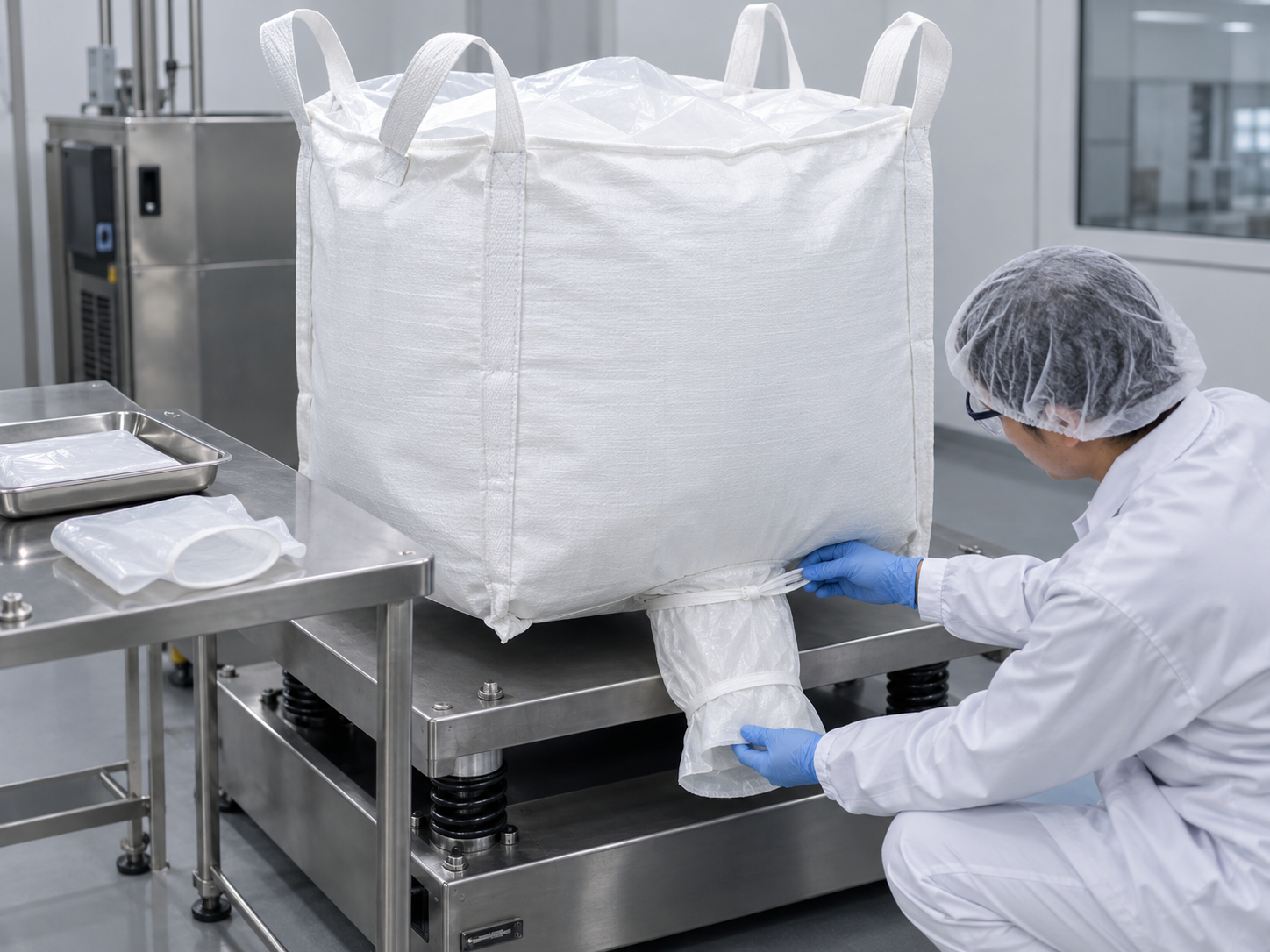
It is common for a bag to look acceptable at the filling line and fail later. There are several reasons.
First, residual powder from filling may remain on the outside of the bag. It can become more obvious after handling or after the bag has been exposed to moisture. That does not always mean the bag is leaking continuously.
Second, vibration and compression can move powder into paths that were not visibly open at rest. A filled bag flexes during lifting, stacking and vehicle movement. This can change the local pressure around seams, closures and liner folds.
Third, closures can loosen or shift. A tie or closure that is correct at the filling station may not remain in the same position after the bag has settled under load.
Fourth, air movement inside the bag can carry fine particles toward an opening. Once powder reaches a seam or closure, the visible dust may appear at a location that is some distance from the original source.
For a controlled transport trial, random-vibration testing of filled shipping units such as ASTM D4728 can provide a repeatable input . It should not be presented as a universal sift-proof certification. The test value comes from reproducing a relevant distribution condition and inspecting the complete package for the failure mode under investigation.
Build a leak map from the evidence
Before changing the bag, build a simple leak map. Use a clean, contrasting surface under the bag and inspect it at fixed points:
Immediately after filling and closure.
After lifting and a short settling period.
After the planned stack or storage period.
After the transport simulation or a representative road journey.
After opening and discharging.
At each point, photograph the same zones: fill spout, top seam, side seams, corners, base, discharge spout and the area between the liner and the outer bag. Record whether the powder is loose dust, a compacted line, a stain or a larger accumulation.
Then ask:
Does the powder appear only on one bag or across a production lot?
Does it appear only on bags filled on a particular line or shift?
Is it concentrated at a closure, a seam or a damaged area?
Is the amount increasing with time, load or vibration?
Is the powder the same colour and texture as the bulk material?
Is it present on an unused bag from the same lot, which would suggest handling or storage contamination?
These observations help separate an external contamination issue from a package leak and a material-handling problem from a construction problem.
Test the complete package
A useful trial does not test a piece of fabric in isolation. It tests the same combination that will be supplied: outer bag, fabric and coating, seam construction, liner, liner attachment, fill spout, discharge spout and closures.
1. Use a representative powder
Use production material with its normal particle-size distribution, including fines. If the material changes by grade or supplier, test the grade with the highest dust or leakage risk. Record moisture content and temperature at the time of filling.
2. Replicate the filling condition
Use the intended filling equipment and rate where practical. Record fill weight, fill time, bag shape, visible dust and any powder trapped in the top closure. Do not fill a sample slowly by hand and assume the result applies to a high-rate production line.
3. Close the bag as it will be shipped
Use the production closure method. If the liner must be extended, folded, tied or secured, record the method and who performs it. Take photographs of the closed fill spout and discharge spout.
4. Apply the handling and transport conditions
Include lifting, stacking and a relevant transport simulation. ASTM D4728 or another agreed method can be used where appropriate, but the trial plan should state the vibration level, duration, orientation and inspection points . A road trial can provide useful field evidence, but it needs a defined route and recording method.
5. Inspect before discharge
Inspect the outside of the bag, the seams, the closures and the liner-to-bag interface. If the liner can be accessed safely, check for powder between the liner and the outer bag. Do not open a production bag in a way that creates a dust or static hazard.
6. Discharge under controlled conditions
Record whether the liner moves, whether powder accumulates at the outlet, whether the spout remains clear and whether residual material remains in folds. A containment solution that leaks during discharge is not a complete solution.
7. Agree acceptance criteria in advance
The buyer and supplier should define what "pass" means before the trial. Possible criteria include:
no visible powder migration at agreed inspection zones;
no powder between the liner and the outer bag;
no measurable weight loss above an agreed limit;
no closure movement or liner displacement;
no damage to seams, coating or liner;
discharge performance within the agreed time and residue limit.
The exact limits should reflect the material value, hygiene requirement, dust hazard and customer specification. Do not borrow a number from another product or another supplier without confirming that the test conditions are comparable.
Choose the construction that controls the identified path
There is no single "best" sift-proof construction. The right choice depends on which path the trial identifies.
Uncoated woven FIBC. Useful where airflow is required and the material is coarse enough that migration through the weave is not the controlling risk. It is not the first choice for a fine powder that produces visible dust.
Coated FIBC. A coating or lamination reduces the open area of the woven fabric and is commonly used to reduce sifting . It may help with the bag body, but it does not replace seam control, closure control or a liner.
Sift-resistant seams. A filler cord or felt can reduce migration through stitch holes . The result depends on the seam design, the material and the quality of execution. It is not a reason to ignore the closures or the liner.
FIBC with a liner. A liner can separate the powder from the woven structure and reduce contact with the outer bag. It adds its own seams, openings, folds and attachment points. The liner must be compatible with the product, the filling and discharge process and any static-protective requirement.
Combined construction. For very fine, high-value or dust-sensitive powders, a coated outer bag, controlled seams, a fitted liner and a defined closure may be considered together. The combination should be justified by the leak map and the trial, not by the assumption that more layers are always better.
More protection can also create new problems. A liner can trap air, shift during filling, interfere with discharge or change the static behaviour of the package. A coating can reduce breathability. A tighter closure can be harder to operate consistently. The specification should balance containment with filling rate, discharge, cleaning and operator use.
What belongs in the specification
A purchase specification for a fine-powder FIBC should be specific enough to compare quotations and repeat the trial.
Product
material name and grade;
particle-size distribution and fines content;
particle shape and bulk density;
moisture content and filling temperature;
flow, dustiness, abrasion and static behaviour;
any food-contact, chemical-compatibility or hazardous-dust requirement.
Package construction
bag style, dimensions and safe working load;
fabric weight and weave;
coated or uncoated construction;
seam type and whether a filler cord or felt is used;
fill spout, discharge spout and closure design;
liner material, structure, fit and attachment;
static classification and liner compatibility where applicable;
printing, identification and any regulatory marking.
Process and route
filling equipment and fill rate;
target fill weight and fill height;
lifting, stacking and storage conditions;
transport mode, duration and handling points;
discharge equipment and acceptable residual material;
single-trip or reuse conditions.
Acceptance
trial sample size and production lot;
test method and conditions;
inspection zones and photographs;
weight-loss or dust criteria;
liner and closure inspection;
approval signature and change-control requirements.
"Sift-proof FIBC required" is not a complete specification. The buyer should be able to explain which path is being controlled, how the complete package will be tested and what result will be accepted.
Conclusion
"Sift-proof" is a useful construction term, but it is not a promise that a fine powder will remain inside every bag under every condition. The bag body, seams, fill spout, discharge spout, liner and handling points all offer different paths. The powder's particle-size distribution and the filling process determine how easily those paths become visible.
The practical approach is to locate the leak before changing the construction. Inspect the bag at filling, after handling and after transport. Use the real powder and the complete bag-and-liner system in a representative trial. Then choose coating, seam construction, liner and closures to control the path that actually failed.
That evidence is more useful than a generic claim that a bag is "leak-proof." It gives the buyer a repeatable specification and gives the supplier a clear basis for improvement.
If you are evaluating a fine-powder application, review our guides to FIBC liner selection and filling and discharge options, or contact FIBC World with the powder data, current bag and liner construction, filling method, discharge equipment, route and photographs of where the powder first appears. The final construction should be confirmed through a representative trial and technical review.
Related News
Other news you might be interested in
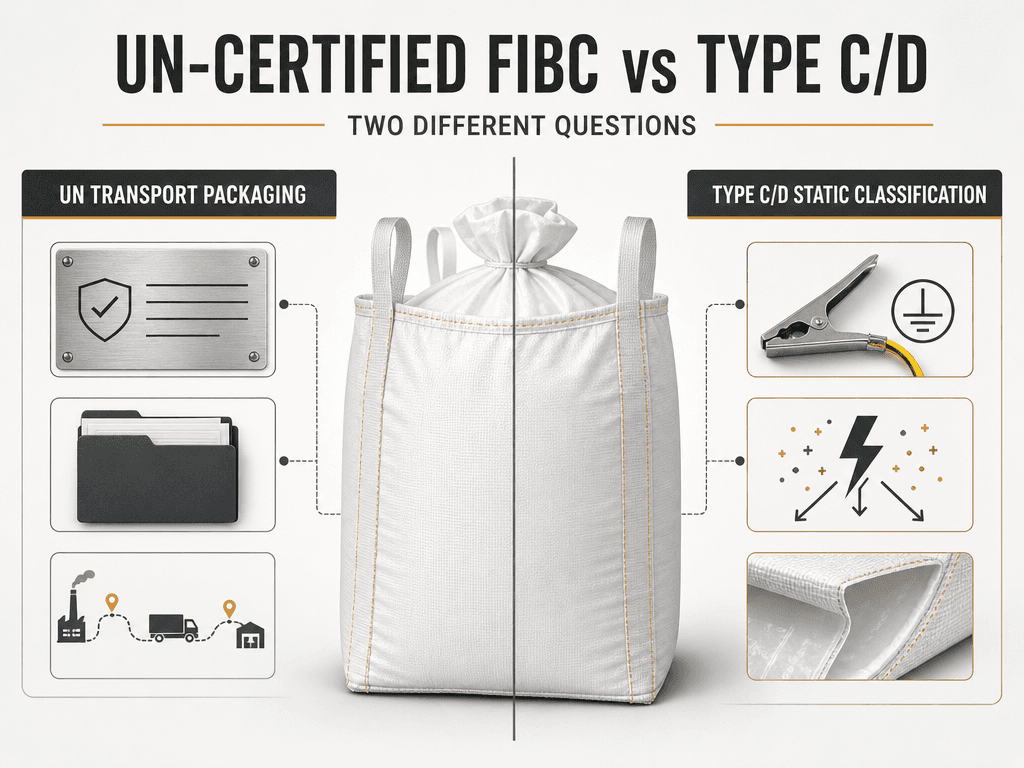
UN-Certified FIBC vs Type C/D Anti-Static Bags: What Chemical Buyers Need to Verify
Chemical buyers often see two labels on the same FIBC quotation: “UN-certified” and “Type C” or “Type D.” They sound like alternative grades of the same thing. They are not.The UN mark answers a transport-packaging question: has this packaging design been tested and marked for the dangerous goods and transport conditions it is intended to carry? Type C and Type D answer a different question: how does the FIBC behave when static electricity could create an ignition risk in a hazardous atmosphere?A bag can carry a UN mark without being suitable for a particular combustible-dust environment. It can also be designed as Type C or Type D without having a UN packaging approval. In some chemical applications, both requirements apply—but each has to be verified separately.
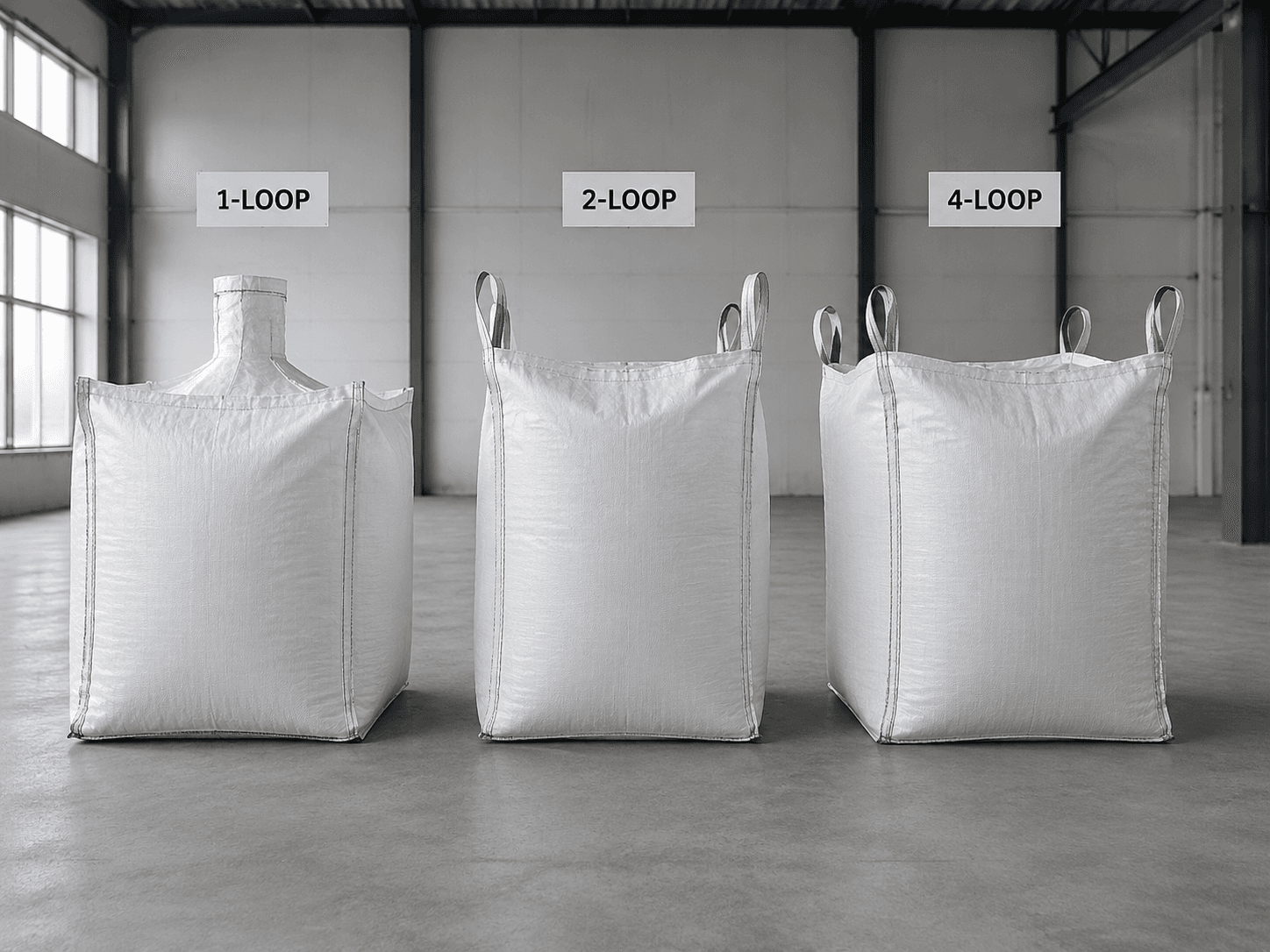
1-Loop, 2-Loop or 4-Loop FIBC: How to Choose Lifting Loops for Your Handling Equipment
The number of lifting loops on an FIBC tells you how the bag is intended to connect to lifting equipment. It does not, by itself, tell you the bag’s capacity or safety level. A one-loop bag, a two-loop bag and a four-loop bag can all be suitable for demanding work—provided the bag design, lifting equipment and operating procedure match.For buyers, the practical question is not “Which loop count is strongest?” It is “How will this bag be lifted, moved, filled and emptied at our site?” This guide explains the common loop configurations, the equipment checks behind each option, and the information to send before requesting a quotation.
Want to know more?
Get in touch with us for more information about our services and products.