
Bulk Bags by Application: Minerals, Fertilizer, Grain and Produce

Dayang Yang
AuthorWith experience in FIBC bulk bag manufacturing and export sales, we operate our own production facility with stable large-scale capacity. We are specialists in bulk bags, conductive FIBCs, food-grade FIBCs, UN certified bags, and customized flexible intermediate bulk containers for industrial packaging and bulk material transportation solutions.
A mineral concentrate, a fertilizer blend, a load of wheat and a load of onions can all be packed in a bulk bag. They should not all be specified the same way.
On a quotation, each may appear as a one-tonne FIBC with a top opening and a discharge spout. In service, the loads behave differently. A dense mineral concentrate can reach its target mass at a low fill level and concentrate stress in the base and seams. A hygroscopic fertilizer can pick up moisture, cake and block the outlet. Grain can arrive dry but become unacceptable if condensation, pests or contamination are not controlled. Fresh produce can lose quality through heat, condensation and handling damage even when the bag itself remains intact.
For buyers, the application is a useful starting point. It is not a specification. It tells the supplier which failure modes to investigate first; the material, equipment and route then determine the bag, liner, openings, lifting arrangement and evidence required. This guide compares bulk bags for minerals, fertilizer, grain and produce, and sets out what changes between them.
Why Application Changes the Bulk Bag Specification
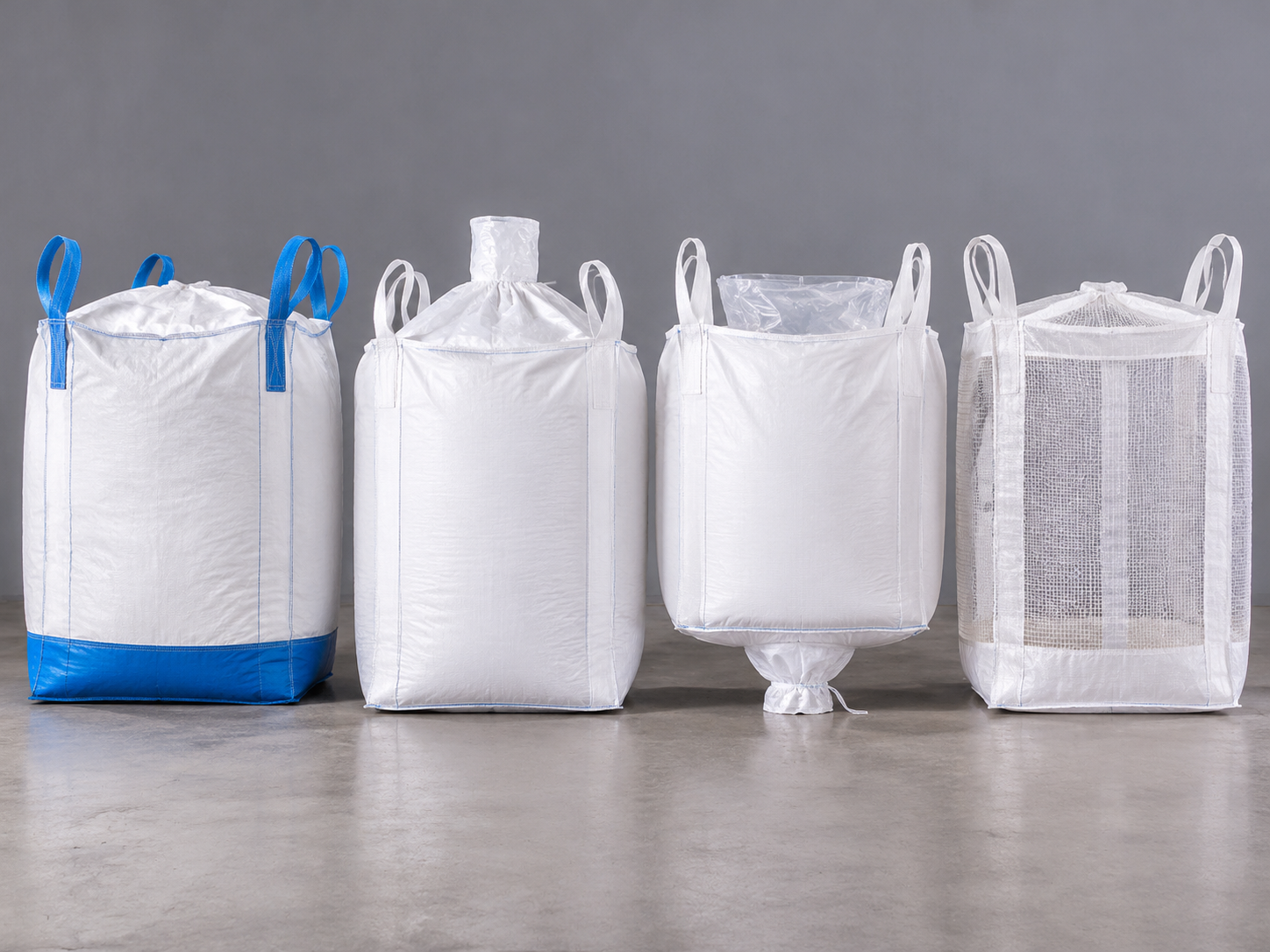
A bulk bag, also called an FIBC, jumbo bag or ton bag, is a system. It includes the woven body and seams, any coating, the liner, the top and bottom openings, closures, lifting loops, base reinforcement and markings. Two bags can look identical in a photograph and differ in every one of those elements.
The application does not decide the specification by itself. It narrows the questions. A buyer should still map six interfaces:
Material: bulk density, particle size, flow behavior, moisture sensitivity, abrasion, temperature and hazard classification.
Filling: open top, duffle, spout, fill rate, dust level and deaeration.
Lifting: crane, hoist, forklift or telehandler; loop pattern, load angle and available headroom.
Storage and transport: stacking, pallet or container plan, climate, duration and UV exposure.
Discharge: flat bottom, spout or full-open base; receiving equipment and acceptable residual product.
Compliance: non-dangerous or dangerous goods, food or feed contact, static classification and destination-market rules.
The first question changes with the application, because the load and the route create different risks.
| Application | What the load does | Primary failure mode to investigate | First question for the supplier |
|---|---|---|---|
| Minerals | Dense, abrasive or dusty; often variable in particle size | Base or seam wear, loop loading, overweight at low fill, dust escape | What are the bulk density, target fill mass, particle form and transport classification? |
| Fertilizer | Hygroscopic, dusty or caking; chemistry varies by grade | Moisture pickup, caking, blocked outlet, liner movement | What is the exact grade or blend, and where does moisture enter the route? |
| Grain | Dry, flowable and food- or feed-related; often stored for weeks or months | Moisture migration, insects, contamination, leakage, poor discharge | Is the grain within its intended storage condition, and what protection does the route require? |
| Produce | Living, respiring and easily damaged | Condensation, heat buildup, bruising, blocked ventilation | What airflow, temperature management and handling does this produce need? |
The rest of this article follows that difference. It does not list every product that can go into an FIBC. It explains why four applications that share the same format need different design priorities.
Minerals: Start With Weight, Then Design for Wear
Mineral bulk bags may carry sand, crushed rock, mineral sands, bentonite, barite, gypsum, iron ore, copper concentrate or other ores and concentrates. These materials range from coarse and abrasive to fine and dusty, and from non-dangerous-goods cargo to regulated dangerous goods. Transport classification is separate from workplace dust hazard.
Calculate the volume from bulk density
“One tonne” describes mass. A bag has usable volume. The relationship is:
Approximate volume = target fill mass ÷ bulk density
At 1,000 kg, a material with a bulk density of 0.8 kg/L needs about 1.25 m³ before filling efficiency and headspace are considered. At 1.6 kg/L, the same mass needs about 0.625 m³. Neither number proves that a particular bag is suitable, but the difference shows why a nominal one-tonne bag cannot be selected from a label.
A dense mineral may reach its target weight low in the bag, creating a concentrated load and a different filled shape. A light mineral powder may reach the top of the bag before the target weight is reached. The specification should begin with the target weight range, bulk density at filling, required filled dimensions, safe working load and safety factor. The bag should then be verified for the actual load and lifting method, not only for a capacity name.
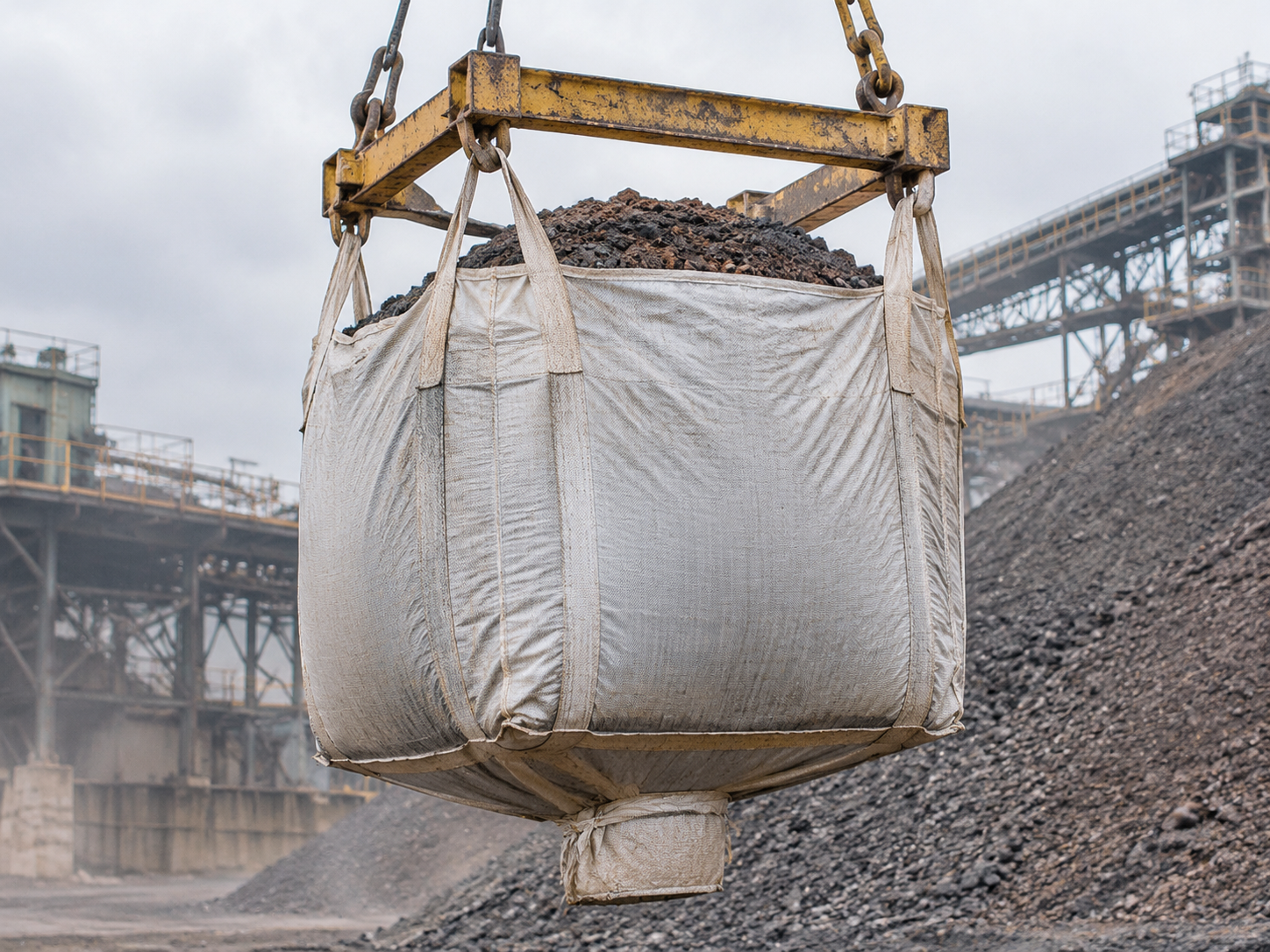
A photograph of an empty bag does not show how it will stand, bulge or load its base after filling. Ask for the proposed filled dimensions and check them against the pallet, container, storage bay and discharge station.
Design for abrasion, dust and moisture
Coarse minerals wear the base, seams and discharge spout. A reinforced base, suitable fabric, protected seams and a spout designed for the duty may be more important than a general “heavy-duty” description. The correct construction still depends on particle shape, drop height, fill rate and how the bag is moved.
Fine minerals create a different problem. Dust can escape through seams, openings and fabric if the package is not designed for it. Sift-proof seams, a coated fabric or a liner, a dust-tight filling connection and a suitable outlet may need to be reviewed together. A liner that is not fixed or does not match the spout can move during filling or obstruct discharge.
Moisture matters for some minerals and not others. Bentonite and some mineral fillers can absorb water and change handling behavior; other coarse minerals may be less sensitive. State the actual sensitivity and the storage route. A coated bag or liner can reduce exposure, but it does not make the bag waterproof, and it does not repair material that was already wet.
Match the lift and the discharge point
Mineral bags are often handled by crane, forklift or telehandler. The loop pattern, loop attachment, base reinforcement and load angle should match the equipment and the site procedure. A bag with four loops is not automatically suitable for every lifting method, and a bag described as “one tonne” is not automatically rated for the intended lift.
Discharge deserves the same attention. A flat-bottom bag may suit a process that tips or opens the base. A discharge spout may support controlled emptying into a hopper, conveyor or mixer. The outlet size, height, liner arrangement and receiving equipment have to work together. A bag that fills well can still bridge, retain product or release an uncontrolled dust cloud when it is emptied.
Confirm the transport classification
Some ores, concentrates and mineral-derived products are classified as dangerous goods because of toxicity, self-heating or another hazard. Start from the safety data sheet and the formal transport classification; the UN number, packing group, concentration and mode of transport determine whether UN-tested and marked packaging is required and which package is permitted.
A heavy-duty bag is not automatically a UN bag. Ask for evidence that the specific bag design, liner and marking match the product classification and transport mode. If the mineral dust is combustible or the site has a hazardous atmosphere, the static assessment is a separate question. UN marking, static classification and general product quality are not interchangeable.
Fertilizer: Design for Moisture, Caking and Closure
Fertilizer is a major FIBC application, but the word itself is not a specification. Urea, ammonium sulfate, monoammonium phosphate, diammonium phosphate, potash, NPK blends and ammonium nitrate grades do not behave in the same way. They differ in moisture sensitivity, caking tendency, dust, corrosiveness and transport classification.
Specify the grade, not just “fertilizer”
A supplier cannot select a liner or closure from the word “fertilizer.” The buyer should provide the product name and grade, the blend composition if applicable, the safety data sheet, the intended storage and transport route, and the current failure. If the product is a blend, the components and their proportions matter.
The same product name can also cover different grades or production conditions. That is why a specification copied from another supplier or another plant should be treated as a starting point, not as an approved design.
Moisture and caking are route problems
Many solid fertilizers are hygroscopic to some degree and can take up moisture from humid air. For a given grade—or the limiting component of a blend—at a given temperature, a critical relative humidity can be identified. Above that level, net moisture uptake can occur; below it, risk is lower but not eliminated. Values and practical behavior vary with composition, impurities, temperature and any coating, so supplier data should be used for the actual grade or blend.
Caking is not caused by moisture alone. Storage time, stack pressure, temperature cycling, fines, blending and handling can all contribute. A fertilizer bag liner can reduce one route for moisture entry, but it does not replace a dry store, a sound closure or appropriate handling. It also cannot reverse caking that has already occurred.
The existing guide to fertilizer bulk bags with liners explains how to assess moisture, caking and discharge in more detail. The key point here is that the bag is only one part of the protection route.
Treat coating, liner and closure as one system
A coating can reduce airflow and product migration through the fabric, but it is not automatically equivalent to a separate liner or a complete moisture barrier. A separate liner adds another layer, but its material, shape, attachment and closure still have to suit the filling and discharge equipment.
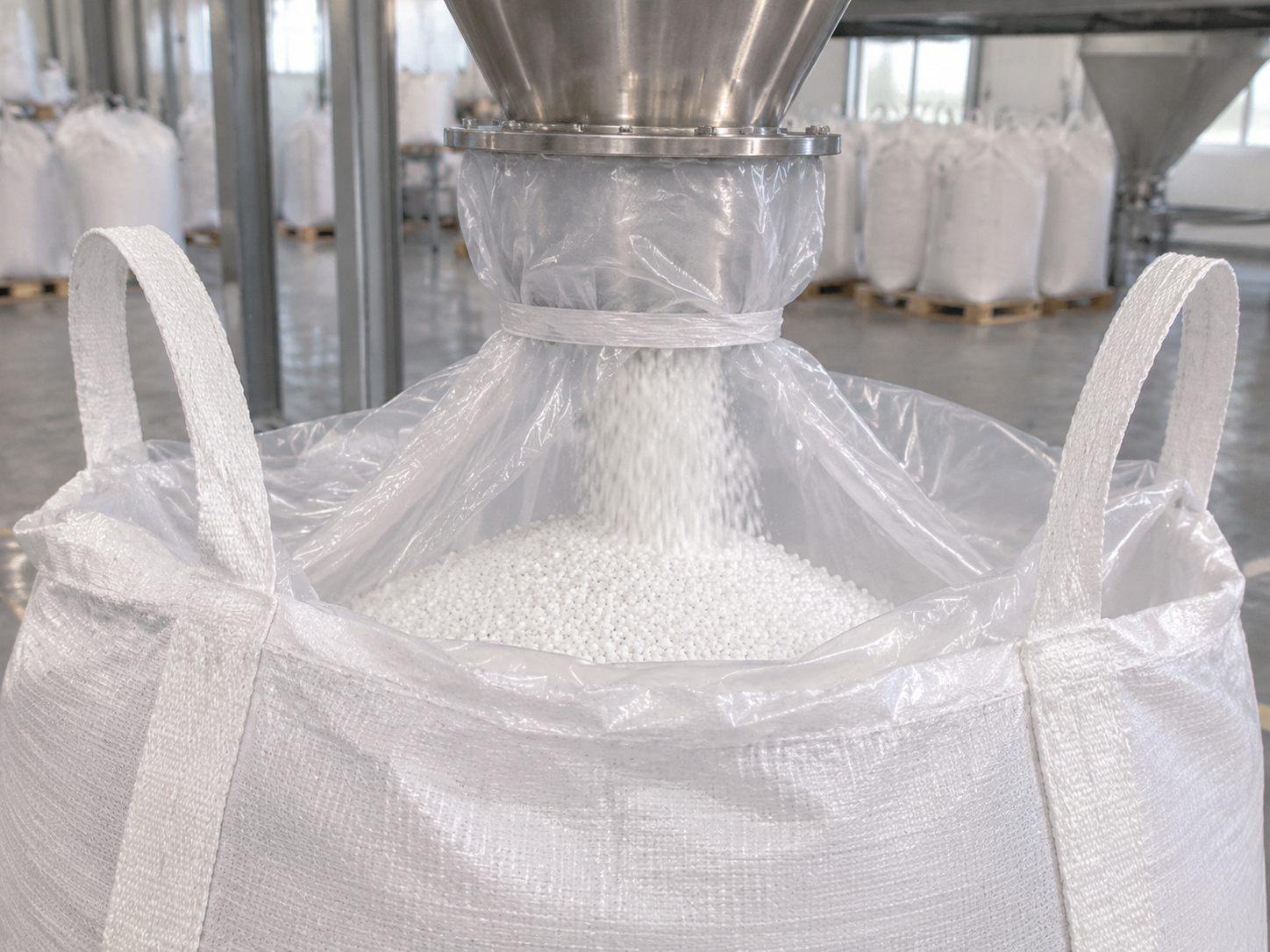
Fixing is part of the design. A liner that is not properly secured can pull out during discharge or move into the product stream. The liner neck has to align with the filling spout, and the outlet has to allow the liner to collapse without blocking the flow. If heat sealing is proposed, confirm that the laminate is suitable for the available equipment and that the sealing conditions are defined. A tied liner and a heat-sealed liner are not the same specification.
Not every fertilizer needs a separate liner. A coated or uncoated bag may be sufficient when the product is less sensitive, the route is short and the storage conditions are controlled. The decision should be made from the grade, the route and an agreed acceptance test, not from a generic “moisture-proof” claim.
Check the outlet and the UN route
Fertilizer can cake, bridge or discharge unevenly. The outlet size, spout position and, if a liner is used, liner length should be reviewed with the receiving equipment as one interface. A larger outlet is not automatically better if the receiving station cannot control the flow. A smaller outlet is not automatically safer if it slows the line or retains product.
Some fertilizer grades and blends are regulated dangerous goods. The safety data sheet, UN number, packing group and transport mode determine the packaging requirement. A standard agricultural bag is not a substitute for a UN-marked package, and a UN mark does not by itself prove that the bag is suitable for every fertilizer or every destination.
Grain: Keep It Dry, Clean and Flowable
Grain, as used here, includes cereals and other dry seed crops such as oilseeds and pulses. Examples include wheat, maize, rice, barley, oats, soybeans and seeds. It may be food, feed or planting material. It is usually dry and flowable, and it may be stored for weeks or months before processing, shipment or sale.
Grain is not fresh produce
Grain and produce are both agricultural, but their packaging priorities differ sharply. Grain is normally stored dry and handled as a flowable solid. Fresh produce is a living crop that continues to respire and is sensitive to heat, condensation and impact.
A ventilated bag may be useful for potatoes or onions. It is not the default choice for dry grain. Grain needs a clean, dry, pest-protected package and a storage plan. Whether the body is coated, uncoated or lined depends on the grain condition, climate, storage duration and any aeration or cooling strategy. A breathable body does not replace drying or controlled aeration, and a sealed liner is not automatically appropriate if the grain is warm or the bulk has a temperature gradient.
Dry grain must stay dry
Grain can enter a bag within an acceptable moisture range and still be damaged by condensation, leaks or humid storage. Temperature gradients can cause moisture to migrate within the grain mass, and condensation can form on cooler surfaces. The bag can slow or reduce exposure; it cannot dry the grain or correct a wet load.
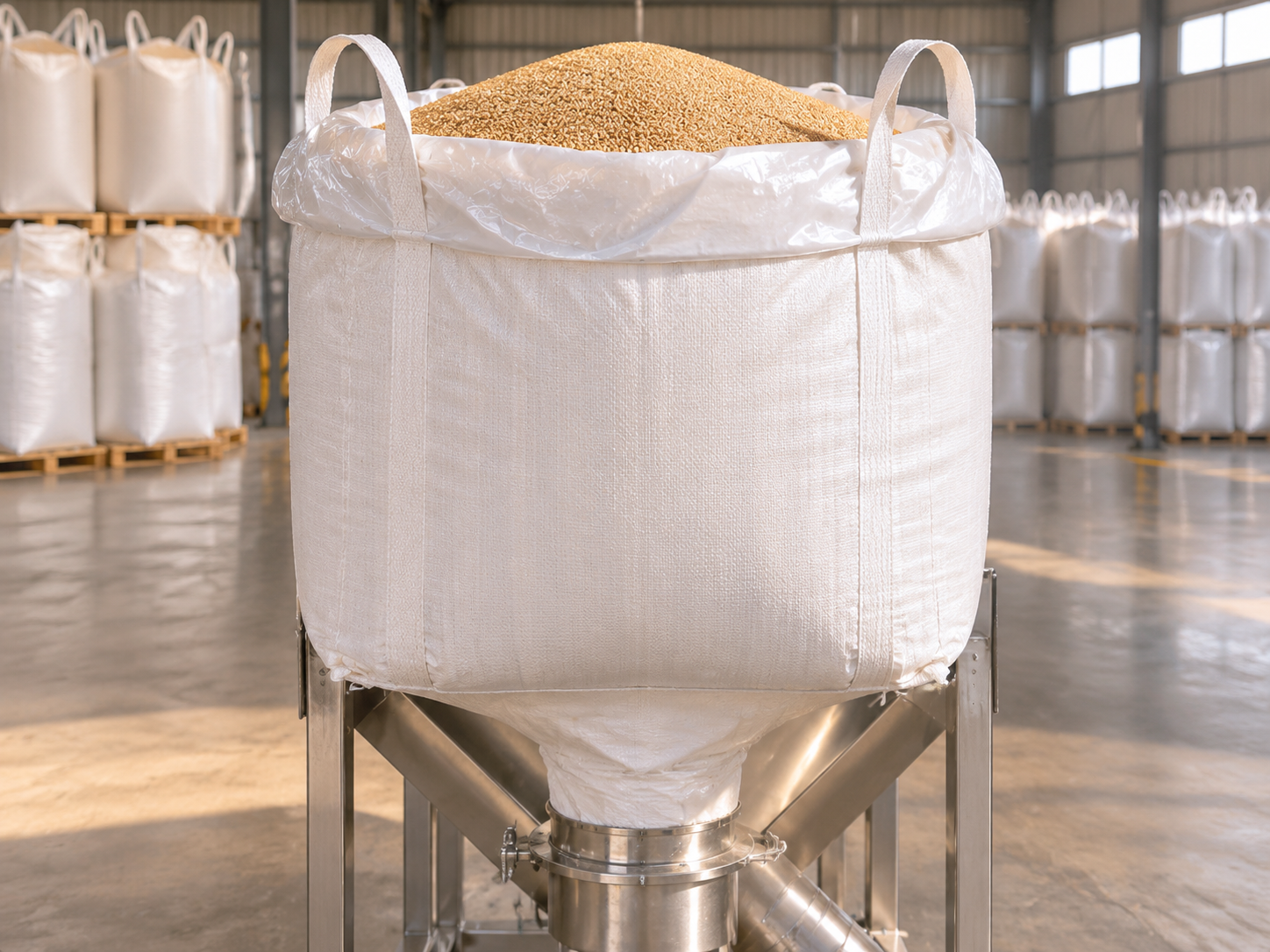
The storage plan is part of the packaging requirement. Bags should be kept on pallets or dunnage, under cover where needed, away from standing water and protected from rain. A coated bag or a clean liner, together with a closure that is actually used, can support protection. A liner that is torn, loose or left open at the neck defeats that protection.
Design for clean flow and discharge
Grain flows more readily than most powders, but fines, foreign material, moisture or a poorly fitted liner can still affect discharge. The outlet should match the receiving equipment, whether that is a pit, auger, conveyor, hopper or processing line. If a liner is used, it must be able to collapse without blocking the outlet or trapping a significant heel.
For grain that will be stacked or shipped in containers, the filled shape and footprint matter. A baffle or a stable flat-bottom construction may help the loading plan, but it does not create a stacking approval by itself. Stack height still depends on the bag design, safe working load, bulk density, storage time and site rules.
Specify food or feed evidence
The bag or liner may be the product-contact layer for grain intended for food or feed, depending on the market and the next step in the chain. Identify which layer contacts the grain and obtain the documentation required for that layer and destination. In the EU, the general food-contact framework includes Regulation (EC) No 1935/2004, with the plastics-specific rule in Regulation (EU) No 10/2011 where the contact layer is plastic. In the United States, confirm the applicable FDA food-contact status. The outer bag still has to be clean and fit for purpose.
A “food-grade” description in a brochure is not a substitute for a declaration that identifies the product-contact layer, its intended use and the conditions of contact. Feed applications may also require feed-hygiene controls. Cleaning, pest control, prior cargo and storage conditions remain part of the chain.
Produce: Design for Airflow, Heat and Damage
Potatoes, onions, garlic and similar whole produce are living products after harvest. They continue to respire, generate heat, lose water and respond to temperature, humidity and handling. A bulk bag can support their handling, but it does not create a storage environment by itself. It is also not a universal produce package: crops that are easily bruised or need a rigid tray may require a different container. Where produce is a direct food-contact application, identify the product-contact layer and confirm the documentation required for that crop and market.
Ventilation supports airflow, not shelf life
A ventilated FIBC uses mesh panels or open-weave sections to allow air movement through the ventilated sections and around the load. The purpose is to support air exchange and help manage heat and condensation around the produce. It is not a guarantee that the crop will stay fresh, and it does not replace temperature management, curing, drying or a suitable storage plan.
Produce quality also depends on pre-harvest condition, harvest maturity, injury, respiration rate, storage temperature, humidity and duration. A ventilated bag can be part of a sound handling system, but it cannot compensate for a warm load, a wet crop or a poor storage room.
Specify the airflow path and containment
“Ventilated” is not a complete description. Ask where the ventilation sections are located, how much of the bag is open to airflow, how the fabric is reinforced, and whether the smallest produce in the batch can escape through the openings. A more open construction is not automatically better. The bag still has to contain the crop and carry the load.
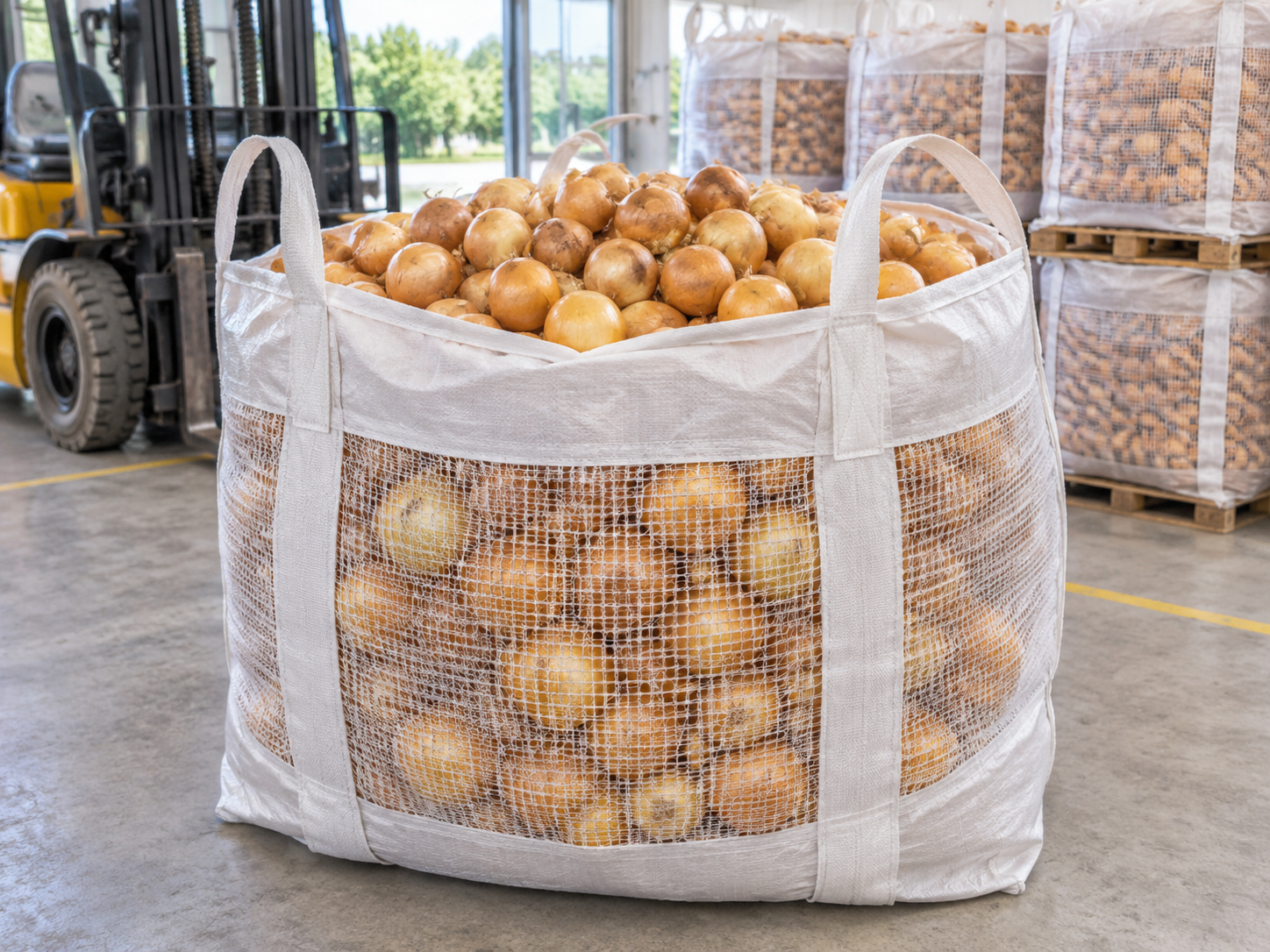
The filling and discharge method also affects the airflow path. Bags that are pressed together, stacked against a wall or covered by a liner may not receive the airflow the design intended. If a liner or coating is added, confirm how it affects ventilation. A fully lined bag is usually a different application, not an upgraded ventilated bag.
The existing guide to custom ventilated bulk bags for potatoes and onions covers ventilation construction, openings and sample approval in more detail.
Protect the produce during filling and discharge
Impact damage can occur before the bag is full. Drop height, filling equipment, the condition of the bag opening and the way the produce is directed into the bag all matter. The same applies at discharge: a rough outlet, an uncontrolled drop or a receiving bin that is too small can damage the crop.
For outdoor or shed storage, UV stabilization can help the fabric resist UV degradation, but it does not make the bag waterproof or indefinitely weather-resistant. Stacking should follow a rated plan for the bag, the crop and the storage period. A bag that looks stable when empty is not evidence that it can be stacked when full.
Trial the route, not just the bag
A produce trial should use representative produce and the actual filling, storage and unloading arrangements where possible. Check whether the bag contains the crop, whether the ventilation sections remain open, whether the filled shape is stable, whether condensation or heat is observed, and whether the produce is damaged during transfer.
Agree the acceptance criteria before the trial. A bag that looks correct when empty, or that is tested with the wrong produce size, does not demonstrate that the design will work in the packhouse or at the destination.
The Four Applications Side by Side
The table below is a starting point for the RFQ conversation. It is not a substitute for the material data, equipment details and trial that a specific project requires.
| Decision | Minerals | Fertilizer | Grain | Produce |
|---|---|---|---|---|
| First data | Bulk density, target mass, particle form, abrasion, hazard class | Grade or blend, moisture sensitivity, storage route, transport class | Moisture at filling, food or feed use, storage duration, pest plan | Produce type and size, harvest condition, storage temperature, handling route |
| Main risk | Base or seam wear, dust, overweight at low fill | Moisture pickup, caking, blocked outlet, liner movement if a liner is used | Moisture migration, insects, contamination, leakage | Condensation, heat, bruising, blocked vents |
| Body and base | Reinforced base, suitable fabric, protected seams | Coated or uncoated body, liner as required, secure closure | Clean body, coated or lined option, stable base | Ventilated panels or open-weave sections where the crop benefits from airflow; adequate body strength |
| Top | Open top or duffle for fast fill; spout for dust control | Filling spout or duffle; liner neck alignment if a liner is used | Filling spout or duffle; dust and contamination control | Open top or duffle; gentle filling and produce retention |
| Bottom | Flat bottom or discharge spout for the receiving point | Discharge spout with a liner that collapses cleanly, if a liner is used | Discharge spout sized for the receiving equipment | Flat bottom, open base or spout for controlled unloading |
| Protection focus | Dust, moisture, contamination, weather | Moisture, caking, dust, closure integrity | Moisture, pests, contamination, odor | Airflow, condensation, impact, UV exposure |
| Lifting | Crane or forklift; loop pattern and base reinforcement | Crane or forklift; spout must not be trapped, and any liner must stay clear | Forklift or crane; pallet and container plan | Forklift or crane; gentle handling and stable stacking |
| Compliance focus | UN if the mineral is a dangerous good; static assessment where needed | UN for applicable grades; destination rules | Food- or feed-contact evidence; destination rules | Food-contact evidence where required; produce-market rules |
| Trial focus | Fill weight, filled shape, lift, abrasion, discharge | Fill, liner position if used, closure, storage, caking, discharge | Fill, moisture protection, pest control, flow, residual | Ventilation, produce damage, condensation, stacking, unloading |
Common Specification Mistakes
Treating “one tonne” as a specification. A tonne is a target mass, not a bag volume, safe working load, filled dimension or liner requirement.
Choosing the bag before deciding whether a liner is needed. A liner changes the filling neck, outlet, closure and discharge path. If one is used, it should be designed with the bag, not added after the bag is approved.
Using ventilation for the wrong cargo. Fine minerals do not become safer in a breathable bag. Grain that needs moisture protection does not either; ventilation is not a substitute for a storage plan and can admit moisture or insects.
Assuming a coating is a complete barrier. A coating can reduce airflow and product migration, but it is not automatically equal to a separate liner or a moisture-proof package.
Treating UN, food contact and static classification as interchangeable. They are separate frameworks with separate evidence. One does not prove another.
Treating grain and produce as one agricultural application. Grain generally needs dryness and protection; produce that benefits from ventilation needs airflow and damage control. The same “agricultural bag” language can lead to the wrong construction.
Ignoring the receiving equipment. The product can still bridge, block or discharge too quickly at the other end of the route.
Approving an empty sample. The useful trial uses the real material, a representative bag and liner, the actual filling and lifting method, and a discharge arrangement close to the production process.
What to Send for Each Application
Common fields such as target fill weight, bag dimensions, filling and discharge equipment, lifting method and destination are always useful. The four application-specific groups below are what most often change the technical proposal.
| Application | Send these details | Confirm before quotation |
|---|---|---|
| Minerals | Bulk density, target mass, particle size and shape, abrasion, transport class, lifting method, discharge point, required filled dimensions | Whether UN-tested and marked packaging is required; whether dust or static risk needs a separate assessment; current base, seam or spout failure |
| Fertilizer | Exact grade or blend, safety data sheet, moisture exposure, storage duration, liner and closure preference, transport class | Whether a liner is needed at all; if so, how it will be fixed and closed; whether the outlet suits the receiving equipment; UN status |
| Grain | Moisture condition at filling, food or feed use, storage duration, pest plan, aeration or cooling strategy, discharge equipment | Which layer contacts the grain; what documentation that layer requires; whether a coated, uncoated or lined body suits the route |
| Produce | Crop and size range, harvest condition, airflow requirement, storage temperature and duration, filling and unloading method | Ventilation construction, produce retention, stacking plan, UV exposure and food-contact documentation where required |
Photographs of the filling head, lifting equipment, storage area and discharge station are often more useful than a catalogue number. A current bag drawing with a revision number is more useful than “same as last time.” If a liner is used, send the liner drawing as well.
Qualify the Application With a Trial
The trial should reproduce the application-specific risk, not only the bag dimensions. Use the intended material or a representative lot, the proposed bag and liner, the actual filling equipment and the planned lifting and discharge method.
Minerals: fill to the target mass, measure the filled shape, inspect the base and seams after lifting, and check abrasion, dust and residual product at discharge.
Fertilizer: check the liner path and closure if used, the fill rate, the storage condition, caking risk and whether the outlet remains clear.
Grain: check moisture protection, pest control, flow, residual product and the product-contact documentation for the intended use.
Produce: check whether the crop is retained, the ventilation sections remain open, condensation or heat is observed, and the produce is damaged during filling, storage and unloading.
Record the bag drawing revision, liner revision, material lot, equipment settings and the person who accepted the result. An empty-bag inspection can confirm dimensions and workmanship. It cannot show how the material will fill, load, store or discharge. If the bag, liner, spout, closure or handling method changes, the previous approval may no longer apply.
Conclusion
Minerals, fertilizer, grain and produce share a bulk bag format but not a bulk bag specification. Minerals put density, abrasion and lifting at the center of the design. Fertilizer adds moisture, caking, closure and transport classification. Grain requires dryness, cleanliness, pest control and reliable flow. Produce requires airflow where the crop benefits from ventilation, plus heat management and protection from impact.
The application tells a buyer what to ask first. The material and the route determine what can be approved. Starting with the application, rather than with a catalogue size, leads to a more useful quotation and a trial that tests the real risk.
To review a bulk bag project, describe the application and the failure you need to avoid. For a mineral, include density, abrasion and transport class. For a fertilizer, include grade, moisture route, liner or closure requirement and UN status. For grain, include moisture condition, food or feed use, storage duration and pest plan. For produce, include crop, size, airflow requirement, storage temperature and handling method. FIBC World can then review the bag and liner configuration and identify what must be tested. The standard FIBC range, the ventilated FIBC range and the form-fit liner range cover the main configuration families discussed here.
Related News
Other news you might be interested in
What Is a Super Sack? FIBC vs Bulk Bag vs Jumbo Bag Explained
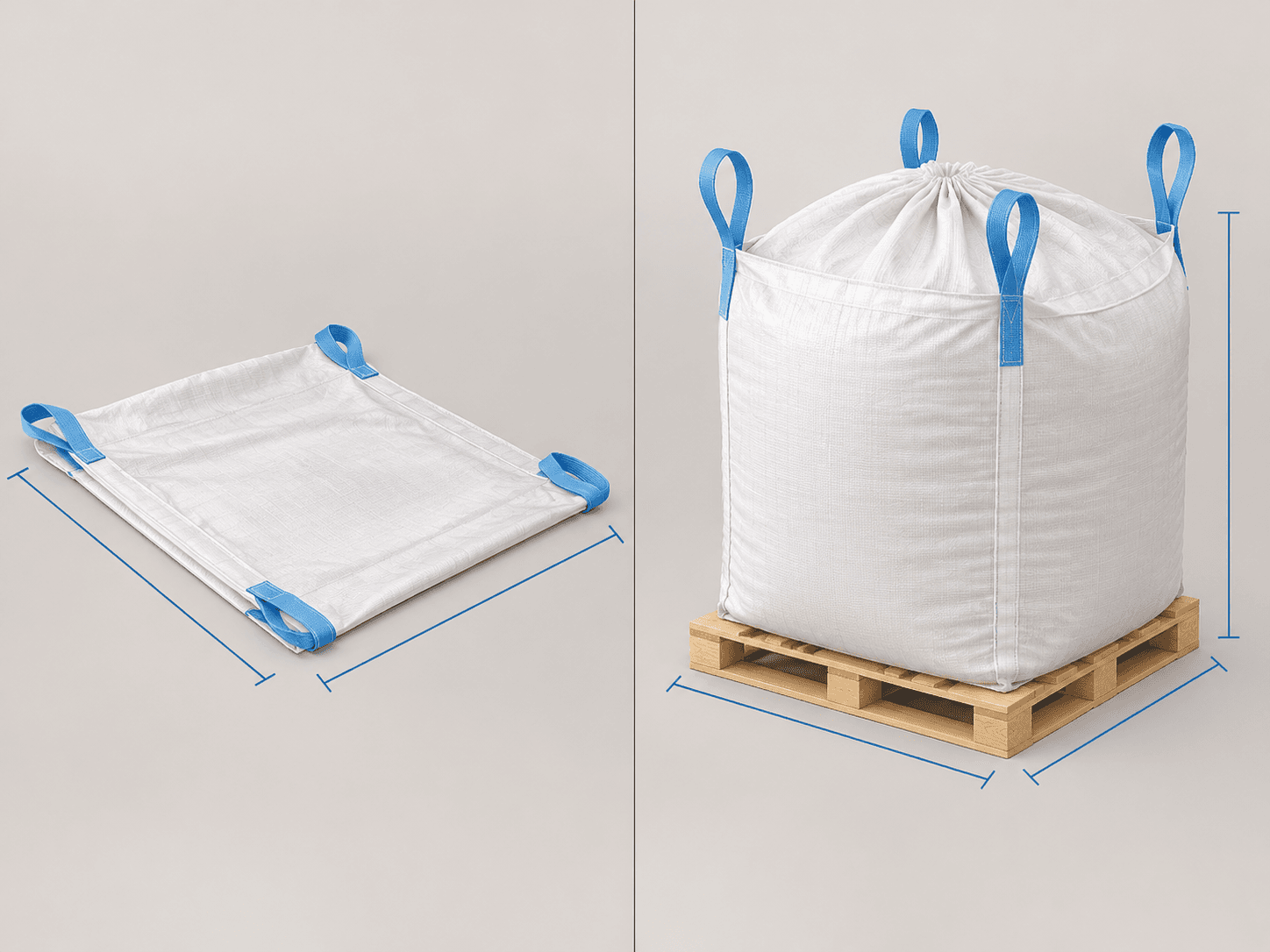
A buyer searches for a “super sack.” The supplier replies with an FIBC quotation. The drawing is titled “jumbo bag.” The warehouse calls it a bulk bag. Four names, one object—usually.The words are not identical in status. FIBC is the technical term used by standards and industry guidance. Bulk bag, big bag, tote and jumbo bag are trade terms. Super Sack® is a registered trademark, not a generic name for every large woven bag.That distinction matters when a purchase order, a drawing or a customs document uses one term while the supplier uses another. The label helps you find the product family. It does not tell you the safe working load, the filled dimensions, the liner, the lifting arrangement or the compliance route. Those have to be specified.
Affordable FIBC Solutions for Small Businesses
A small business can need bulk bags for reasons that have nothing to do with its size. A family farm may pack a few hundred ventilated bags during harvest. A feed mill may use one pallet of standard bags a month. A food-ingredient repacker may need a moisture barrier for a sensitive powder but cannot justify a full container of custom-printed bags. A landscaping supplier may ship aggregates in the same bag size all year. In each case, the search for an affordable FIBC runs into the same obstacles: minimum order quantities, custom setup costs, freight charges and quotations that are difficult to compare.
Want to know more?
Get in touch with us for more information about our services and products.