
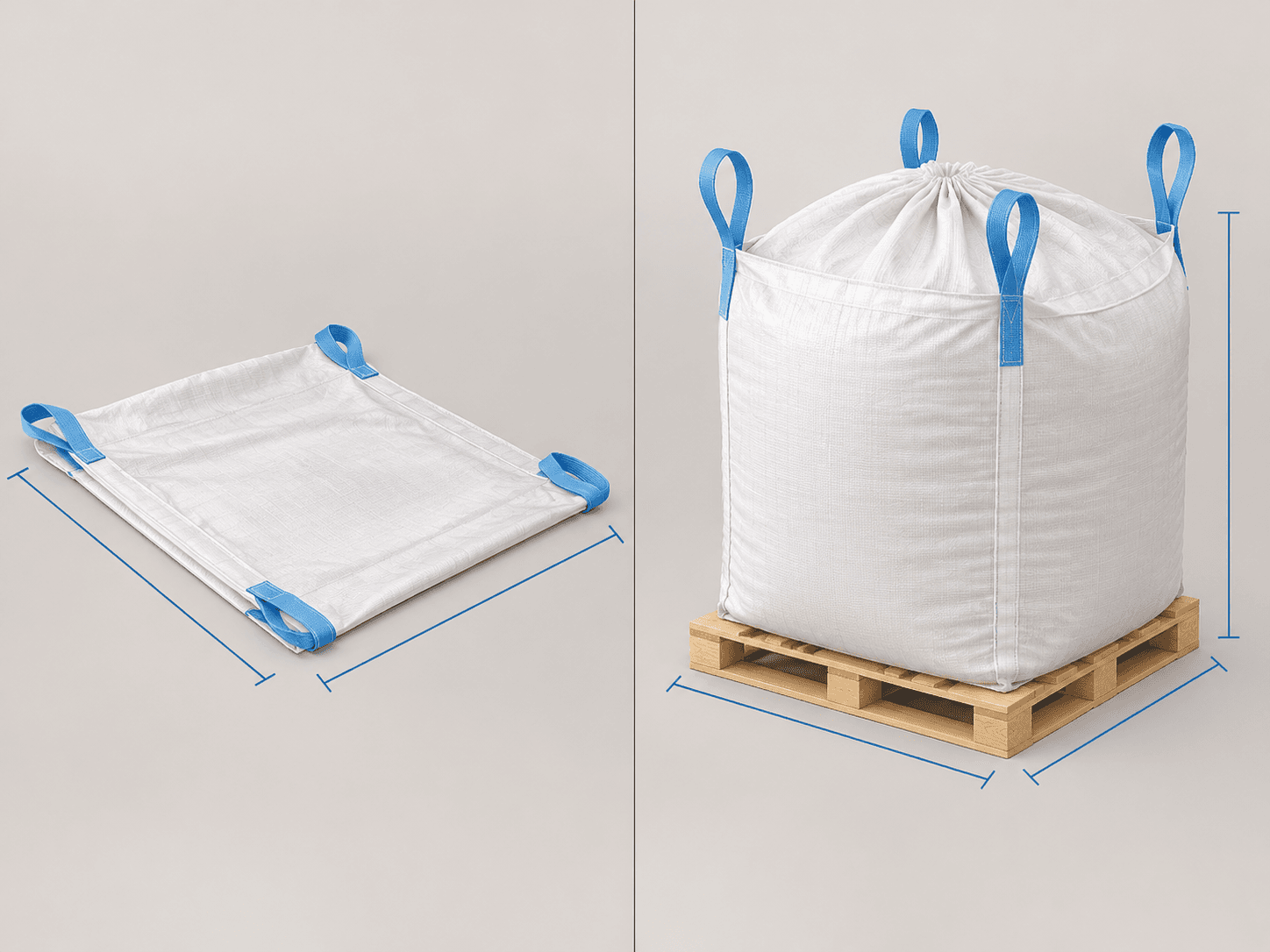
What Is a Super Sack? FIBC vs Bulk Bag vs Jumbo Bag Explained

Dayang Yang
AuthorWith experience in FIBC bulk bag manufacturing and export sales, we operate our own production facility with stable large-scale capacity. We are specialists in bulk bags, conductive FIBCs, food-grade FIBCs, UN certified bags, and customized flexible intermediate bulk containers for industrial packaging and bulk material transportation solutions.
A buyer searches for a “super sack.” The supplier replies with an FIBC quotation. The drawing is titled “jumbo bag.” The warehouse calls it a bulk bag. Four names, one object—usually.
The words are not identical in status. FIBC is the technical term used by standards and industry guidance. Bulk bag, big bag, tote and jumbo bag are trade terms. Super Sack® is a registered trademark, not a generic name for every large woven bag.
That distinction matters when a purchase order, a drawing or a customs document uses one term while the supplier uses another. The label helps you find the product family. It does not tell you the safe working load, the filled dimensions, the liner, the lifting arrangement or the compliance route. Those have to be specified.
What Is a Super Sack?
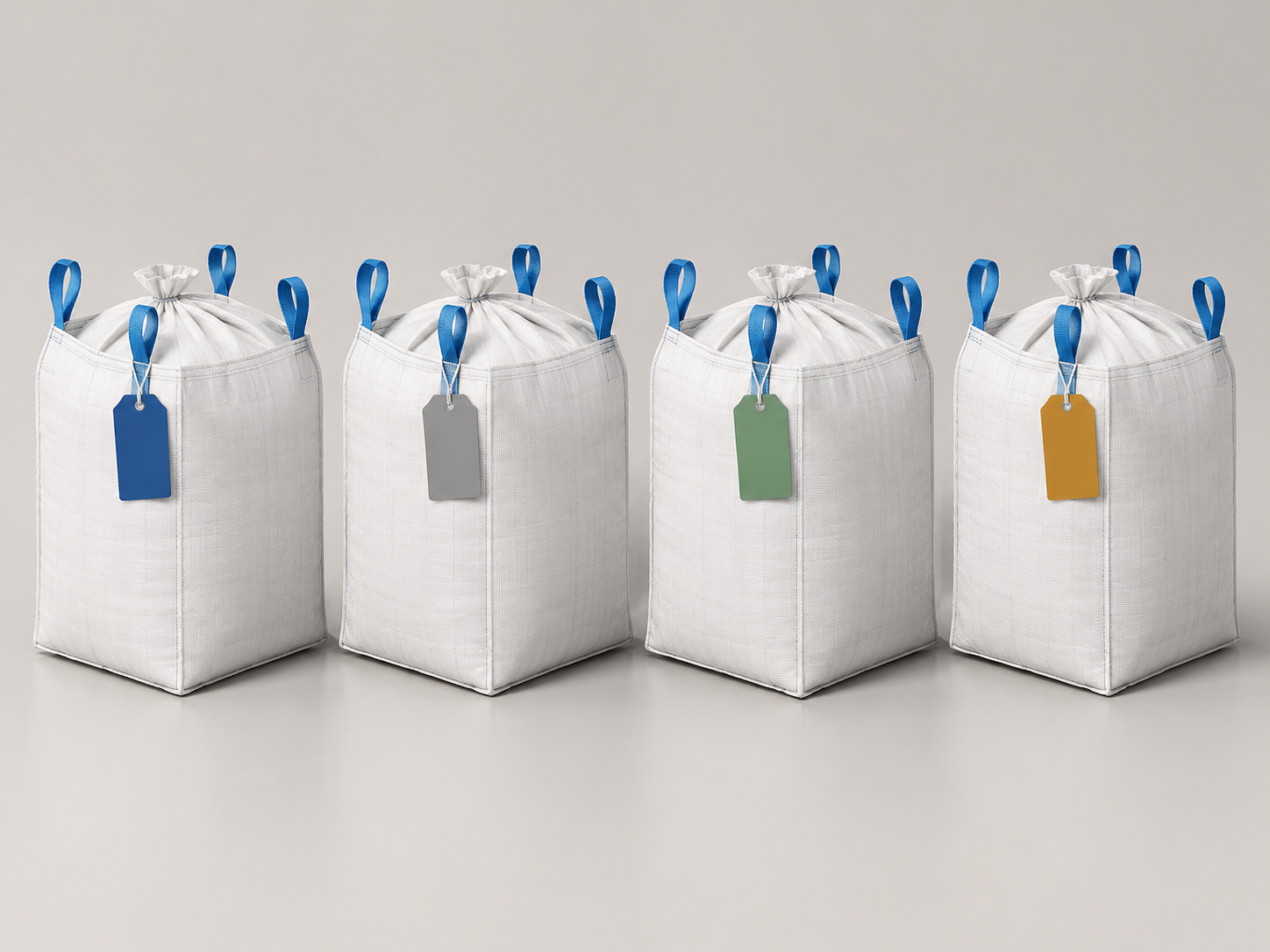
A Super Sack® is a branded FIBC sold by BAG Corp, a United Bags brand. BAG Corp's current product page states that “SUPER SACK® is a Registered Trademark of United Bags” and describes BAG Corp as “the originator and only source of the SUPER SACK®” . That is a brand statement, not an industry-wide product definition.
In construction, a Super Sack® is an FIBC: a large flexible container with a woven body, designed to be lifted from above and used for bulk solid materials. In everyday buying, people often say “super sack” when they mean any FIBC, the same way a brand name can become shorthand for a product category. The shorthand is common; it is still not a specification.
The shortest useful answer is:
Super Sack® is a brand.
FIBC is the technical category.
Bulk bag, big bag, tote and jumbo bag are trade names that usually refer to an FIBC.
The specification—not the name—determines whether the bag fits your product and plant.
If you need a quote, ask for an FIBC to a defined duty. If you specifically need the United Bags product, say so and verify the source. Those are different requests.
Why the Same Bag Has Four Names
The terminology follows three different languages: engineering, trade and branding.
Engineering language uses FIBC. ISO 21898:2024 is titled Packaging — Flexible intermediate bulk containers (FIBCs) for non-dangerous goods. Its public abstract describes requirements for materials, construction, design, type testing and marking, and covers containers “designed to be lifted from above by integral or detachable devices” . The Flexible Intermediate Bulk Container Association (FIBCA) gives a similar definition: a body made of flexible woven material, handled mechanically by forklift, crane or hoist, and lifted by permanently attached loops, stevedores or sleeves.
Trade language uses several names. FIBCA notes that an FIBC is commonly called a “Bulk Bag,” “Big Bag” or “Tote” . “Jumbo bag” is also widely used in international sourcing, particularly in Asia and Europe, according to one US packaging supplier's terminology guide. None of these phrases is a formal size class. A “jumbo bag” can be 500 kg, 1,000 kg, 1,500 kg or something else. “Jumbo” is a marketing adjective, not a measurement.
Brand language produced Super Sack®. BAG Corp developed and sells the SUPER SACK® line, and its page describes the product as an innovation for the bulk bag industry. Over time, the brand name became a convenient shorthand in some buyers' vocabulary. That does not change its legal status. A trademark can be widely recognized and still remain a trademark.
The practical lesson is simple: use technical terms when you specify, trade terms when you search and brand names only when you actually mean the brand.
This article is independent and is not sponsored by or affiliated with United Bags or BAG Corp. The SUPER SACK® name is used here only to explain terminology that buyers encounter in the market.
FIBC vs Bulk Bag vs Jumbo Bag: Definitions Compared
The table below separates what each term tells you from what it leaves open.
| Term | What it is | Who tends to use it | What it tells you | What it does not tell you |
|---|---|---|---|---|
| FIBC | Flexible intermediate bulk container; a technical category for a large flexible container with a woven body, lifted from above | Standards, engineers, technical datasheets, regulators, experienced buyers | The product family and the general handling concept | SWL, dimensions, construction, openings, liner or compliance status |
| Bulk bag | Broad trade term for a large bag used to handle bulk material; in practice, usually an FIBC | Procurement, logistics, warehousing, distributors | A large flexible bulk container is being discussed | Whether the seller means an FIBC, a different flexible container or a specific design |
| Big bag | Trade synonym for an FIBC, common in international sourcing | Suppliers, importers, freight forwarders | The same general product family as bulk bag | Size, capacity, safety factor or intended equipment |
| Jumbo bag | Trade term often used for an FIBC; “jumbo” is not a standardized capacity or dimension | International buyers, traders, some Asian and European markets | A large bag, usually an FIBC | Any defined size, load rating or construction standard |
| Tote | Informal term that can mean an FIBC or a rigid intermediate bulk container | Warehouses, plant operators, buyers | A reusable bulk container | Whether the container is flexible or rigid; the term is ambiguous |
| Super Sack® | Registered trademark of United Bags, used for the BAG Corp product line | Brand owner, distributors, buyers who know the brand | A specific commercial source and brand | Whether another supplier's FIBC is equivalent; the required specification still has to be written |
The pattern is consistent: the more informal the term, the less it tells you about the engineering. “FIBC” is not a complete specification either, but it is the best starting point because it connects to a recognized technical framework.
The Technical Definition Behind FIBC
ISO 21898:2024 is the current international standard for FIBCs intended to contain non-dangerous solid materials in powder, granular or paste form. It is not a certificate that every bag automatically holds. It is a framework for materials, construction, design, type testing and marking.
FIBCA's definition adds the handling detail that distinguishes an FIBC from a generic sack: the filled container is handled mechanically, and it is lifted from above by integral, permanently attached devices such as lift loops, stevedores or sleeves. FIBCA also notes that FIBCs typically hold about 500–2,000 kg. That range is useful for understanding the category. It is not a promise that every 1,000 kg bag has the same volume, safety factor or discharge behavior.
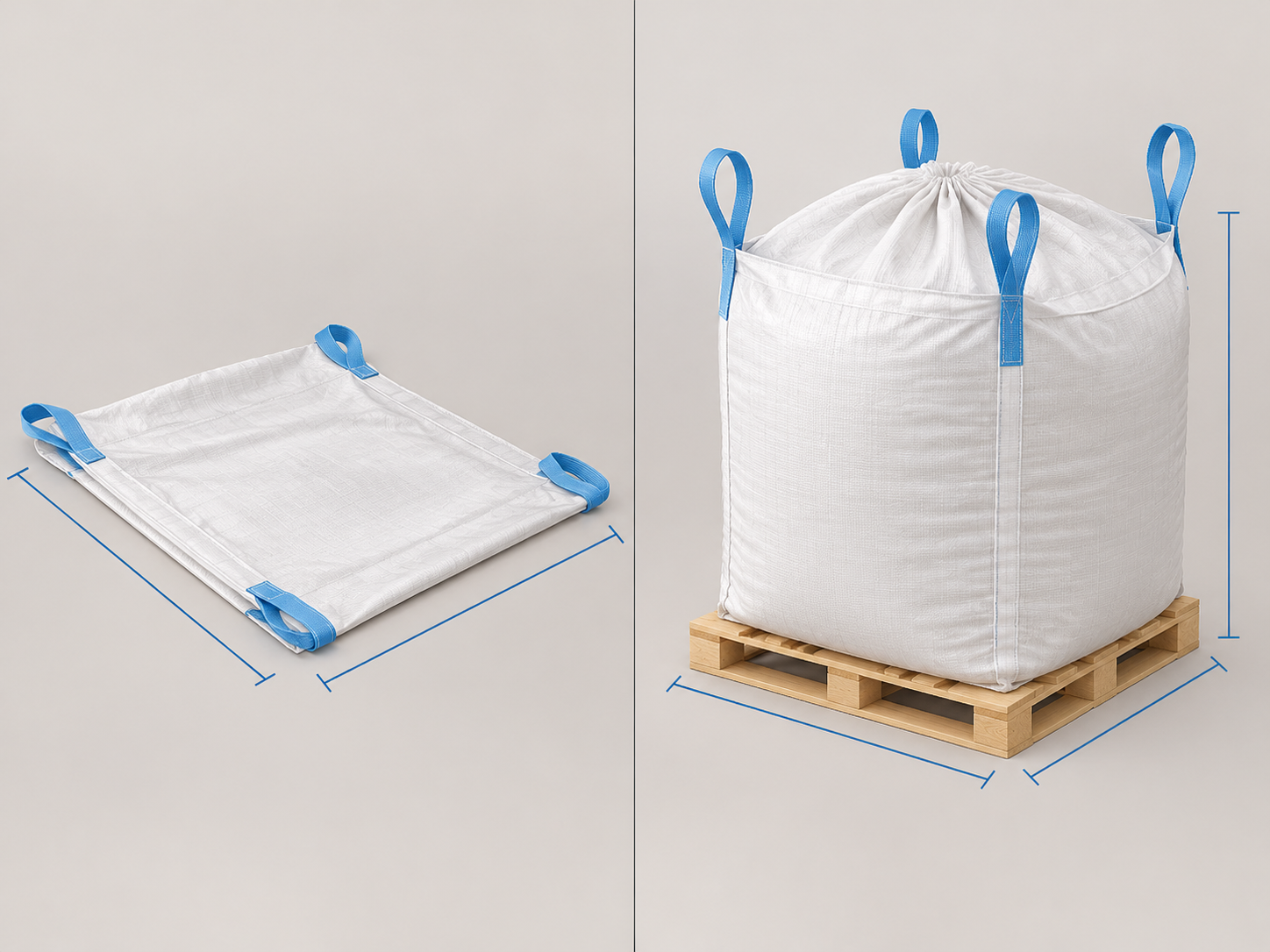
The difference becomes obvious when the product changes. At a bulk density of 300 kg/m³, 1,000 kg of product needs about 3.3 m³ of space. At 1,500 kg/m³, the same weight needs about 0.67 m³. One bag may be tall and broad; the other may be compact. Both could be described as “1-ton bags.” Only one may fit the filling head, the pallet pattern, the container and the discharge station.
This is why the technical term is worth keeping. An FIBC drawing can be checked against a standard, a filled-envelope calculation and a trial. A nickname cannot. For the broader product family, see FIBC bags: types, load capacity and industry applications.
FIBC Is a Category, Not a Compliance Stamp
An FIBC can be designed for non-dangerous goods under ISO 21898, or for dangerous goods under the applicable UN packaging rules. Those are different routes. A bag that looks like an FIBC is not automatically UN-approved, food-contact compliant, anti-static or suitable for a flammable dust environment.
FIBCA's guidance on dangerous goods is direct: an FIBC can be used for hazardous materials only if it is an approved package for the particular product, the package and components are compatible, and the design fully complies with the applicable regulatory code. The UN Model Regulations provide the international framework, but the applicable national and modal rules still govern the shipment.
In the same way, “food grade” is not a property of the word FIBC. It is a claim about the finished article and every product-contact component, supported by the appropriate documentation for the intended use. The same logic applies to static control: the bag and liner combination must be assessed together.
For a deeper treatment of load ratings, see the article on FIBC safety, safe working load and safety factor.
What the Label Does Not Tell You
A product page can say “1-ton FIBC” or “jumbo bulk bag” and still leave most of the purchase undecided. The table below lists the questions that the label cannot answer.
FIBCA defines the safe working load (SWL) as the amount of load, in pounds or kilograms, that a bag is designed to carry. That definition is a useful starting point because it separates the designed load from a marketing phrase such as “1 ton.”
| Hidden specification | Why it matters | What to ask |
|---|---|---|
| SWL and safety factor | The safe working load is the designed load; the safety factor describes the test margin. A nominal “1-ton” label does not prove either. | What is the SWL in kilograms? What safety factor and test basis apply? |
| Filled dimensions | Empty bag dimensions do not show how the bag will sit when full. Product settlement, liner volume and baffles change the envelope. | What are the expected filled length, width and height at the target weight? |
| Body construction | U-panel, four-panel, circular and baffled bodies behave differently in filling, bulging and stacking. | Which construction is proposed, and why does it fit the handling plan? |
| Top and bottom design | Open top, duffle top, filling spout, flat bottom, discharge spout and full-open bottom are not interchangeable. | What are the opening type, diameter, length and closure method? |
| Liner and barrier | A liner can control dust, moisture, oxygen, light or contamination, but only if the film, seams, neck and closure are designed as a system. | What liner is proposed, how is it attached, and what evidence covers the finished liner? |
| Lifting interface | Loop count alone does not define strength. The loop pattern, belt, reinforcement and equipment matter. | Which forklift, crane, hoist or spreader will lift the bag, and what loop arrangement does it require? |
| Compliance scope | A standard, a test report, a declaration and a certificate are different documents. Each may cover a different design. | Which exact design, liner and closure does the document cover? |
The filled envelope is the most commonly skipped item. A buyer may approve a drawing based on empty dimensions, then discover that the filled bag misses the pallet grid or hits the container roof. The FIBC dimensions and load capacity guide explains the measurements to collect before a design is frozen.
How to Read a “1-Ton Super Sack” Listing
Product listings compress a lot of uncertainty into a few familiar phrases. Read them as claims to verify, not as a finished specification.
“1 ton” or “1,000 kg.” This may mean the target net load, the SWL, a maximum capacity or simply the product family. Ask which number is the design load and which number is the safe working load. A 1,000 kg target does not tell you the volume; bulk density does.
“4 loops.” Four loops are common, but the count is not a strength rating. The loop pattern has to match the lifting equipment, and the belt, stitching and body reinforcement have to be designed for the load. A four-loop bag is not automatically stronger than a two-loop design for every application.
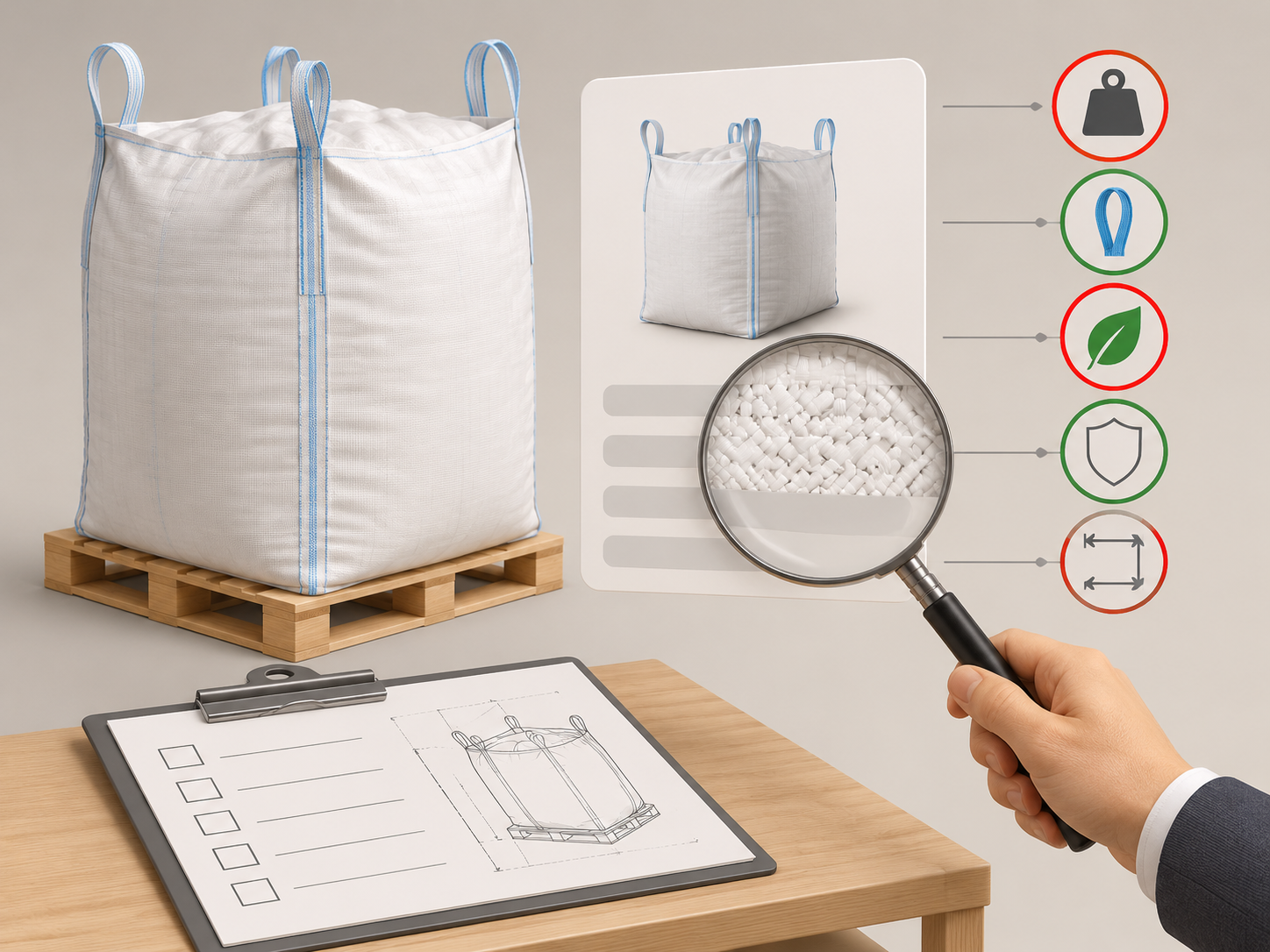
“Food grade.” This phrase should lead to a document trail: the finished article, the liner, the ink, the adhesive and the conditions of use. A resin supplier's statement does not automatically cover the finished bag. If food or feed contact is part of the duty, ask which evidence applies and who issued it.
“UN certified.” UN packaging approval is tied to a tested design, packaging code, packing group and the applicable liner and closure. A generic “UN” badge on a website is not enough. Ask for the exact design scope and the documents that will ship with the order.
“Jumbo.” This is the least specific word in the listing. It may signal a large bag, but it does not define the footprint, height, capacity, SWL or construction. Treat it as a search term, not a specification.
“Anti-static.” Static-control performance depends on the bag and liner combination and the intended hazardous area. The word alone does not establish a Type C or Type D classification. Ask for the applicable standard, test basis and configuration.
The same discipline applies to construction. A U-panel bag, a four-panel bag, a circular bag and a baffled bag are not interchangeable just because all four are FIBCs. The article on U-panel, four-panel, circular and baffle constructions explains how the body style changes filling, shape and handling.
Common Mistakes Buyers Make
Most terminology problems become purchasing problems in one of six ways.
Ordering a brand name when a product category is intended. “Super Sack” may mean the United Bags brand to one person and any FIBC to another. Clarify before the PO is issued.
Treating “jumbo” as a size. There is no universal jumbo-bag dimension or capacity. Specify the filled envelope and target weight.
Treating 1 ton as 1 m³. A weight is not a volume. The volume depends on bulk density, fill level and the shape of the filled bag.
Assuming four loops mean a stronger bag. Loop count describes the lifting interface, not the design load. The belt, stitching, body and reinforcement carry the load.
Treating “food grade,” “UN” or “anti-static” as generic labels. Each claim belongs to a specific design, material set and document scope.
Using four names in one purchasing process. Sales, engineering, warehouse and customs may create duplicate SKUs or compare quotations that describe different products. Pick one technical term for drawings and specifications, then add the trade name in parentheses if needed.
None of these mistakes is solved by asking for a “better” or “heavier” bag. They are solved by writing down the duty and the interface.
Seven Questions Before You Quote
Use these questions as a minimum brief. The answers do not need to be perfect on the first email, but the unknowns should be visible.
What is the product? Include the material name and grade, bulk density, particle size, flow behavior, moisture sensitivity, filling temperature and any hazard information.
What is the target net weight, and what SWL is required? State both. Do not use “1 ton” as a substitute for the design load.
What is the filled envelope? Give the expected filled length, width and height at the target weight, plus the pallet, rack, truck or container limit.
How is the bag filled and discharged? Include the opening type, diameter and length, the equipment connection, the fill rate and the receiving hopper or conveyor.
How is the bag lifted? Name the forklift, crane, hoist or spreader, the number of attachment points and any loop or sling restriction.
What liner and closure are needed? State the protection target—dust, moisture, oxygen, light, contamination or static—and the evidence required for the finished liner.
Which compliance route applies? State the destination market and whether the product is a dangerous good, a food or feed contact material, or used in a classified hazardous area.
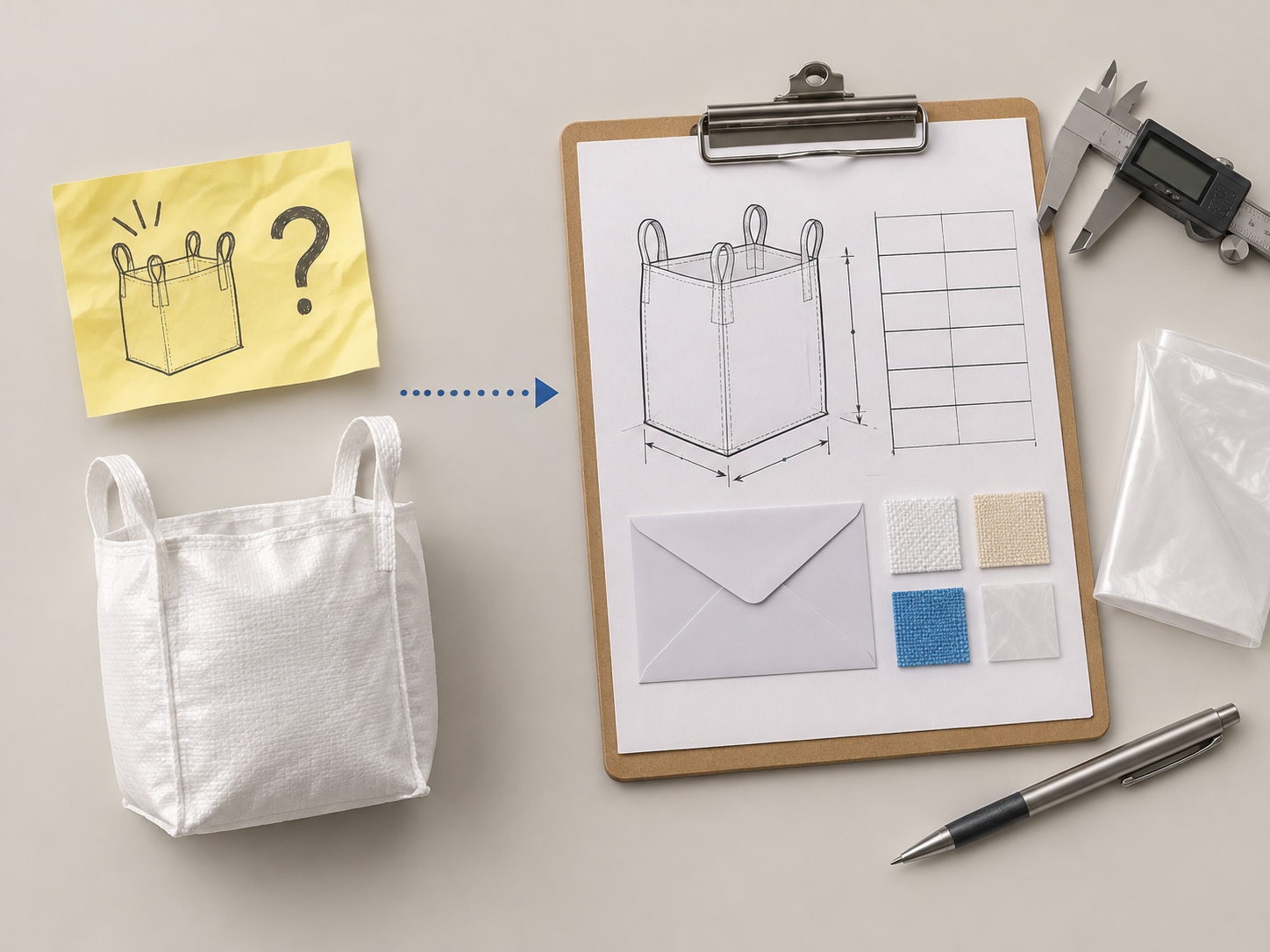
A quotation that answers only “what size and what price” is not yet a comparable quotation. It is a starting point.
FAQ
Is a Super Sack the same as an FIBC?
A Super Sack® is a branded FIBC. FIBC is the broader technical category. The brand name identifies a commercial source; it does not define the dimensions, SWL, liner or compliance route of every bag that looks similar.
Is a jumbo bag bigger than a bulk bag?
Not necessarily. “Jumbo bag” has no universal size definition, and “bulk bag” is a broad trade term. Either phrase can describe the same FIBC. Check the filled dimensions and target weight rather than the adjective.
Are bulk bags and FIBCs the same thing?
In everyday trade, the terms are usually used for the same product family. FIBC is the more precise technical term, and it is the better word to use in a drawing, specification or international RFQ.
Can a Super Sack be used for food or dangerous goods?
Only the specific design and document scope can answer that. A brand name does not establish food-contact suitability or UN approval. Ask for the finished article evidence, the tested design, the liner and closure combination, and the applicable regulatory route.
Why do suppliers use different names for the same bag?
Because buyers search with different words. “Bulk bag,” “big bag,” “jumbo bag” and “tote” are convenient trade terms; “FIBC” is the technical term; “Super Sack®” is a brand. A supplier may use all of them on the same website to match how customers search. The specification should still be written in one consistent technical language.
The Name Is the Beginning, Not the Specification
The next time a colleague asks for a “super sack,” the useful reply is not a correction. It is a question: “Which FIBC specification do we need?”
Answer the product, weight, bulk density, filled envelope, filling and discharge interfaces, lifting method, storage plan and compliance route. Then the supplier can quote a bag that fits the job, whether the market calls it an FIBC, a bulk bag, a jumbo bag or a Super Sack®.
If the brand is required, name the brand and verify the source. If the job is the requirement, name the job and attach the specification. That is how a four-name conversation becomes a purchase order that can be checked.
To review a bulk bag requirement, send FIBC World the product, target net weight, bulk density, filling and discharge details, lifting arrangement, storage and transport plan, destination market and required compliance route. You can also explore the FIBC product range for the main starting points.
Related News
Other news you might be interested in
Bulk Bags by Application: Minerals, Fertilizer, Grain and Produce
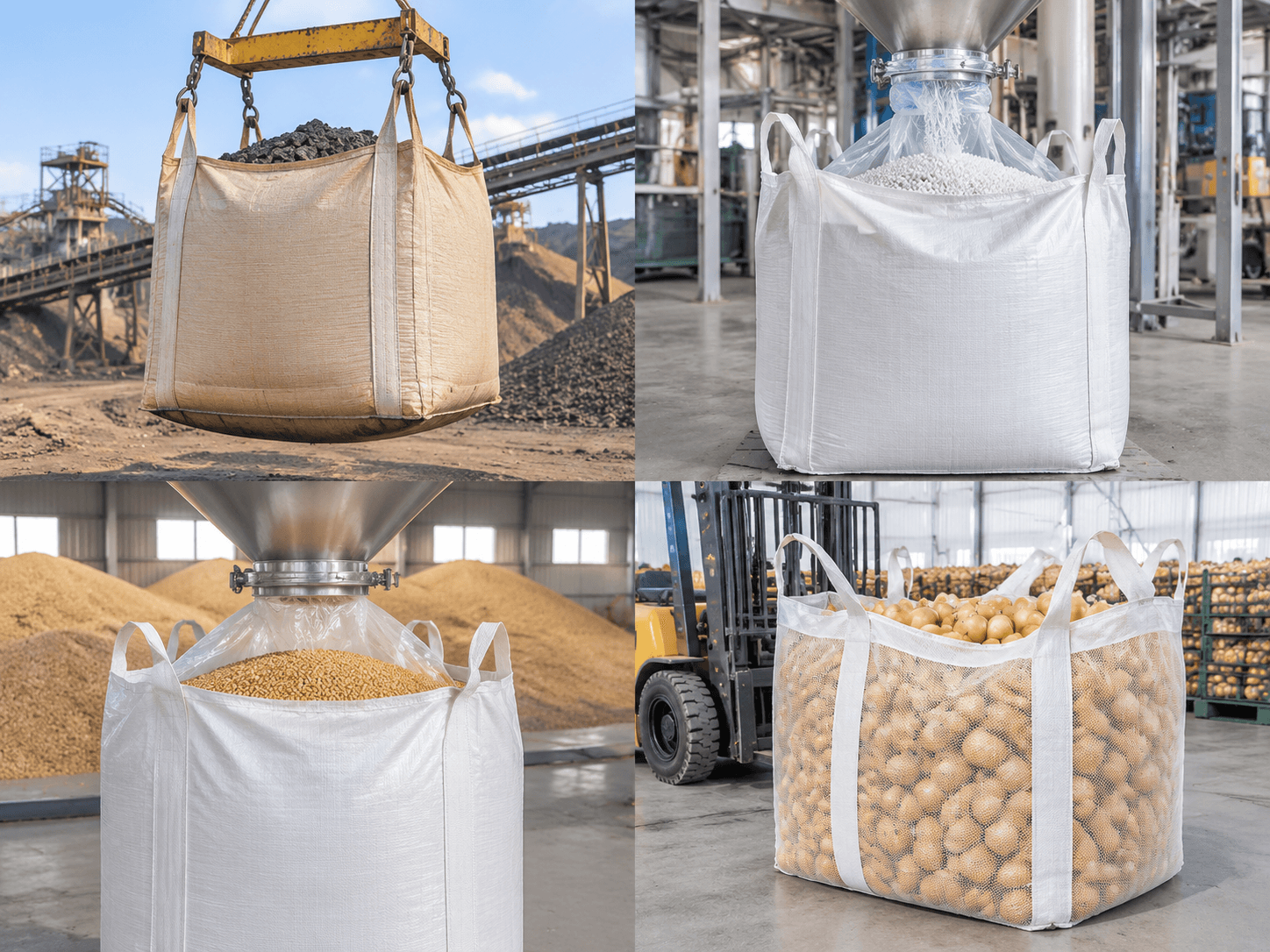
A mineral concentrate, a fertilizer blend, a load of wheat and a load of onions can all be packed in a bulk bag. They should not all be specified the same way.On a quotation, each may appear as a one-tonne FIBC with a top opening and a discharge spout. In service, the loads behave differently. A dense mineral concentrate can reach its target mass at a low fill level and concentrate stress in the base and seams. A hygroscopic fertilizer can pick up moisture, cake and block the outlet. Grain can arrive dry but become unacceptable if condensation, pests or contamination are not controlled. Fresh produce can lose quality through heat, condensation and handling damage even when the bag itself remains intact.

Affordable FIBC Solutions for Small Businesses
A small business can need bulk bags for reasons that have nothing to do with its size. A family farm may pack a few hundred ventilated bags during harvest. A feed mill may use one pallet of standard bags a month. A food-ingredient repacker may need a moisture barrier for a sensitive powder but cannot justify a full container of custom-printed bags. A landscaping supplier may ship aggregates in the same bag size all year. In each case, the search for an affordable FIBC runs into the same obstacles: minimum order quantities, custom setup costs, freight charges and quotations that are difficult to compare.
Want to know more?
Get in touch with us for more information about our services and products.