
What Are The Advantages of FIBC Bulk Bags for Seeds & Grains Storage?

Dayang Yang
AuthorWith experience in FIBC bulk bag manufacturing and export sales, we operate our own production facility with stable large-scale capacity. We are specialists in bulk bags, conductive FIBCs, food-grade FIBCs, UN certified bags, and customized flexible intermediate bulk containers for industrial packaging and bulk material transportation solutions.
Seeds and grains rarely lose quality in a single event. Quality slips slowly: moisture moves through the bulk, warm grain cools and forms condensation, insects find a seam, a forklift tears a corner, or one lot gets mixed with the next. By the time the problem is visible, the cost is already in the bin.
That is why the advantage of an FIBC is not simply that it holds a tonne. A well-specified FIBC is a storage and handling unit that can be matched to the way the crop behaves, the way the warehouse works, and the way the bag is filled and emptied. For seeds, it can also protect lot identity. For grains, it can support airflow, moisture control, and fast turnover.
This guide explains the practical advantages, the limits, and the selection points that matter before you order. It is written for buyers and operations teams who need a bag that works in storage, not just a bag that looks strong in a photo.
Seeds and grains are not the same storage problem
Both are dry bulk products, but they are bought and stored for different reasons.
Grain is usually a high-volume commodity. The priorities are cost per tonne, moisture control, insect pressure, fast filling and discharge, and efficient use of warehouse or container space. A grain lot may move quickly, or it may be held for months under controlled conditions.
Seed is a higher-value product with a biological job to do. The priorities shift toward lot identity, germination vigor, freedom from contamination, clean handling, and traceability. A seed lot may be smaller, but the cost of a mix-up or a moisture event is much higher.
The shared requirements are straightforward: keep the product dry, clean, protected, identifiable, and movable. The difference is which requirement dominates. That is the first input to bag selection.
For a broader map of bulk-bag applications, see What Are FIBC Bags Used For?. For the wider agricultural picture, see FIBC Bags for Agriculture.
Advantage 1: one liftable bulk unit instead of dozens of small sacks
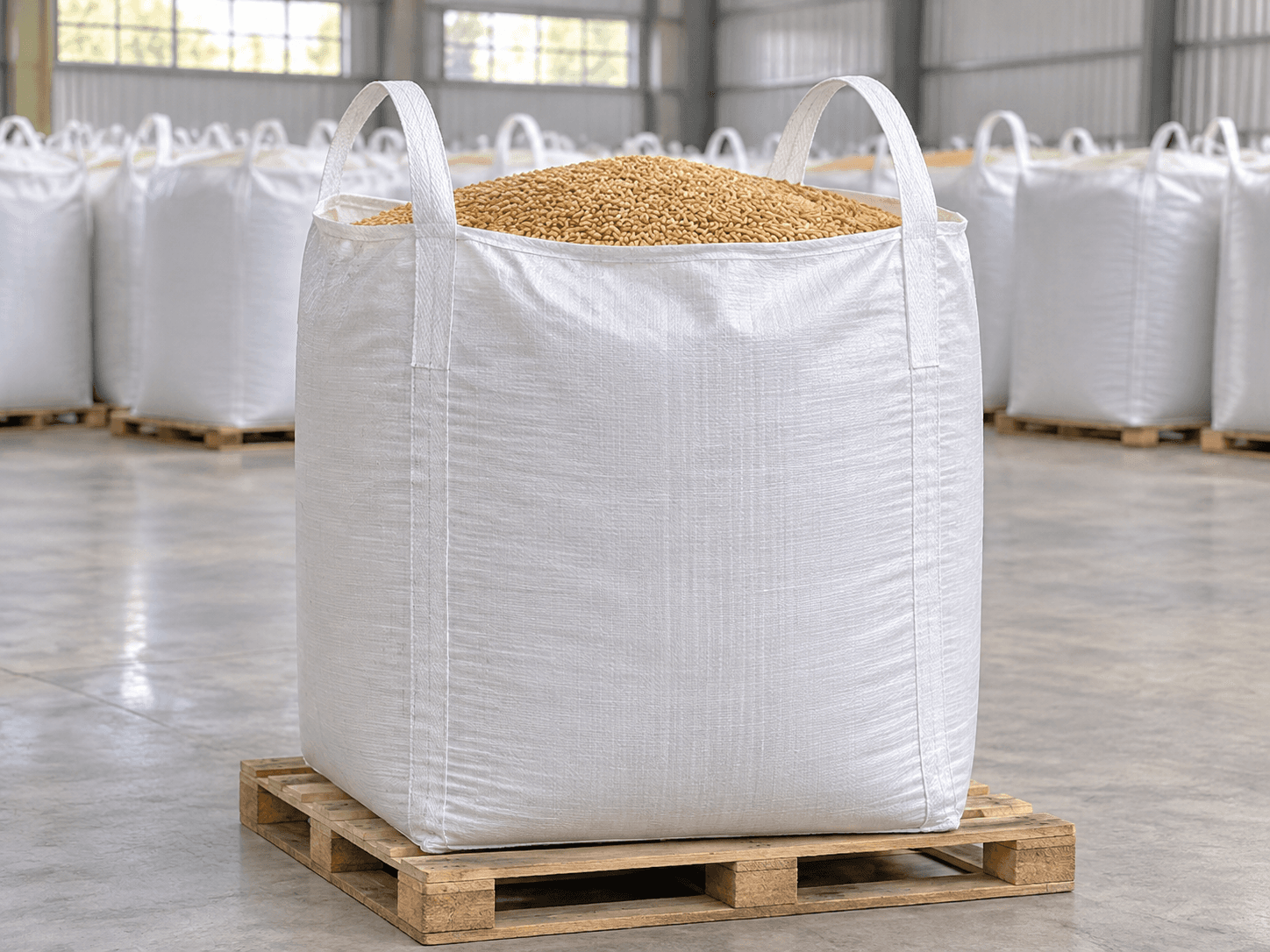
The most immediate advantage is handling efficiency. A 1,000 kg FIBC replaces forty 25 kg sacks. That means forty fewer manual lifts, forty fewer seams to fail, and a much faster warehouse count. Filling, moving, storing, and discharging become one controlled unit rather than a series of small operations.
FIBC World's standard configurations commonly cover 500 kg, 1,000 kg, and 1,500 kg, with heavier designs available depending on the bag structure and project requirements. Four corner loops or cross-corner webbing allow the filled bag to be lifted by forklift, crane, or standard handling equipment.
Two practical points matter more than the headline capacity:
Safe Working Load is not a target fill weight. SWL is the load the bag is designed to carry under the stated conditions. The actual product weight depends on bulk density, bag dimensions, and how the bag is filled.
A bag that fills by volume may be under or over its weight limit. A light, fluffy product may fill the bag before reaching the SWL. A dense product may reach the SWL while the bag still looks partly empty. Weigh the filled bag, and confirm the dimensions with your supplier rather than assuming that a standard size fits every material.
For seed producers, smaller bulk units can preserve lot identity while still reducing manual handling. For grain traders, the same unit can move through intake, storage, and dispatch without being repacked.
3. Advantage 2: airflow options for grain that needs to breathe
Not every grain or seed should be sealed in a barrier liner. Some bulk products continue to release moisture after harvest, and some coarse agricultural materials benefit from air movement during storage. This is where a ventilated FIBC earns its place.
FIBC World's ventilated bulk bags use alternating tight-weave panels and open-weave ventilation strips. The product page describes configurations with roughly 11 to 26 air lines, a UV-stabilized polypropylene fabric, and standard safe working loads of 500 kg, 1,000 kg, and 1,500 kg. The open strips allow air exchange through the bag body rather than trapping it inside a sealed fabric.
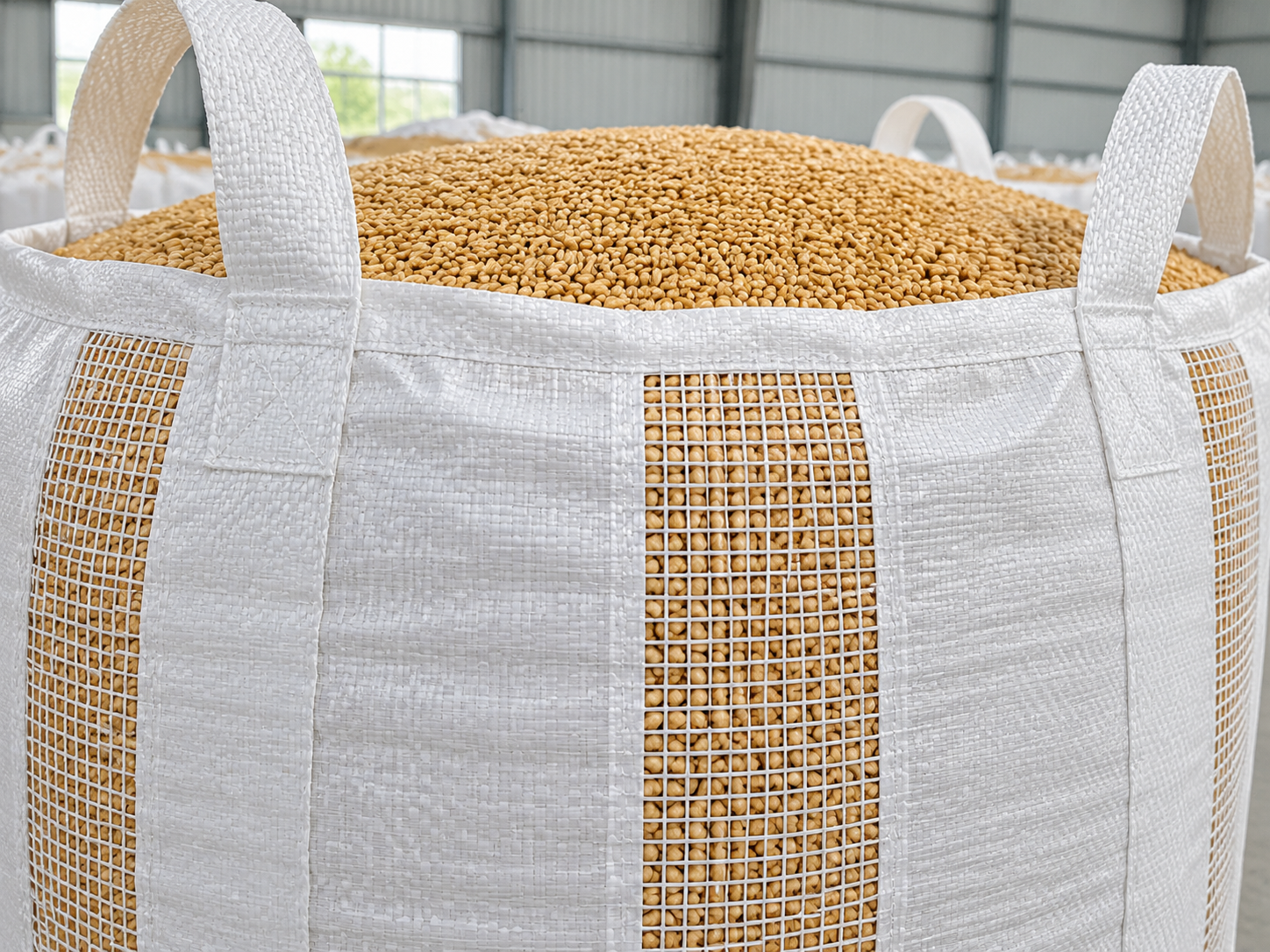
The practical benefits are:
Less internal condensation. When warm grain cools in storage, moisture can condense on cooler surfaces. Air exchange helps moisture vapor move out instead of collecting inside the bag.
Support for natural drying and curing. For coarse products that are still releasing moisture, airflow can help the product continue to dry under suitable conditions.
A more stable storage environment. Moving air reduces the stagnant, humid pockets that favor mold and quality loss.
But the limits are just as important:
Ventilated does not mean rainproof. The same openings that let air in let water in. Ventilated bags should be stored under a waterproof roof or canopy, never exposed to direct rain.
Ventilated does not mean insect-proof. Open weave strips are not a barrier to insects or rodents. Clean storage, monitoring, and an integrated pest program are still required.
Ventilated is not for fine seed or powder. Small particles can sift through the air lines. The product page specifically recommends sealed bags and sift-proof seams for fine materials.
A liner cancels the airflow. If you add a PE or foil liner to a ventilated bag, you have created a sealed package inside a breathable outer bag. Choose the airflow path or the barrier path, not both by accident.
Ventilation is not a dryer. If grain is above safe storage moisture, dry it before filling. Passive air exchange through a bag is not a substitute for a proper dryer or an aeration floor.
The best use case is a covered, well-ventilated store where the crop is already dry enough for storage but still benefits from air movement, and where rain, insects, and contamination can be controlled.
Advantage 3: a liner system for moisture, contamination, and clean discharge
When the storage risk is moisture, contamination, or product loss rather than airflow, the liner becomes the most important part of the specification.
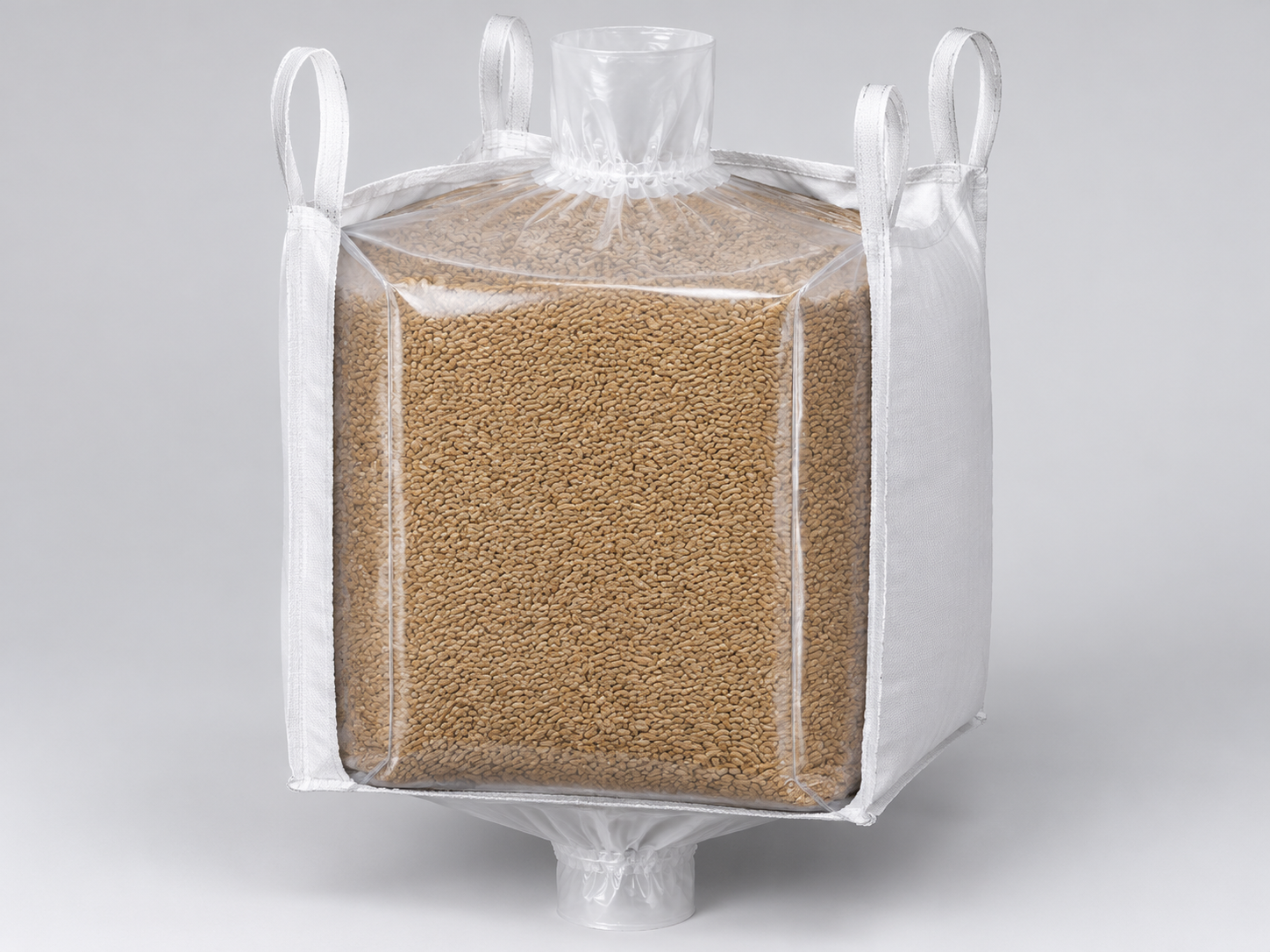
FIBC World offers PE liners, form-fit liners, EVOH barrier film, and aluminum foil composite liners for different protection levels. A form-fit liner is shaped to follow the inside of the outer bag rather than hanging as a loose flat tube. The product page describes several practical benefits: fewer wrinkles, less liner movement during filling, less material trapped in corners, and cleaner discharge with lower residue.
That matters for both seeds and grains:
For seed lots, a fitted liner supports cleaner containment and reduces the chance of product migrating into folds or seams. It also makes it easier to keep one lot separate from the next.
For grain in humid climates or ocean freight, a liner adds a barrier between the product and the outside environment. The right choice depends on the moisture sensitivity of the crop, the length of storage, and the conditions during transport.
For food or feed grain, the liner and the outer bag should be selected with the relevant contact requirements in mind. Ask for the specific declaration or certificate rather than relying on a general "food-grade" description.
There are two specification traps to avoid:
"Aluminum foil" is a structure, not a performance guarantee. The barrier depends on the full film structure, the number and quality of layers, the seals, and the test conditions. Ask for the material structure, barrier data, seal strength, and the supplier's recommended use.
A barrier liner is only as good as its closures. If the filling spout, discharge spout, or liner seal is not closed correctly, moisture and contamination can enter around the barrier rather than through it. Match the liner openings to your filling and discharge equipment, and confirm how the liner is fixed, folded, and sealed.
Advantage 4: stable stacking and better use of warehouse or container space
Storage cost is driven by volume as much as by weight. A bag that bulges, leans, or cannot be stacked safely wastes space and creates handling risk.
A flat-bottom FIBC uses a solid base with no discharge opening. That gives the bag a stable footprint for warehouse stacking and container loading, and it removes a potential leak path at the bottom. FIBC World's flat-bottom range is commonly configured for 500 kg, 1,000 kg, and 1,500 kg, with heavier options depending on the design, and can be fitted with PE, form-fit, or aluminum foil liners.
A baffled FIBC, often called a Q-bag, takes the idea further. Internal fabric baffles are designed to hold the bag close to a square shape under load. The product page cites a reduction in side bulge, a more stable top surface for two-high stacking in high-cube containers, and up to 25% more payload in the same floor space compared with a standard bag that bulges. Those figures are product-page claims and should be confirmed with a layout calculation for your actual bag size, weight, and route.
For seeds and grains, the practical value is:
More predictable stacks. Bags are less likely to lean, shift, or press against each other.
Better container utilization. A square footprint reduces wasted space between bags.
Less handling damage. A stable stack is easier to inspect and unload, and puts less stress on the bottom layer.
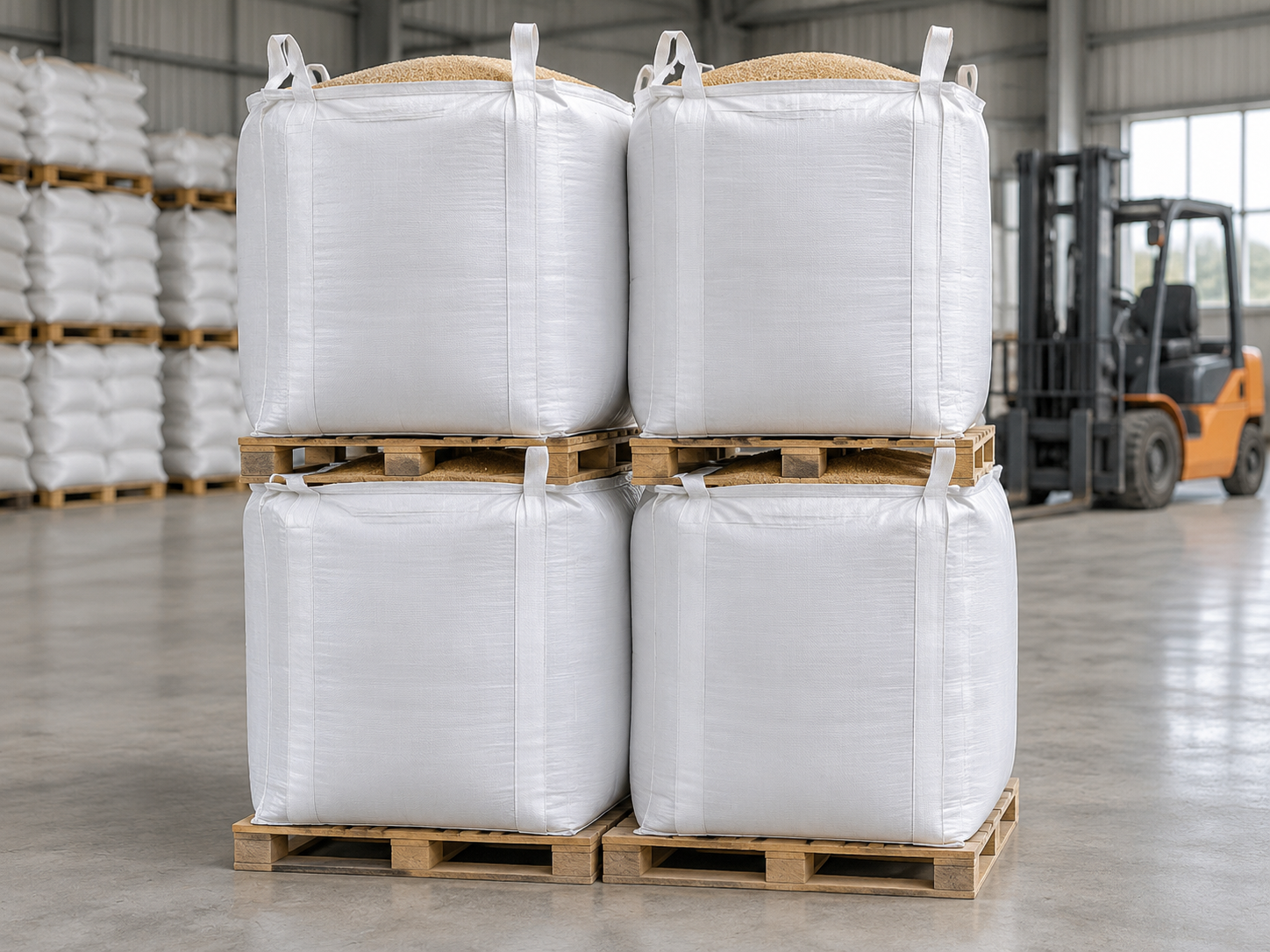
The limits are equally practical. Stack height depends on the bag design, the filled weight, the floor or racking, the storage duration, and local safety rules. Do not stack beyond the height your supplier and site rules allow, and inspect the bottom layer regularly for deformation or abrasion.
Advantage 5: filling and discharge matched to your equipment
A bag that is difficult to fill or empty erases much of its handling advantage. The right spout and top configuration can be the difference between a smooth intake line and a daily cleanup job.
FIBC World's product pages list several options:
Top: open top, skirt top, filling spout, duffle top, or cover flap.
Bottom: flat bottom, discharge spout, conical outlet, or full discharge.
Lifting: corner loops, cross-corner loops, side-seam loops, or custom lifting belts.
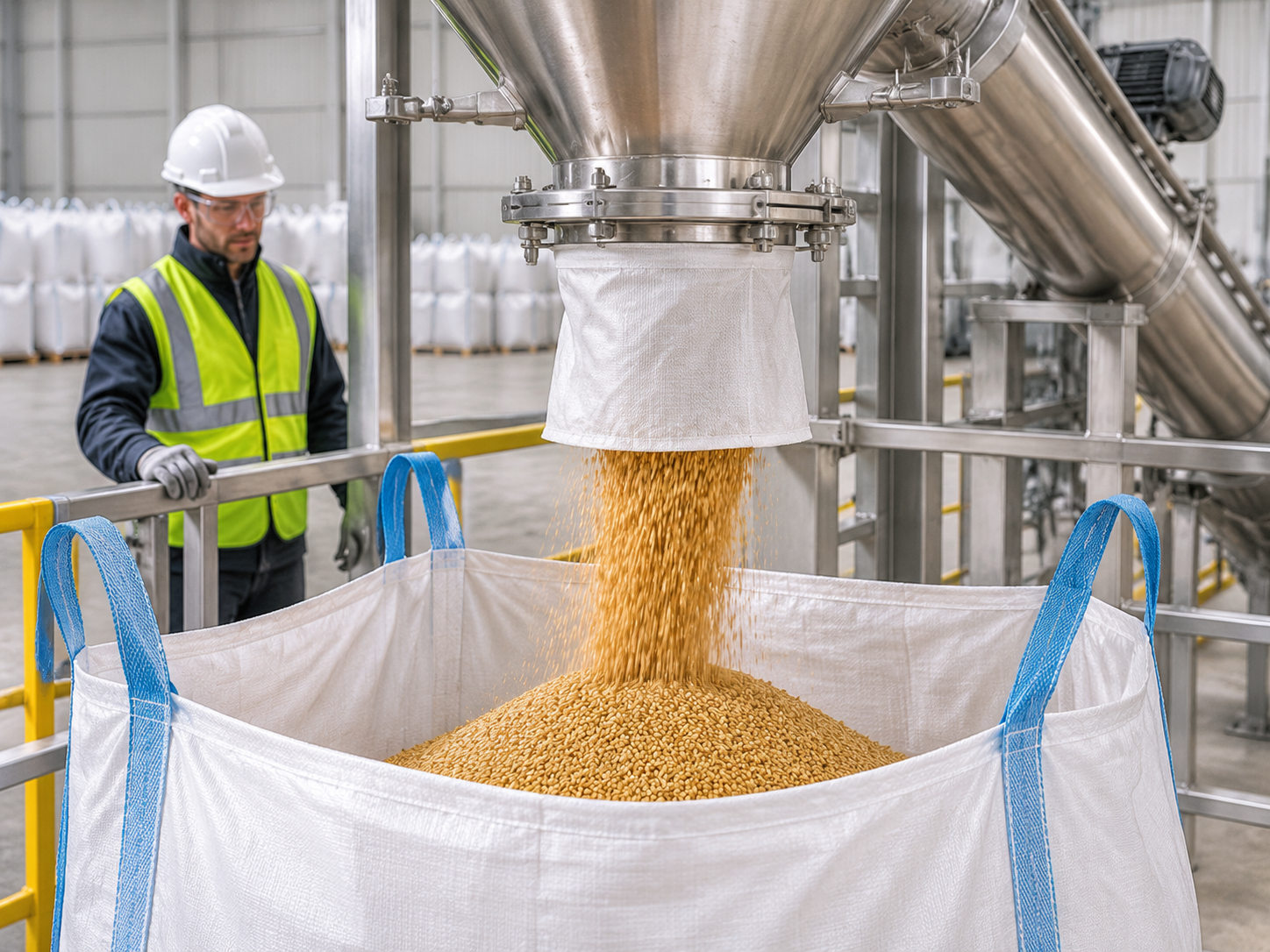
The best combination depends on the equipment you already have:
An open top works well with a loader, auger, or manual filling. It is simple and fast, but it offers less dust control.
A filling spout can be connected to a silo, hopper, or filling line for a more closed transfer and less dust.
A discharge spout supports controlled emptying into a pit, hopper, or conveyor. It reduces manual scooping and spillage.
A flat bottom is suitable when the bag will be emptied by tipping, cutting, or vacuum, or when a closed base is more important than bottom discharge.
For seed, clean discharge and low residue matter because every kilogram is valuable and because residue can carry over into the next lot. For grain, a discharge spout that matches the receiving pit can shorten unloading time and reduce labor. In both cases, confirm the spout diameter, tie closure, dust-proof closure, and the height and reach of your handling equipment before ordering.
Advantage 6: contamination control and lot traceability
Storage is also an information problem. If a lot cannot be identified, its history is lost, and a quality issue becomes a search through the warehouse.
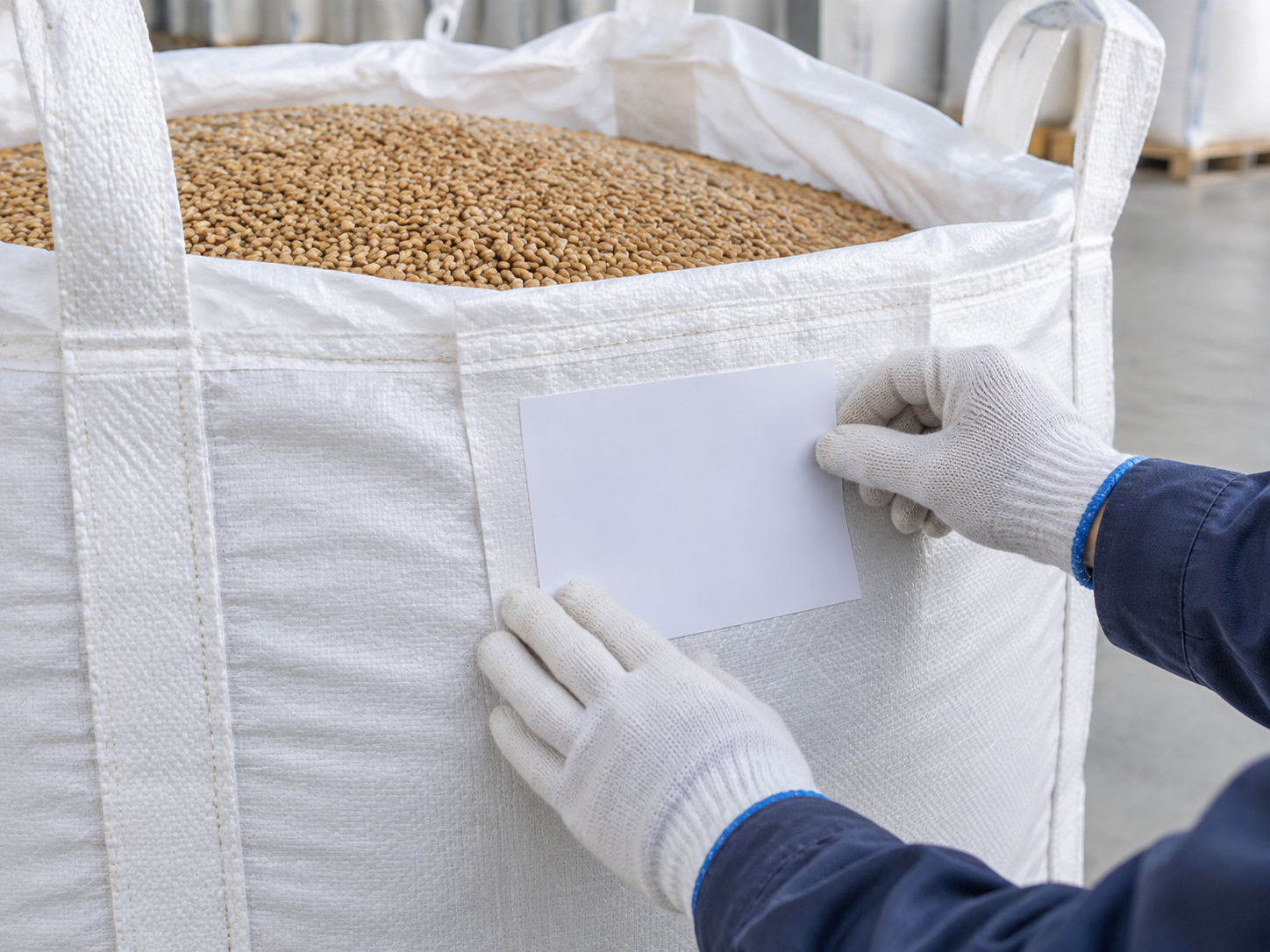
FIBCs can be printed or labeled with the information that matters to your operation: product name, lot number, crop year, seed treatment, net weight, filling date, destination, and handling marks. Clear labeling supports first-in, first-out rotation, traceability, and a cleaner recall or investigation process if something goes wrong.
The bag also helps with physical separation. A dedicated bag and liner reduce the chance of cross-contamination between lots, between conventional and treated seed, or between food/feed grain and non-food materials. If seed has been treated, keep it in dedicated, clearly labeled bags and never reuse those bags for food or feed.
Two boundaries are worth stating plainly:
A woven FIBC is not an insect barrier. Insects can move through openings, seams, and storage gaps. Control comes from clean storage, monitoring, sanitation, and an integrated pest program. Fumigation, where needed, should be carried out by trained operators under local regulations.
A bag is not a certificate. If your buyer requires food-contact compliance, UN rating, or a specific barrier performance, ask for the document and confirm that it covers the exact bag, liner, and application. Do not assume that a product description or a similar-looking bag proves compliance.
Advantage 7: total cost and logistics, not just the price per bag
The purchase price of a bag is easy to compare. The cost of using it is not.
A cheaper bag can become expensive if it tears during lifting, leaks at a seam, traps grain in a liner fold, or forces manual scooping at discharge. The useful comparison is cost per tonne stored and moved, including:
bag and liner cost;
filling and discharging labor;
product loss from spillage, residue, and contamination;
warehouse or container space;
freight and handling;
inspection, cleaning, and disposal or reuse.
FIBCs can reduce the number of packages, the number of manual touches, and the amount of spillage. They can also improve cube utilization when the bag keeps a stable shape. For one-way shipments, a single-trip bag with a 5:1 safety factor is often appropriate. For multiple trips, a 6:1 design may be specified, but reuse should be based on inspection, cleaning, and suitability for the product, not on the safety factor alone.
The lowest total cost is usually the bag that fits the handling system and protects the product, not the bag with the lowest quote.
Matching the bag to the storage job
Use this table as a starting point, then confirm the specification with your supplier and your site's safety rules.
| Storage job | Suggested starting point | Liner | Top / bottom | Watch-outs |
|---|---|---|---|---|
| Dry grain, covered warehouse, forklift handling, fast turnover | Flat-bottom or standard 4-panel FIBC, 500–1,500 kg | None, or PE liner if humidity is a concern | Open top or filling spout; discharge spout if emptying into a pit | Confirm bulk density and actual fill weight; do not overstack |
| High-value seed lots, identity preservation | Flat-bottom or baffled FIBC in a size that matches the lot | Form-fit PE liner; barrier liner for sensitive lots | Sealed filling spout; clean discharge spout | Confirm contact requirements, liner fit, and lot labeling |
| Humid climate or long ocean freight | Standard FIBC with a barrier liner | PE, EVOH, or aluminum foil composite, depending on the risk | Filling spout and discharge spout with secure closures | Ask for barrier data and seal strength; do not rely on the material name alone |
| Outdoor temporary staging | UV-stabilized FIBC under a waterproof canopy | Usually a liner if rain or ground moisture is a risk | Closed top or cover flap; discharge spout | Never store in standing water; ventilated bags are not rainproof |
| Container export, cube optimization | Baffled Q-bag with a square footprint | Form-fit liner | Filling spout; discharge spout | Confirm the layout and weight limit for the container |
| Processing plant, fast discharge | Standard or baffled FIBC with a large discharge opening | PE or form-fit liner if needed | Filling spout; full discharge or conical outlet | Match the spout to the receiving hopper and check residue |
Eight operating practices that make the advantages real
A good bag cannot compensate for a poor storage routine. These practices do more for seed and grain quality than any single fabric upgrade:
Measure moisture before filling. Safe storage moisture varies by crop, harvest condition, and storage duration. Use a calibrated meter and follow local extension guidance. If the crop is too wet, dry it first.
Start with clean, dry bags. Inspect the bag body, seams, loops, and liner. Reject bags with cuts, abrasion, contamination, or a damaged liner. Do not use a bag that has held an unknown chemical.
Keep bags off the floor and away from walls. Use pallets or dunnage, leave space for air movement, and avoid contact with standing water or damp concrete.
Respect the stack height. Follow the supplier's recommendation and your site's rules. Check the bottom layer for deformation, and do not stack bags in a way that puts point loads on the fabric.
Rotate stock first-in, first-out. Use labels and lot records so older stock leaves first. A bag that disappears into the back of the warehouse is a quality risk.
Separate products and lots. Keep seed, food/feed grain, treated seed, and chemicals in distinct areas. Use dedicated bags and liners where cross-contamination matters.
Close and cover during transport. Close filling and discharge openings, use the specified ties or seals, and cover the load. A bag that is open in transit is exposed to rain, dust, and insects.
Train the people who lift and fill the bag. They should know the SWL, the lifting points, the maximum fill level, and the correct way to connect the spout. Most bag damage happens at the interface between the bag and the equipment.
Common mistakes buyers make
Using a ventilated bag for fine seed or powder. The air lines let material sift out. Choose a sealed bag with sift-proof seams.
Using a ventilated bag outdoors. Airflow is useful; rainwater is not. Keep ventilated bags under cover.
Adding a liner to a ventilated bag and expecting airflow. The liner blocks the air path. Decide which protection you need.
Filling by volume and assuming the weight is correct. Bulk density varies. Weigh the bag and confirm the dimensions.
Buying on price per bag alone. Include liner, labor, loss, freight, and storage space in the comparison.
Assuming "food-grade," "UN," or "high-barrier" without documents. Ask for the certificate or test report and check the scope.
Reusing a single-trip bag. A 5:1 bag is not automatically a multi-trip bag. Reuse only when the design, inspection, and cleaning support it.
Mismatching the spout to the equipment. A bag that cannot discharge cleanly into your pit or hopper becomes a manual job.
Stacking too high or on an uneven floor. Stable stacking is a system, not just a bag feature.
Frequently asked questions
Are FIBC bulk bags suitable for long-term grain storage?
They can be, for clean, dry grain in a suitable covered store, but they are not a hermetic storage system. Long-term success depends on moisture at filling, temperature, pest control, barrier choice, and monitoring. For multi-season storage or high-risk conditions, compare FIBCs with silos, controlled-atmosphere options, and local storage guidance.
Do seeds need a liner in an FIBC?
Not always. A liner is useful when the seed is moisture-sensitive, the storage period is long, the climate is humid, or contamination is a concern. A form-fit PE liner is a common starting point; a barrier liner may be appropriate for higher-risk lots. Confirm the contact requirements and the barrier data for the exact application.
Are ventilated FIBC bags better for grains?
They are better when airflow is the priority and the bag can be kept under cover. They are not better for fine seed, outdoor storage, or products that need a moisture barrier. Ventilation and barrier protection are different jobs.
Can FIBC bags prevent insects?
No. A woven bag is not an insect-proof barrier. Insect control comes from clean storage, monitoring, sanitation, and an integrated pest program. Fumigation, if required, should be carried out by trained operators under local regulations.
What size FIBC do I need for one tonne of grain?
It depends on the bulk density of the grain and the dimensions of the bag. A bag rated for 1,000 kg is not automatically the right size for 1,000 kg of every product. Share the product density, target weight, and handling equipment, and ask for a dimension recommendation.
Can I reuse FIBC bags for seeds?
Only if the bag is designed for multiple trips, has been inspected and cleaned, and is suitable for the product. Never reuse a bag that held chemicals or treated seed for food or feed. When in doubt, use a new bag.
The bottom line
The advantages of FIBC bulk bags for seeds and grains storage come from fit, not from size alone. A well-specified bag can reduce manual handling, support airflow or barrier protection, improve stacking and cube utilization, match your filling and discharge equipment, and make lot traceability easier.
The same bag can also fail if it is used outside its limits: ventilated bags in the rain, barrier liners with open spouts, single-trip bags in repeated service, or stacks that exceed the safe height. The practical answer is to define the storage job first, then choose the bag structure, liner, openings, and handling method around it.
If you are planning a seed or grain storage project, send us the product type, moisture content, target weight per bag, bag dimensions, storage conditions, filling and discharge equipment, and destination. FIBC World can recommend a bag and liner configuration for your application and quote it against your volume.
Need a specification review? Contact FIBC World with your material and storage details.
Related News
Other news you might be interested in
What Is a Super Sack? FIBC vs Bulk Bag vs Jumbo Bag Explained
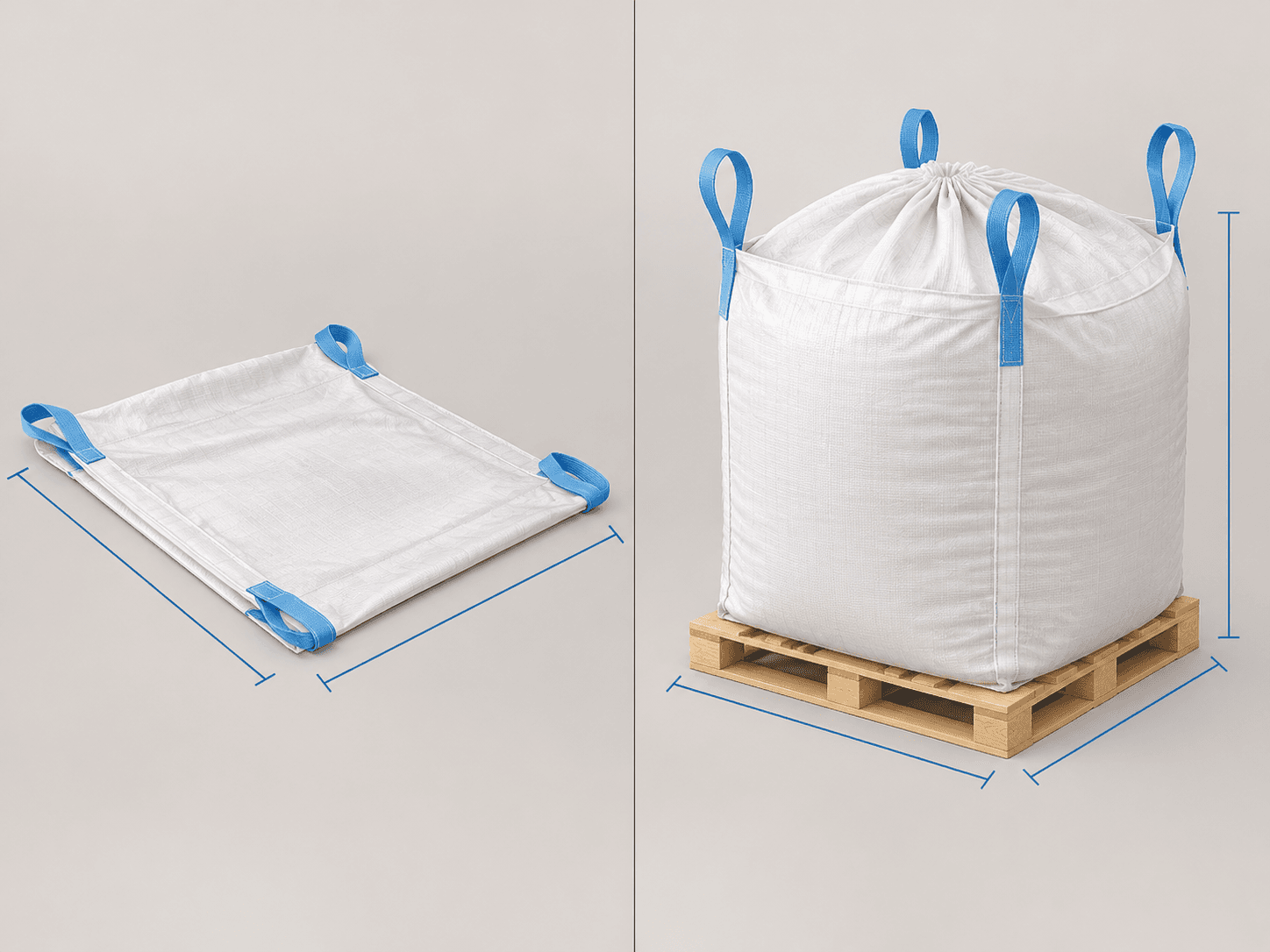
A buyer searches for a “super sack.” The supplier replies with an FIBC quotation. The drawing is titled “jumbo bag.” The warehouse calls it a bulk bag. Four names, one object—usually.The words are not identical in status. FIBC is the technical term used by standards and industry guidance. Bulk bag, big bag, tote and jumbo bag are trade terms. Super Sack® is a registered trademark, not a generic name for every large woven bag.That distinction matters when a purchase order, a drawing or a customs document uses one term while the supplier uses another. The label helps you find the product family. It does not tell you the safe working load, the filled dimensions, the liner, the lifting arrangement or the compliance route. Those have to be specified.
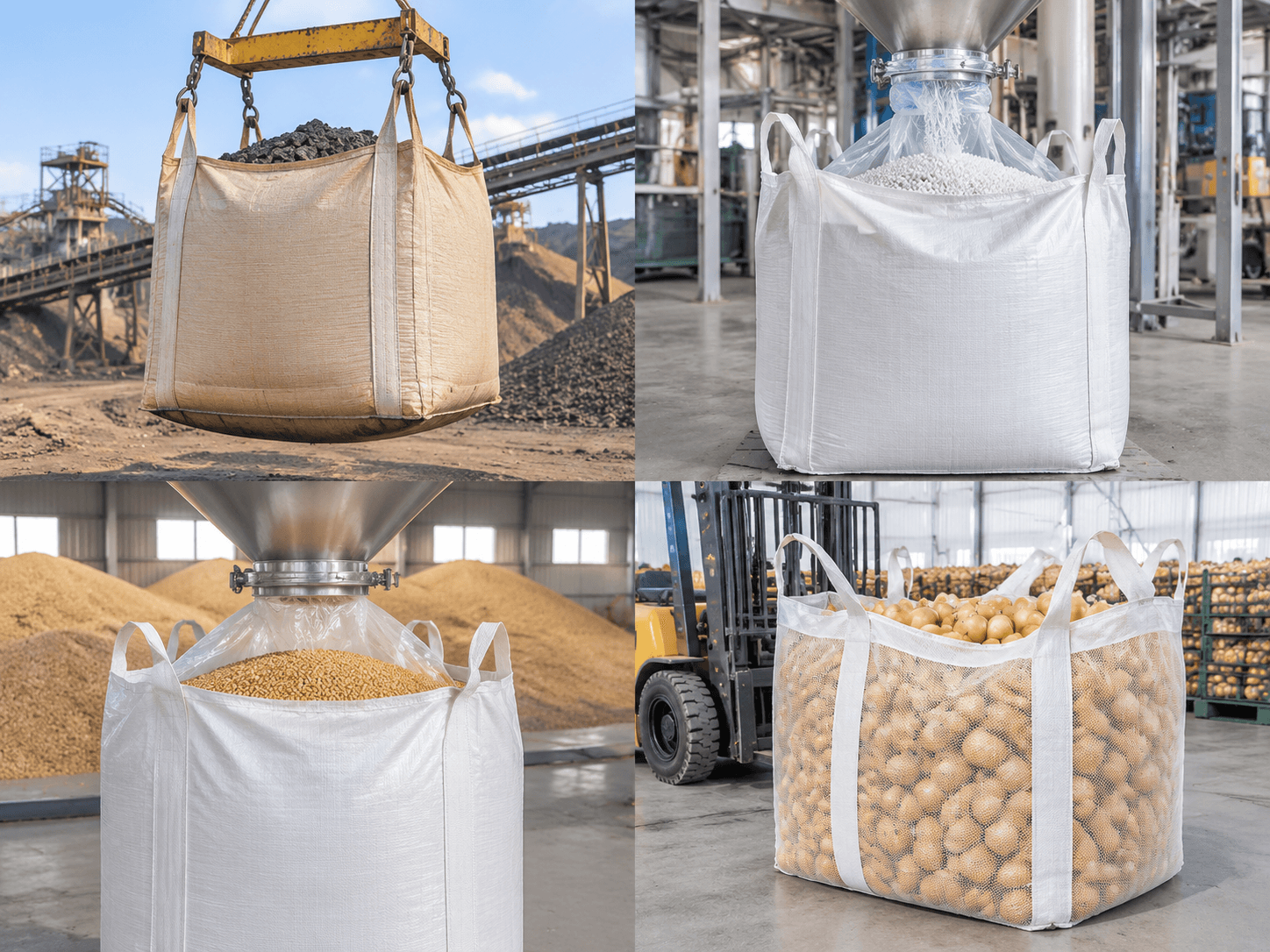
Bulk Bags by Application: Minerals, Fertilizer, Grain and Produce
A mineral concentrate, a fertilizer blend, a load of wheat and a load of onions can all be packed in a bulk bag. They should not all be specified the same way.On a quotation, each may appear as a one-tonne FIBC with a top opening and a discharge spout. In service, the loads behave differently. A dense mineral concentrate can reach its target mass at a low fill level and concentrate stress in the base and seams. A hygroscopic fertilizer can pick up moisture, cake and block the outlet. Grain can arrive dry but become unacceptable if condensation, pests or contamination are not controlled. Fresh produce can lose quality through heat, condensation and handling damage even when the bag itself remains intact.
Want to know more?
Get in touch with us for more information about our services and products.