

How to Choose a Reliable FIBC Manufacturer for Global Bulk Packaging

Dayang Yang
AuthorWith experience in FIBC bulk bag manufacturing and export sales, we operate our own production facility with stable large-scale capacity. We are specialists in bulk bags, conductive FIBCs, food-grade FIBCs, UN certified bags, and customized flexible intermediate bulk containers for industrial packaging and bulk material transportation solutions.
Most FIBC supplier evaluations begin with three artifacts: a price, a sample, and a certificate. Those artifacts matter, but they do not answer the question that decides whether a global bulk packaging program works: can this manufacturer make the same bag, to the same drawing, with the same evidence, three production lots and six months from now?
The most expensive failure is rarely a bag that tears in half on the first fill. It is a bag that is almost right. The spout is 15 mm shorter than the approved sample. The liner pulls out of the filling neck. The fabric is a little lighter. The certificate refers to a different model. The print is correct, but the barcode will not scan. Each difference looks small in isolation. Together they create line stops, product loss, rejected loads, audit findings, and the slow erosion of trust that turns a low unit price into a high cost per ton delivered.
Reliability is not a personality trait and it is not a certificate. It is a chain of control: a defined duty, a controlled drawing, design-specific evidence, a process that can repeat the drawing, and a commercial relationship that prevents silent substitution. Most supplier checklists ask whether a factory has certifications, capacity, and experience. This guide asks a harder question: are those claims tied to your design, your process, and your next production lot? The answer is what separates a supplier you can scale with from one you can only sample.
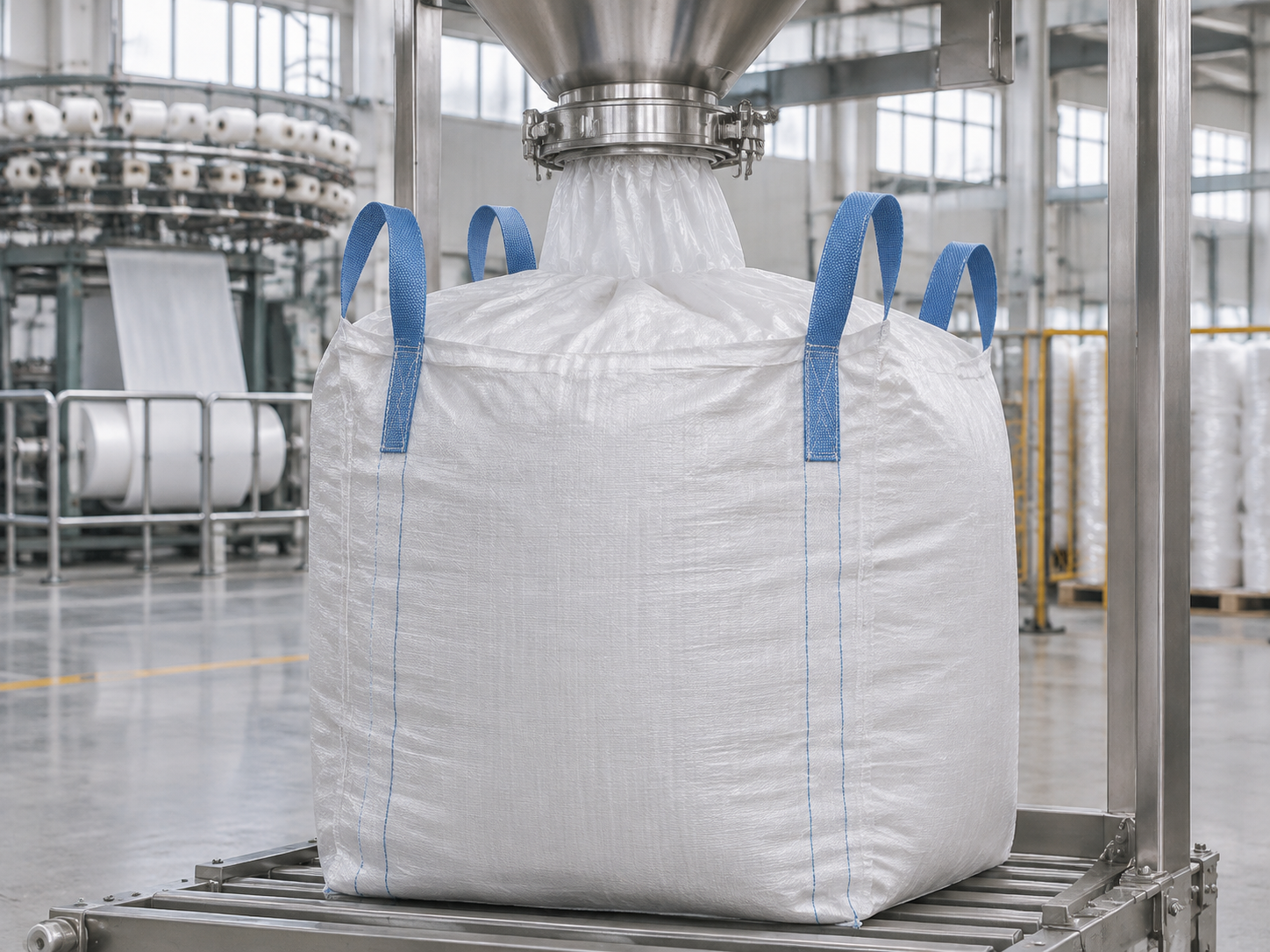
The Short Answer
A reliable FIBC manufacturer can show four things:
A controlled specification for your duty. Not a catalogue size, but a drawing with dimensions, tolerances, materials, construction, openings, liner attachment, printing, markings, and a revision number.
Evidence that matches that specification. Test reports and declarations must cover the actual design, not the brand in general.
Process records that prove repetition. Fabric lots, liner lots, in-process checks, final inspection, test records, and traceability from a finished bag back to its inputs.
A change-control system that prevents silent substitution. A new fabric, liner film, spout, print layout, seam, or subcontractor should trigger review, not a shipment.
If any of those four is missing, a good sample and a folder of certificates are not enough. They describe a moment, not a system.
Start With the Duty, Not the Supplier
The most common sourcing mistake happens before the first email: the buyer asks for a price for “a 1-ton bag” or “a 90 × 90 × 110 cm bag.” Those are dimensions, not a specification. Two bags with the same empty dimensions can behave completely differently once they are filled with materials of different bulk density, flowability, and moisture content. One may run out of volume before it reaches the target weight. The other may exceed the safe working load before it is full.
Write a duty statement first. It does not need to be long, but it needs to be specific enough that two suppliers are quoting the same job.
| Duty field | What to write | Why it changes the bag |
|---|---|---|
| Material and hazard | Product name, powder/granule/flake, SDS or TDS, moisture sensitivity, static propensity, temperature, food-contact or dangerous-goods status | Determines fabric, coating, liner, static route, and documentation |
| Bulk density and particle size | Loose bulk density, typical range, particle size and shape, flow behavior | Converts weight into volume and affects discharge, dust, and stability |
| Fill weight and SWL | Target net weight, maximum weight, required safety factor, stacking load | Sets the load case; SWL must not be exceeded in service |
| Filling interface | Filling head type, spout diameter and length, clamp position, fill rate, dust extraction, liner inflation | A spout that works manually can stop an automated line |
| Discharge interface | Flat bottom, spout, conical outlet, full-open, receiving hopper, dust extraction, operator access | Determines discharge time, residual product, and dust control |
| Lifting and storage | Forklift, crane, port spreader, loop type, lift height, pallet pattern, stack height, rack clearance | Loop pattern and bag height must match the handling equipment |
| Route and destination | Origin, port, transit time, transshipment, climate, container or truck, destination labeling | Long routes and humid climates change liner and packaging requirements |
| Compliance route | Non-dangerous, UN dangerous goods, food contact, electrostatic classification, EU market, customer specification | Each route has different evidence and marking requirements |
| Current failure | Leakage, moisture, liner movement, blocked spout, seam failure, instability, print error | The shortest path to the right design is the failure you already have |
| Volume and timing | Annual volume, order pattern, first order quantity, sample window, launch date | Determines capacity fit, tooling, and whether the supplier can reserve a slot |

FIBCA’s safe handling guidance cites a typical maximum filled height-to-width ratio of 2:1 and advises users to check the applicable standard or code. That is a useful design check, not a universal rule for every material and route. The same guidance says an FIBC should never be suspended on fewer loops than it was provided with, and loops should not be gathered onto one hook unless the design is specifically approved for that method. Those are safety requirements, but they are also specification inputs: the lifting method determines the loop pattern, and the loop pattern determines how the bag sits when filled.
For a global program, the duty statement should also record where the bag will be filled and where it will be discharged. A bag that is filled through a 300 mm spout in one plant and discharged through a 250 mm spout in another may need a different neck, liner, or vent path. A bag that is stacked four high in a dry warehouse may fail in a humid port if the liner and closure are not specified for the route. The point is not to design for every possible condition. It is to name the conditions that actually apply.
Minimum RFQ package: product data sheet or SDS, target fill weight, bulk density, current bag drawing or photo, filling-head dimensions and photo, discharge-station details, lifting equipment, pallet and container plan, destination and compliance route, annual volume, and the current failure. If a supplier quotes without this package, the supplier is guessing.
Verify What the Manufacturer Actually Controls
“We are a factory” is not a control map. A supplier may own the weaving line but buy the liner from a third party. It may own the sewing floor but subcontract printing. It may be an integrated manufacturer, a converter, a trader, or a broker. Each model can be legitimate. The risk depends on which steps the supplier controls, which steps it discloses, and who signs the documents.
| Supplier role | What it usually controls | What the buyer must verify |
|---|---|---|
| Integrated manufacturer | Fabric, coating or lamination, cutting, printing, sewing, liner, testing, packing, export | Whether the actual production line and test lab are inside the same management system; whether capacity is reserved for the order |
| Converter or assembler | Cutting, printing, sewing, assembly; fabric or liner may be purchased | Fabric and liner sources, incoming inspection, who tests the finished bag, who signs the certificate |
| Trader | Supplier selection, order coordination, export documentation, claims handling | The actual factory, the factory’s evidence, the contractual responsibility for nonconformity, and the inspection rights |
| Broker | Matches buyer to factory; limited operational control | Who is legally responsible, who holds the certificate, who handles a failed lot, and whether the buyer can audit the real producer |
Ask for a process flow with the name of the legal entity and the site that performs each step. Then ask which site will make the sample and which site will make the production order. If those are different, the sample is not a qualification of the production site.
Useful evidence includes the business license and registered address, a live or recorded factory tour that shows the actual lines, a machine list, the process flow, the subcontractor list, the test-lab location, and redacted export records that show the port and destination pattern. A supplier that cannot name the weaving, coating, sewing, liner, and testing steps is not necessarily dishonest, but it is not giving you enough information to qualify it.
Factory-direct supply can shorten the communication chain and make accountability clearer. It is not automatically more reliable. A trader with a controlled supply chain, a technical reviewer, and a clear claims process can be more reliable than a factory that sells through several intermediaries and cannot trace a complaint back to a production lot. The question is not “factory or trader?” The question is “who controls the specification, the process, the evidence, and the remedy?”
FIBC World’s public site describes a factory-direct model and says one team handles specification review, sampling, production, inspection, and export dispatch. That is the right kind of claim to test. Ask for the process flow, the site that will make the order, the person who signs the technical review, and the records that connect the finished bag to its fabric and liner lots.
Test Customization With a Controlled Drawing
Customization is not a menu of options. It is a controlled drawing plus a bill of materials, a revision number, and a validation record. A manufacturer that can offer 25 options but cannot show how those options are captured in a drawing is offering variety, not engineering.
Ask for a specification package with the following:
Dimensioned drawing with tolerances, including empty and target filled dimensions
Fabric type, weight per unit area, coating or lamination, and UV stabilization
Body construction: U-panel, four-panel, tubular, baffle, or another approved style
Seam type, stitch pattern, thread, and seam reinforcement
Lifting loop pattern, placement, length, and attachment
Top and bottom opening type, diameter, length, and closure
Liner material, structure, thickness, attachment points, and spout connection
Print artwork version, colors, coverage, placement, and ink system
Markings: SWL, safety factor, maximum stack count, product number, test number, test date, manufacturer, and any route-specific marks
Packaging method: bale, carton, pallet, moisture protection, label, and container loading plan
Bill of materials with the component, supplier, and revision for each item
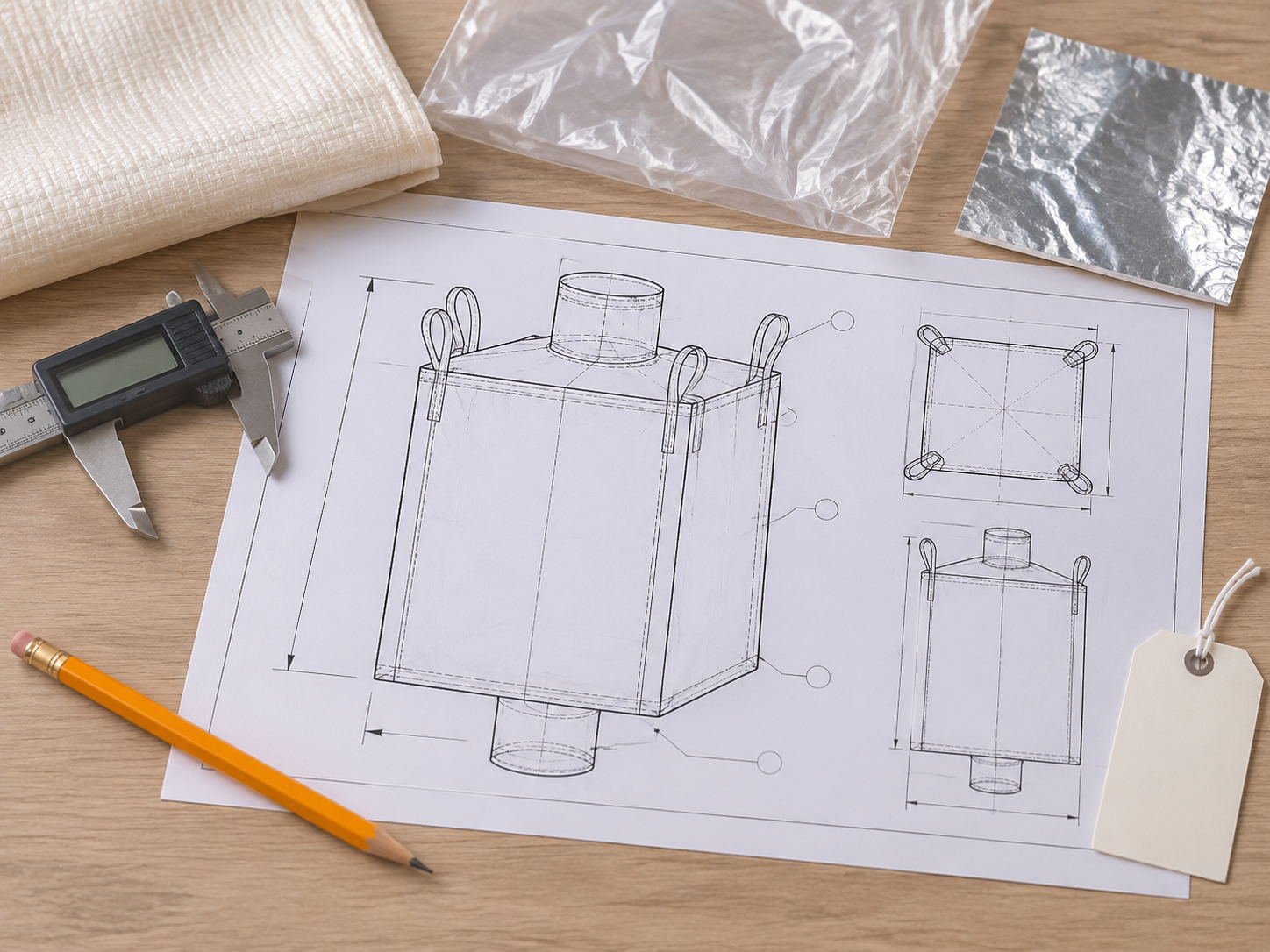
Then ask how a change propagates. If the buyer changes the spout diameter, does the liner neck change? If the buyer adds a baffle, does the liner need a different shape or fixation? If the buyer switches from a standard liner to a barrier liner, does the effective volume change? If the buyer increases print coverage, does the fabric handling or ink cure change? A reliable supplier answers these questions before quoting, because the interactions are where most custom projects fail.
The FIBC customization overview explains the individual choices. The liner fit and interface guide shows why the bag, liner, and spout must be measured as one system. The eight openings guide is useful for matching the opening to the filling or discharge job. These are the conversations a reliable manufacturer should be able to have before a price is fixed.
| Question to the supplier | A reliable answer | A warning sign |
|---|---|---|
| “Can you make this bag?” | “Send the duty data; we will confirm the structure, then issue a drawing for approval.” | “Yes, no problem” before any technical question |
| “What changes if we add a baffle?” | Explains the effect on filled shape, liner path, stacking, and container fit | Treats the baffle as a cosmetic add-on |
| “Can you match our current liner?” | Asks for the liner drawing, film structure, fixation method, and spout dimensions | Offers a generic “same size” liner |
| “How do you control a fabric change?” | Describes the revision, validation, and customer notification process | Says “same same” or “our fabric is always stable” |
| “Can you make the sample on the production line?” | Confirms the line, materials, and lot; provides a sample report | Sends a hand-made sample with no production record |
FIBC World’s custom page organizes its offer into six feature groups and more than 25 choices, starting from cargo profile, load rating, structure map, and sample check. That structure is useful because it mirrors the buyer’s decision sequence. The qualification question is whether each choice ends up in a controlled drawing and a sample report, not whether the list is long.
Ask for Design-Specific Evidence, Not a Certificate Collection
A certificate is evidence only when its scope matches the thing you are buying. Many supplier folders contain a quality certificate, a material certificate, a test report, and a customer approval letter. None of them may cover the exact bag, liner, closure, and marking configuration in your quotation.
Use an evidence hierarchy. Start at the top and work down. Do not let a lower-level document substitute for a higher-level one.
| Level | Evidence | What it can prove | What it cannot prove |
|---|---|---|---|
| 1 | Design-specific type test or certification: ISO 21898:2024, UN dangerous-goods certificate, IEC 61340-4-4 classification | The tested design met the applicable test regime, within its stated scope | That a different size, fabric, liner, or closure is covered |
| 2 | Material and article compliance: food-contact declaration of compliance, migration test, material specification | The named materials or article meet the stated regulatory conditions | That the finished bag, print, adhesive, and liner are all covered |
| 3 | Batch and process records: fabric lot, liner lot, seam test, dimensional check, final inspection | The production lot was made and checked under the documented process | That the design is capable or that the test regime is complete |
| 4 | Management-system certification: ISO 9001, ISO 22000, BRCGS, or a customer audit | The site operates a documented management system within the audit scope | That a specific product conforms or that a specific test passed |
| 5 | Marketing claims: catalogue, website, sales presentation | The supplier’s public position | Independent performance, certification, or customer approval |

ISO 21898:2024
ISO 21898:2024 covers FIBCs for non-dangerous goods and replaced the 2004 edition. Its marking set includes the safe working load, safety factor, maximum stacking count, test number, test date, and laboratory reference. When you receive a report, check the standard edition, the product model, the drawing revision, the fabric and liner construction, the SWL and safety factor, the test date, and the laboratory. A report for a 1,000 kg bag with one liner does not automatically cover a 1,250 kg bag with a different liner and closure.
UN dangerous-goods certification
For dangerous goods, the UN packaging code (for example, 13H1 to 13H4) identifies the packaging category, and the certification is tied to the tested design, packaging group, liner, and closure. A UN certificate for one configuration is not a certificate for a different liner or closure. If the bag is offered with a liner, the liner and its attachment are part of the configuration that must be evaluated. Ask for the certificate, the test report, the marking drawing, and a statement of the exact configuration covered.
IEC 61340-4-4 and Type A/B/C/D
IEC 61340-4-4:2018 covers the electrostatic classification of FIBCs, including the classification of inner liners. FIBCA’s FAQ explains the practical differences: Type C requires grounding, while Type D does not require grounding but is not a universal substitute for every hazardous area or every powder. A Type D bag is a system of fabric, seams, accessories, liner, labeling, and instructions, not a fabric property that can be swapped into any design. Ask for the classification report, the liner classification, the marking, and the operating instructions.
Food-contact evidence
Food-contact compliance is component-specific. The finished bag, liner, closure, ink, and adhesive may all need evidence for the intended use. In the United States, 21 CFR 177.1520 covers certain olefin polymers. In the EU, Regulation (EU) No 10/2011 covers plastic food-contact materials and requires a declaration of compliance and, where applicable, migration testing under the intended conditions. “Food-grade” is not a document. Ask for a declaration that names the components, the test conditions (simulant, temperature, duration), the intended use, and the supporting test reports.
Migration testing may be required depending on the intended use; ask for the test conditions, the simulant, and the basis for the declaration. Confirm the final applicability with your regulatory specialist or the authority for the destination market.
EU PPWR and design for recycling
The EU Packaging and Packaging Waste Regulation, Regulation (EU) 2025/40, has applied since 12 August 2026, with a PFAS restriction for food-contact packaging from the same date and other measures phased in. For packaging placed on the EU market, the technical documentation and declaration of conformity need to match the actual product. PPWR also raises the profile of recyclability, recycled content, and material documentation, but the detailed requirements phase in over time. Do not let a supplier turn a future requirement into a current certification.
EFIBCA’s Design for Recycling Guidelines 2.0, published in September 2026, set a voluntary standard for polypropylene FIBCs, with a focus on predominantly mono-material PP construction, compatible liners and components, and controlled additives and colors. It is a useful design framework, not an EU regulation or a product certification. If a supplier claims “designed for recycling,” ask for the material breakdown by component, the separation method, the recycled content evidence, and the recycling route assumed. A foil or EVOH barrier liner may be necessary for the product and still not fit a PP closed-loop claim.
ISO 9001 and ISO/IEC 17025
ISO 9001 certification covers a quality management system, not a product. It is relevant because it supports consistency, document control, and corrective action, but it does not prove that a specific bag passed a specific test. ISO/IEC 17025 covers the competence of testing and calibration laboratories. If a test report is central to your qualification, check whether the laboratory is accredited for that test and whether the report number can be verified.
In short, the certificate covers the management system, not the bag. Treat it as a signal of process discipline, not as a substitute for a design-specific test report.
How to verify a document
Read the scope, not just the cover page. Identify the product, model, size, fabric, liner, closure, SWL, and safety factor.
Check the revision and date. A report to an older standard edition may still be useful, but ask why it was not updated and whether it covers the current design.
Check the issuer. Confirm the legal entity, accreditation, and contact details. Call or email the laboratory or certification body if the document is important.
Check the sample. Ask for photos of the tested sample and the construction details. If the report says “sample submitted by client,” clarify who made it and whether it represents the production design.
Check the language. “Tested to,” “compliant with,” and “certified” are not interchangeable. Ask for the exact claim the supplier is willing to put in the contract.
Audit the Process Where Failures Start
A factory tour that stays in the showroom and the packing area does not tell you where failures start. Follow the order through the process. You do not need to audit every machine. You need to see the control points that determine whether the approved drawing can be repeated.
| Process stage | What to check | Evidence to request |
|---|---|---|
| Incoming material | Resin or fabric supplier, fabric lot, weight per unit area, tensile, coating, UV stabilization, liner film | Incoming inspection record, material certificate, lot label |
| Weaving | Loom type, warp/weft density, fabric defects, roll identification | Weaving record, roll traceability, defect log |
| Coating or lamination | Coating coverage, adhesion, pinholes, cure, roll handling | Coating record, sample coupon, visual standard |
| Cutting and printing | Artwork version, color, registration, ink, cure, print position | Approved artwork, first-piece approval, print inspection record |
| Sewing and loops | Seam type, stitch density, thread, needle, seam strength, loop placement and attachment | Sewing specification, seam test, loop pull test, operator qualification |
| Openings and liner | Spout dimensions, liner seal, liner attachment, fit check, vent path | Dimensional check, seal integrity test, liner fit report |
| Final inspection | Dimensions, weight, appearance, cleanliness, markings, print, barcode | Final inspection record, sampling plan, nonconformance log |
| Testing | Tensile, seam, drop, toppling, liner seal, or other applicable tests | Test report, calibrated equipment record, sample identification |
| Packing and loading | Bale or carton, moisture protection, label, pallet, container plan, seal | Packing specification, loading photos, seal number |

Ask for the quality plan, not just the quality certificate. The plan should define incoming, in-process, final, and pre-shipment checks; the sampling plan (AQL or equivalent); the acceptance criteria; the record format; the person responsible; and the action when a check fails. Ask how test equipment is calibrated and who calibrates it. Ask for the last three months of nonconformance and corrective-action records, with customer names removed. A supplier that cannot show a nonconformance has either perfect control or no recordkeeping; the second is more common.
CAPA here means corrective and preventive action: the record of what went wrong, why it happened, what changed, and how the change was verified.
Traceability is the test that exposes many weak systems. Pick a finished bag or a label from a recent lot and ask the supplier to trace it back to the fabric lot, liner lot, production date, line, operator shift, test record, and shipment. If the trace stops at “the warehouse,” the supplier cannot contain a problem if something goes wrong.
For global orders, add a pre-shipment inspection step. Define who inspects, against which drawing and sample, with which sampling plan, and what happens if the lot fails. Ask for container loading photos and the seal number. If a third-party inspection is required, agree on the scope before production, not after the container is loaded.
Test Communication Before You Trust the Relationship
Reliability is visible in the first technical exchange. Send a real but incomplete requirement and see what comes back. For example: “Our liner moves during filling and sometimes blocks the discharge spout.” A weak supplier responds with a price for a new liner. A strong supplier asks about the filling rate, the liner fixation points, the spout diameter and length, the vent path, the bag support, the operator procedure, and the discharge equipment. The questions are the product.
Ask for a named technical contact and a named quality contact, not only a salesperson. Ask who reviews the drawing, who approves the sample, who signs the test report, and who handles a complaint. Ask for a response time and an escalation path. If the supplier operates across time zones, confirm the handoff between sales, engineering, and production.
Put the answers in writing. A reliable supplier will accept technical questions by email and answer them in a way that can be attached to the RFQ. A supplier that only answers by phone or messaging app is creating a record gap that will matter when a lot is disputed.
Test the supplier’s willingness to say no. Ask for a bag to carry more than its SWL, for a Type C bag to be used without grounding, for a Type D bag in a conductive dust, for a food-contact claim without a declaration, or for a UN configuration without a certificate. A reliable supplier refuses or states the conditions. A supplier that agrees to everything is not flexible; it is uncontrolled.
Verify Commercial and Logistics Reliability Across Borders
A global bulk packaging program is not only a bag purchase. It is a landed-cost, working-capital, and delivery-risk decision. A quote that is missing a specification reference, an Incoterm, a price validity, or a freight assumption is not a comparable quote.
| Quote item | What to require | Why it matters |
|---|---|---|
| Specification reference | Drawing number, revision, BOM, and sample reference | Prevents a price for one bag being applied to another |
| Quantity breaks and MOQ | Price at the planned volume, MOQ, and mixed-size rules | Avoids a low headline price that disappears at your order size |
| Sample and tooling | Sample fee, tooling or plate cost, refund conditions, sample lead time | Separates one-time cost from piece price |
| Lead time | Start point (artwork approval, deposit, sample approval), production time, inspection, transit | A lead time without a start point is not a commitment |
| Incoterms | EXW, FOB, CIF, DAP, or another rule, with named place | Defines cost, risk transfer, and who arranges insurance |
| Payment terms | Deposit, balance, letter of credit, or other terms | Affects cash flow and risk |
| Price validity | Validity period and the PP or raw-material basis | PP raffia is volatile; a price without a basis is a guess |
| Freight assumptions | Route, carrier, surcharges, war-risk or congestion assumptions | Freight can change faster than the bag price |
| Packaging | Bale, carton, pallet, moisture protection, label, container loading | Affects damage, handling, and warehouse cost |
| Inspection and documents | Pre-shipment inspection, test reports, certificate of origin (COO), packing list, destination labels | Determines whether the shipment clears and the buyer can audit it |

Raw-material volatility is not a theoretical concern. China’s homo-PP raffia export offers crossed USD 1,400 per ton FOB in late October 2026, and the weekly average had risen about 40% since mid-July. That does not tell you what will happen next month. It tells you that a quote should state its basis and validity, and that a supplier who offers a fixed price for a long period is either hedged, absorbing risk, or assuming a cost path that should be stated.
Freight is the same story. Drewry’s World Container Index was USD 4,389 per 40 ft container on 5 November 2026, down 1% week on week. The index can move in either direction. What matters for qualification is whether the supplier states the route, the surcharges, the transit assumption, and the buffer. The WFP reported in October 2026 that delivery times on some routes affected by Red Sea disruptions and rerouting had increased by 30 to 50 days. A supplier that promises a fixed delivery date without naming the route is not giving you a plan; it is giving you a hope.
Ask for the export document set: commercial invoice, packing list, certificate of origin, HS code, shipping marks, destination-language labels, and any test or compliance documents required by the market. If wood packaging is used, confirm ISPM 15 treatment. If the buyer is the importer of record, clarify who is responsible for the EU PPWR obligations and the declaration of conformity. The answer depends on the product, the sales structure, and the destination; it is not a detail to leave to the freight forwarder.
Finally, ask about capacity and continuity. Which line will make the order? Is it the same line that made the sample? How much capacity is reserved for your volume? What happens in peak season? Are printing, sewing, or liner production subcontracted? What is the backup plan if a line stops? Who notifies you if a material or process changes? For a strategic program, also ask about ownership, financial standing, and customer concentration. A supplier that cannot survive a raw-material swing is a continuity risk, even if the sample is perfect.
Score Reliability, Then Calculate the Cost of Getting It Wrong
A scorecard is useful only if it follows a gate. First define the must-have requirements: safety and compliance, traceability, manufacturing capability, and legal export status. If a supplier fails a gate, do not average the failure away with a high score elsewhere. A supplier with a beautiful catalogue and no design-specific evidence is not a 70% solution; it is a failed gate.
For suppliers that pass the gates, use a weighted score. The weights below are a starting point, not a universal formula. Adjust them to the risk of the product and the market.
| Category | Weight | What good looks like |
|---|---|---|
| Specification control | 25 | Drawing, BOM, tolerances, revision control, change notification |
| Evidence integrity | 20 | Design-specific reports, declarations, traceable lab results, clear scope |
| Process and QC | 20 | Incoming to pre-shipment controls, records, calibration, CAPA, traceability |
| Communication and problem-solving | 15 | Named technical contact, written answers, good questions, willingness to say no |
| Commercial and logistics | 10 | Complete quote, Incoterms, price validity, freight assumptions, documents |
| Continuity and sustainability | 10 | Capacity, backup, material sourcing, PPWR/DFR readiness, honest trade-offs |
Score each category from 0 to 5, multiply by the weight, and divide by 5. Keep the evidence for each score in a register. Have a second reviewer score independently; a large gap between the two scores is a signal to collect more evidence, not to average the difference away. The score is not the decision; it is a record of why the decision was made.
Then calculate a reliability-adjusted landed cost:
Expected failure cost is an estimate, not an accounting truth. It should include product loss, line downtime, rework, expedited freight, inspection, and the management time to resolve a claim. A bag that costs a little more but eliminates a recurring liner failure can be cheaper per ton delivered. A bag that costs less but forces an extra inspection, a rework shift, or a customer credit is not cheaper.
The purpose of the calculation is not to produce a false-precision number. It is to make the hidden costs visible before they appear in the plant.
Qualify With a First Order, Not a Sample Alone
A sample approves a shape. A first order qualifies a system. The gap between them is where most supplier problems live.
| Stage | Evidence | Pass criteria | Owner |
|---|---|---|---|
| Duty statement and RFQ | Complete product, equipment, route, and compliance data | Supplier asks the missing questions and confirms the scope | Buyer |
| Technical review | Drawing, BOM, compliance route, open issues | Drawing is complete and revision-controlled; open issues have owners | Supplier and buyer |
| Sample | Pre-production sample made with production materials and line | Dimensions, weight, liner, spout, print, and markings match the drawing | Supplier |
| Trial | Trial report with the real material and equipment | Filled envelope, discharge, residual, liner position, and handling meet the agreed criteria | Buyer and supplier |
| First production lot | Pre-shipment inspection, batch records, retained sample, loading photos, seal number | Lot matches the approved sample and drawing; deviations are documented and approved | Supplier and inspector |
| Repeat order | Change log, CAPA record, lot consistency | No unapproved change; performance remains within the approved range | Supplier and buyer |
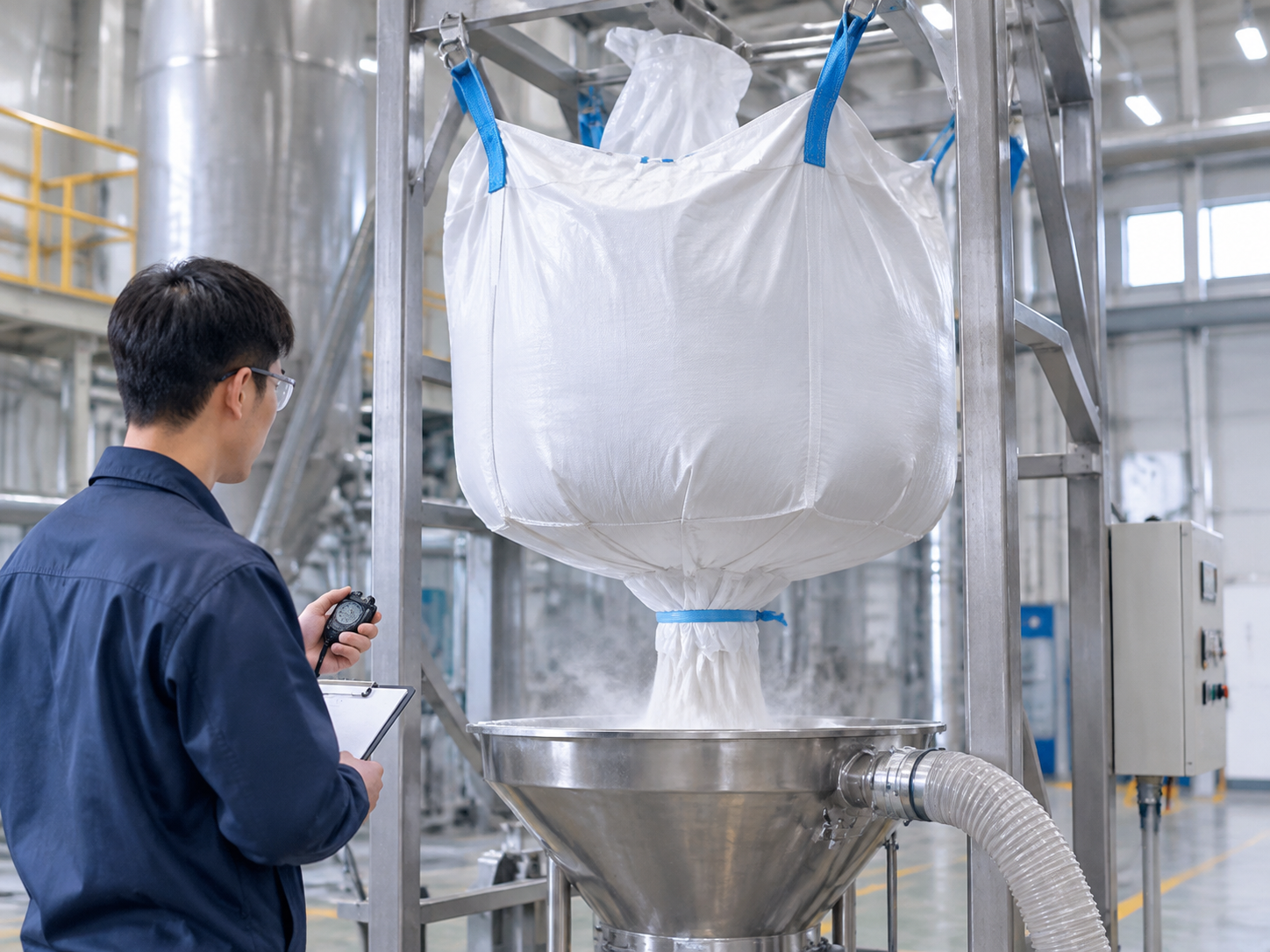
A sample should be labeled as a pre-production sample and should record the line, material lot, and date. If the sample is handmade or made on a different line, it is a concept, not a qualification. The trial should use the real material and the real filling and discharge equipment. Measure the filled length, width, and height; the net weight; the liner position; the discharge time; the residual product; the dust; the seam and loop condition; the print; and the barcode scan. A sample that looks correct when empty is not a qualification.
The first production lot should be inspected against both the drawing and the approved sample. Retain a sample from the lot and record the storage location. Ask for the batch record, the test record, and the loading photos. If the first lot is split across more than one plant or line, record which plant made which lot and confirm that both used the same drawing revision.
Release the first production lot only after the trial report and the drawing revision are approved. If the trial reveals a change, update the drawing and re-approve the sample; do not let a verbal adjustment become the new standard.
Freeze the design after approval. A new fabric, liner film, spout, print layout, seam, or subcontractor is a change, not an equivalent substitution. A reliable supplier has a change-control procedure that tells the buyer what changed, why, what was re-tested, and what the buyer needs to approve. If the supplier cannot describe that procedure, the approved sample is only a temporary agreement.
Red Flags and the Questions That Expose Them
| Red flag | What it usually means | Question to ask |
|---|---|---|
| Price before questions | The supplier is quoting a guess, not a design | “What do you need to know about our material and equipment before you can quote?” |
| “Any size, any liner, any certification” | No control over the design or the evidence | “Show me the drawing and the design-specific report for this exact configuration.” |
| Certificate without model or revision | The scope may not cover your bag | “Which model, revision, size, liner, and test date does this certificate cover?” |
| No dimensioned drawing | Customization is verbal, not controlled | “Can you send the drawing with tolerances and a revision number?” |
| Sample from a different line | The sample does not represent production | “Was this made on the production line with the production materials?” |
| “Same same” verbal assurance | No change control | “What is your procedure when a fabric, liner, or spout changes?” |
| No batch traceability | A failure cannot be contained | “Show me how you trace a finished bag back to its fabric and liner lots.” |
| Sales-only contact | No technical accountability | “Who signs the technical review and the sample approval?” |
| Quote without Incoterms or validity | Commercial risk is hidden | “What is included, what is excluded, and how long is the price valid?” |
| No CAPA record | Problems repeat | “What were your last three nonconformances, and what changed after them?” |
A supplier does not need to be perfect. It needs to be honest about what it controls, what it does not, and what it will do when something goes wrong. The red flags matter most when they cluster. No drawing, no traceability, no technical contact, and a certificate that does not match the design do not become acceptable because the price is lower.
What a Good Manufacturer Should Ask You
The evaluation runs both ways. A manufacturer that treats the bag as a commodity will ask for a size and a quantity. A manufacturer that treats it as an engineered package will ask for the duty.
Expect questions about the material and its hazards, bulk density, particle size and shape, moisture sensitivity, static propensity, filling temperature, and any food-contact or dangerous-goods status. Expect questions about the target fill weight, the current bag, the filling head, the discharge station, the lifting equipment, the pallet pattern, the container plan, the storage conditions, the destination market, the compliance route, the annual volume, and the failure that needs to be solved. Expect a request for photos or drawings of the actual equipment, not a description.
FIBC World’s custom process is organized around cargo profile, load rating, structure map, and sample check. That is the right sequence: the cargo and the equipment define the structure, the structure defines the drawing, and the drawing defines the sample. If a supplier starts with a catalogue page and works backward, the buyer is the one who will discover the mismatch.
Why FIBC World Fits This Qualification Model
FIBC World is positioned as a factory-direct custom FIBC supplier rather than a catalogue-only seller. Its public site describes custom outer bag structures, shaped liners, filling and discharge spouts, moisture protection, printing, labels, and compliance support, with the bag, liner, and interface presented in one sequence. The custom page groups the offer into six feature areas and more than 25 choices: bag styles, lifting loops and straps, top filling, bottom discharge, liners and seams, and printing and compliance.
The relevant advantage for a custom program is not simply the number of options. It is that the bag, the liner, and the filling or discharge interface can be reviewed as one specification. FIBC World’s range includes form-fit liners and multi-layer aluminum foil liners, which are the kinds of components that must be designed with the bag rather than added after the bag is chosen.
The public About page says one team handles specification review, sampling, production, inspection, and export dispatch, and the homepage states 20+ years of export experience, 1M+ annual production capacity, 50+ countries delivered, and a 24-hour quote turnaround. These are public claims. A serious buyer should verify them with the same process described in this guide: ask for the drawing, the sample report, the evidence scope, the production site, the inspection record, and the people who sign the technical review.
The practical advantage is not that FIBC World has every answer. It is that the specification sequence starts in the right place: cargo profile, load rating, structure map, sample check. A buyer can test that sequence with a real duty statement and a real failure. The supplier should respond with questions, a drawing, a sample plan, and an evidence list, not just a price.
Where a project requires UN, food-contact, electrostatic, or EU-market evidence, the applicable certificate or declaration must match the proposed design. FIBC World should be asked to state exactly what is covered, what is not, and what needs to be tested. That is the standard this article applies to every manufacturer, including this one.
Conclusion
Reliability is a chain, not a certificate. It starts with a duty statement that is specific enough to quote, continues through a controlled drawing and design-specific evidence, and is proven by a process that can repeat the approved sample across lots and borders. A good sample is a beginning. A first production lot that matches the drawing, the sample, and the evidence is the qualification.
Before the next supplier comparison, do three things: write the duty statement, ask for the design-specific evidence package, and qualify the supplier with a trial and a first lot. If a supplier cannot show the chain, the price is not comparable, because it does not include the cost of the failure you are about to discover.
To review a custom FIBC or liner program, send FIBC World the product data, target fill weight, current drawing or photos, filling and discharge details, lifting equipment, pallet and container plan, destination market, compliance route, annual volume, and the current failure. The custom FIBC capability page shows the available structure choices. The customization overview explains how the individual choices fit together.
Related News
Other news you might be interested in
What Is a Super Sack? FIBC vs Bulk Bag vs Jumbo Bag Explained
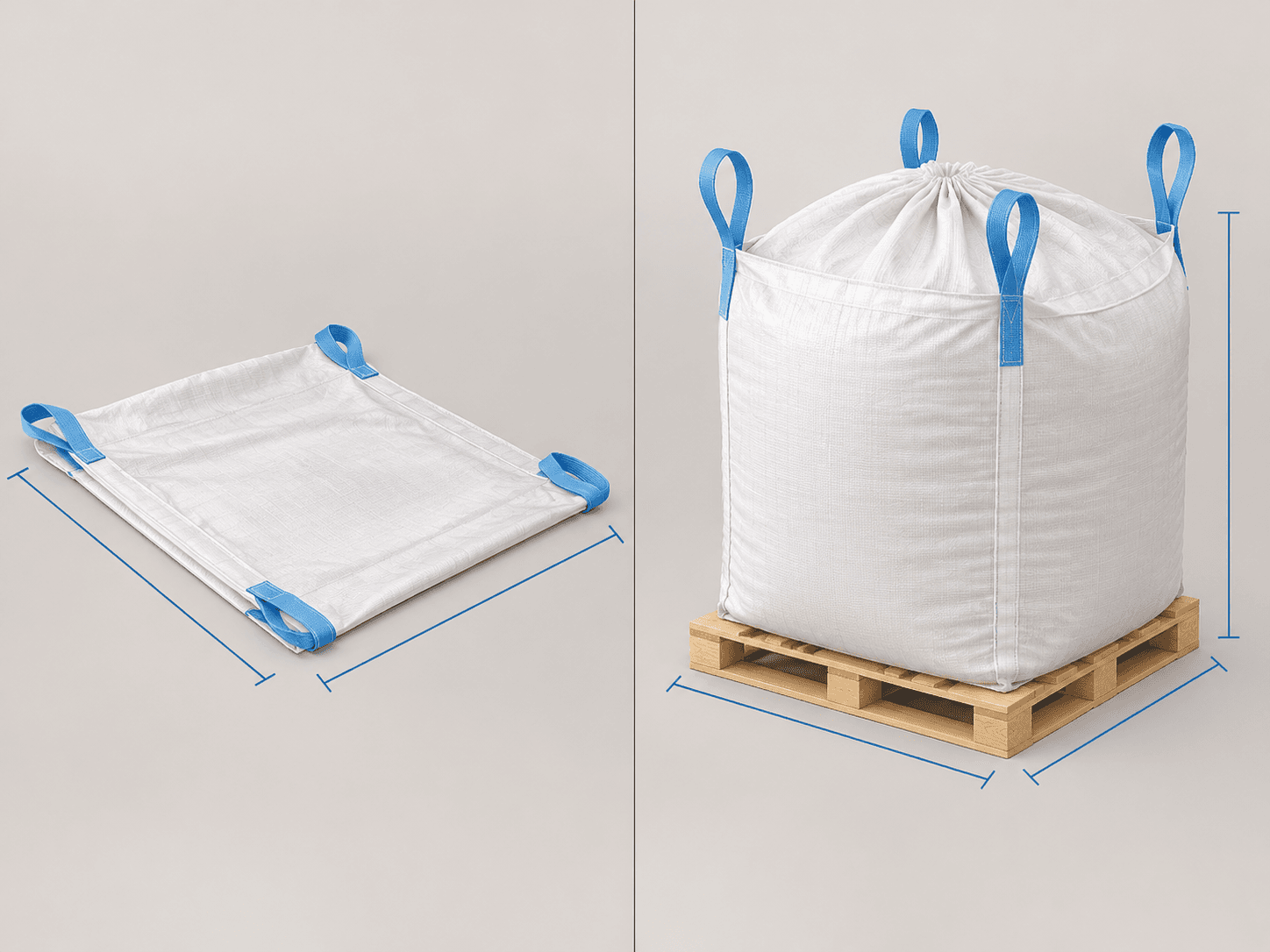
A buyer searches for a “super sack.” The supplier replies with an FIBC quotation. The drawing is titled “jumbo bag.” The warehouse calls it a bulk bag. Four names, one object—usually.The words are not identical in status. FIBC is the technical term used by standards and industry guidance. Bulk bag, big bag, tote and jumbo bag are trade terms. Super Sack® is a registered trademark, not a generic name for every large woven bag.That distinction matters when a purchase order, a drawing or a customs document uses one term while the supplier uses another. The label helps you find the product family. It does not tell you the safe working load, the filled dimensions, the liner, the lifting arrangement or the compliance route. Those have to be specified.
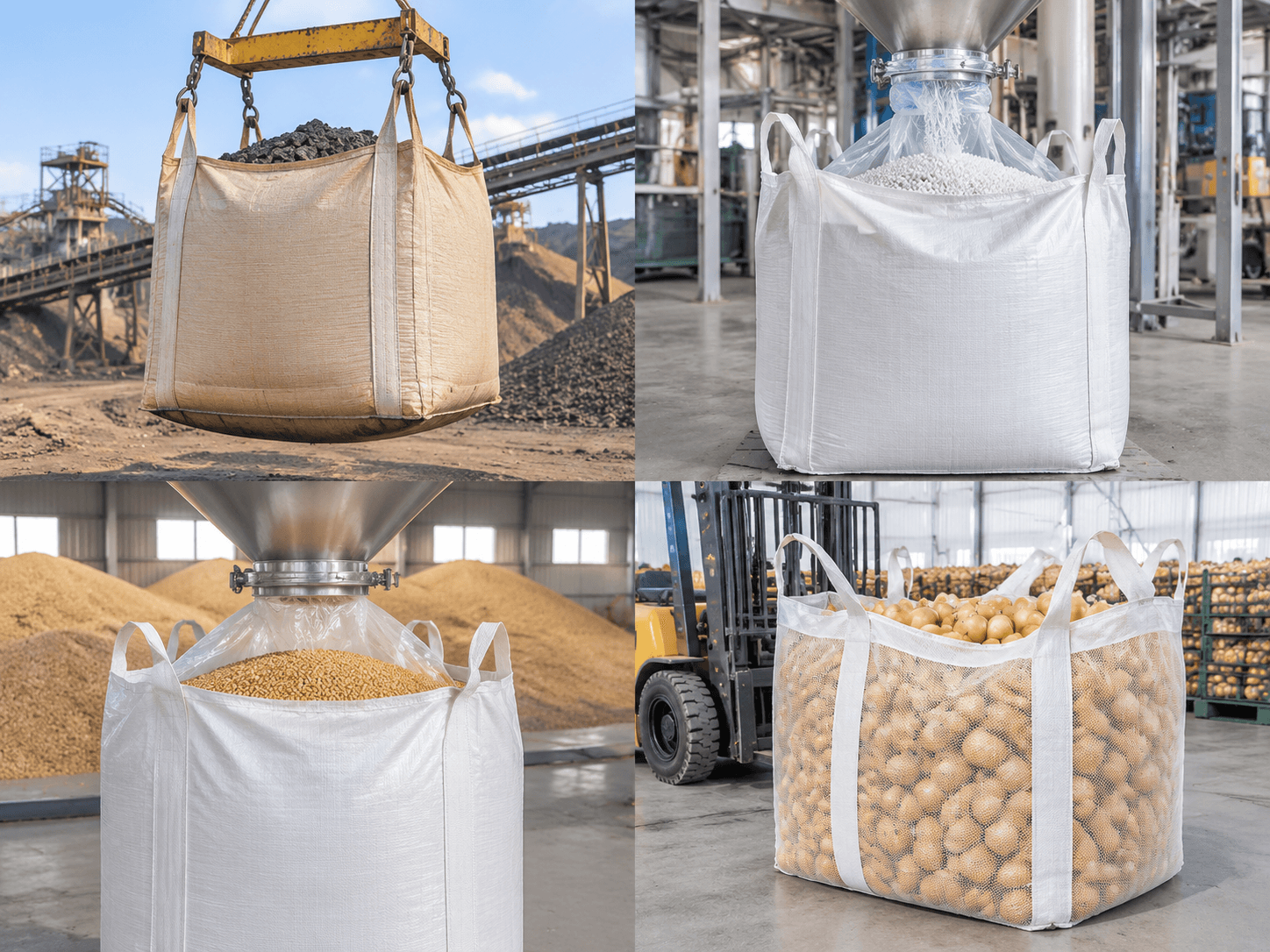
Bulk Bags by Application: Minerals, Fertilizer, Grain and Produce
A mineral concentrate, a fertilizer blend, a load of wheat and a load of onions can all be packed in a bulk bag. They should not all be specified the same way.On a quotation, each may appear as a one-tonne FIBC with a top opening and a discharge spout. In service, the loads behave differently. A dense mineral concentrate can reach its target mass at a low fill level and concentrate stress in the base and seams. A hygroscopic fertilizer can pick up moisture, cake and block the outlet. Grain can arrive dry but become unacceptable if condensation, pests or contamination are not controlled. Fresh produce can lose quality through heat, condensation and handling damage even when the bag itself remains intact.
Want to know more?
Get in touch with us for more information about our services and products.