
What Can You Customize in an FIBC Bag? A Complete Overview

Dayang Yang
AuthorWith experience in FIBC bulk bag manufacturing and export sales, we operate our own production facility with stable large-scale capacity. We are specialists in bulk bags, conductive FIBCs, food-grade FIBCs, UN certified bags, and customized flexible intermediate bulk containers for industrial packaging and bulk material transportation solutions.
Two FIBCs can carry the same nominal load, use the same fabric weight and still behave differently at the filling line, in the warehouse and at the discharge station. One may fill cleanly and stack squarely. The other may bulge into the next pallet position, trap product in a corner or pull its liner away from the spout. The difference is rarely the headline specification. It is the combination of details that were specified, or left unspecified.
FIBC customization is often presented as a menu: choose a size, choose a liner, choose a loop type. That is not how a reliable bulk bag is specified. Each choice changes the behavior of the others. A baffle changes the liner path. A liner changes the effective volume. A discharge spout changes the discharge time and the residual heel. A coated fabric changes how the bag can be printed and repaired. The useful question is not “How many options can I add?” but “Which combination fits the product, the equipment and the compliance route?”
This guide covers the main areas a buyer can customize, the trade-offs behind each one, and the information needed to turn a list of preferences into a specification that can be quoted, sampled and repeated.
Why FIBC Bag Customization Matters
Bulk materials are not interchangeable. A plastic resin pellet, a fine chemical powder, a food ingredient, a mineral aggregate and a battery cathode powder differ in bulk density, particle size, flow behavior, moisture sensitivity, static propensity and temperature tolerance. The equipment around the bag differs too: filling heads, forklifts, crane hooks, discharge stations, pallet patterns, warehouse racks and container dimensions.
A standard FIBC is a sensible starting point when those variables are mild and the filled shape is not a constraint. Customization matters when a specific constraint would otherwise cause a failure: product loss through seams, moisture pickup, dust escape, a liner that blocks the spout, a bag that is too tall for the container, a loop arrangement that does not match the lifting equipment, or a marking that does not satisfy the destination market.
The cost of a mismatch is rarely limited to the bag. It can appear as product left in the bag, a rejected load, a stopped filling line, a cleanup, a damaged liner, a failed stack or a safety incident. That does not mean every project needs a high-feature bag. It means the specification should be driven by the consequences of getting it wrong.
Customization also has a cost side. Internal baffles consume usable volume. High-barrier liners add cost, weight and handling steps. Tight-tolerance spouts can slow filling. Extra printing adds artwork approval and inspection. A heavier fabric may improve strength but reduce container utilization. Good customization is the smallest set of changes that solves the real problem, not the longest list of options.
The practical approach is to separate the specification into seven areas: size and capacity, fabric and construction, filling and discharge, lifting, liners, printing and identification, and safety or special requirements. Then review the areas together before approving a drawing. The sections below follow that sequence.
What Can You Customize in an FIBC Bag?
Almost every visible part of an FIBC can be changed, but most projects only need to control a smaller set of decisions. The table below is a quick reference. The sections that follow explain what each choice changes and what to verify.
| Customization area | What can change | Typical reason to change it |
|---|---|---|
| Size and capacity | Bag dimensions, SWL, fill volume, base shape, filled height | Match a target fill weight, pallet, container or stack plan |
| Fabric and construction | Fabric weight, weave, coating, UV stabilization, body style, seams, ventilation | Balance strength, sifting, moisture protection, airflow and liner fit |
| Filling and discharge | Open top, duffle, spout, conical top, flat bottom, discharge spout, full-open bottom | Match the filling head, product flow, dust control and discharge equipment |
| Lifting | Corner loops, cross-corner loops, side-seam loops, single-point or multi-point lift, sleeves | Match forklift, crane or hoist geometry and rated capacity |
| Liners | Tubular, form-fit, gusseted, PE, metallized or foil composite, barrier and static options | Protect against moisture, oxygen, light, contamination or fine-powder loss |
| Printing and identification | Branding, product data, lot and date, barcode or QR code, handling symbols, warnings | Support picking, traceability, correct handling and brand presentation |
| Safety and special requirements | SWL and safety factor, UN certification, static protection, food contact, stack rating, UV exposure | Meet a transport regulation, food-safety requirement or hazardous-area assessment |
No row can be decided in isolation. A larger discharge spout may improve flow but increase dust exposure. A form-fit liner may improve discharge but require a different baffle and spout arrangement. A UN-certified design may require a specific liner and closure, not just a stronger fabric. The rest of this guide takes each area in turn.
Size and Capacity of the Bag
Size is usually described by empty length, width and height, but the buyer is really purchasing a filled envelope. The bag must hold the target weight, fit the pallet or container, remain stable when filled and leave enough room at the filling head. Those requirements can point in different directions.
The first number is the safe working load (SWL), the maximum load the bag is rated to carry in service . The second is the target fill weight. The third is the bulk density of the product. Volume, weight and dimensions are linked: a low-density product needs more volume for the same weight, while a high-density product can reach the SWL in a smaller volume. A bag that is generously sized for a light product may be dangerously overweight with a dense one.
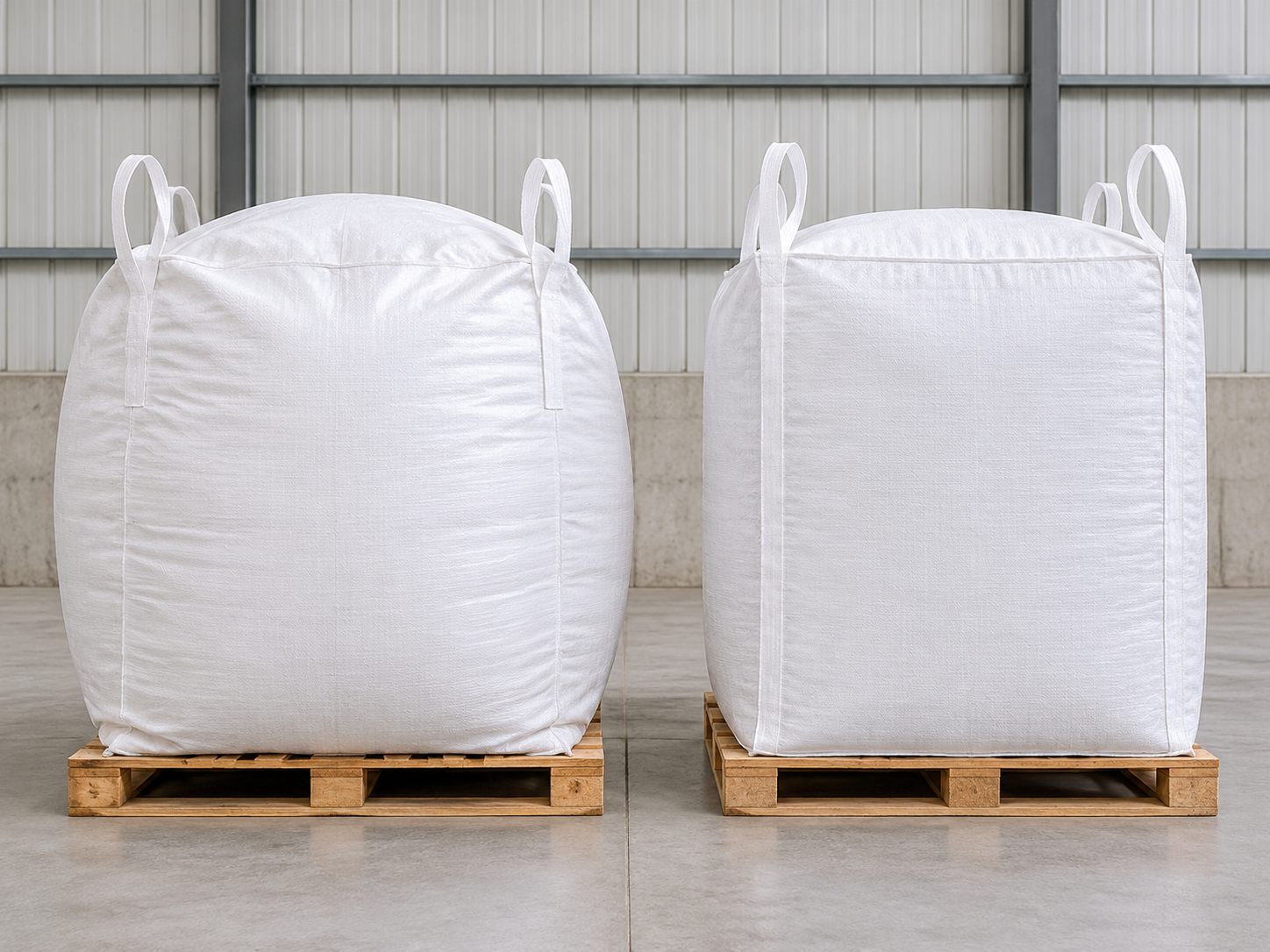
Empty dimensions also overstate usable capacity. Baffles, liner folds, spout intrusion and the way the bag fills all reduce the space available for product. A baffle bag may need a larger empty size to hold the same fill weight as a standard bag. A form-fit liner may change the effective volume and the discharge path. The quotation should state the target fill weight and the expected filled length, width and height, not only the empty bag size.
Filled height deserves particular attention. FIBCA guidance cites a typical maximum filled height-to-width ratio of 2:1 and points users to the applicable industry standard or regulatory code for the current requirement. A tall, narrow bag can become unstable, especially when the product settles or the bag is stacked. A bag that is too tall for the container door or the warehouse rack is not fixed by a larger SWL.
The useful specification asks for:
SWL in kilograms and the intended single-trip or reusable class.
Product bulk density and target fill weight.
Target filled length, width and height.
Pallet footprint, stack height and storage duration.
Container or transport envelope, including door height.
Filling-head height, spout insertion depth and available headroom.
Whether the bag will be lifted, conveyed, stacked or discharged in a constrained area.
The filled shape is a function of the bag, the product and the process. It cannot be guaranteed from an empty-bag drawing alone. For a deeper explanation of how body construction changes bulging and container utilization, see the guide to FIBC body construction.
Fabric and Construction
Most FIBCs are made from woven polypropylene, but “woven polypropylene” is not a complete specification. Fabric weight, tape width, weave, coating, seam construction, UV stabilization and ventilation all affect performance. The body style matters as well: U-panel, four-panel, circular and baffled constructions distribute load differently and create different internal geometry for the liner .
Coated and uncoated fabrics solve different problems. A coating can reduce sifting through the weave and slow moisture ingress, which is useful for fine powders and humid storage. It is not a hermetic barrier. Seams, spouts, closure points and the liner system remain potential paths, and a coated bag can still take up moisture through an unsealed opening. The practical distinction is between a bag that reduces dusting and one that provides a controlled barrier; the second usually requires a liner and a sealed interface. The article on why sift-proof is not leak-proof explains where fine powders escape after filling.
UV stabilization is another option that is easy to overstate. UV exposure weakens polypropylene, and FIBCA advises protecting bags from sunlight and inclement weather. UV-stabilized fabric can be appropriate for a defined exposure period, but the useful question is not “Is it UV stabilized?” It is “What exposure duration, test method and evidence apply to this design?” FIBCA also notes that it does not endorse a universal shelf life for FIBCs; storage, handling, UV exposure and contents all affect the answer. Outdoor storage should be treated as a project-specific risk, not a default.
Ventilated construction is a different function, not a premium version of a standard bag. Potatoes, onions, beans, grains and firewood may need airflow to reduce condensation and spoilage. A liner or a tight coating can work against that requirement. The ventilation area, hole pattern and fabric design should be matched to the produce and the storage regime. See the guide to ventilated bulk bags for potatoes and onions for the application details.
Fabric and construction also set the limits for everything that follows. A heavy fabric does not compensate for a weak seam. A coated fabric does not replace a liner. A baffle does not make a bag stackable by itself. The construction should be selected with the liner, filling interface and lifting design visible on the same drawing. With the body defined, the next decision is how the product enters and leaves the bag.
Filling and Discharge Options
Filling and discharge are where the bag meets the plant. A configuration that looks reasonable on a specification sheet can fail at the filling head because the spout is the wrong diameter, the liner neck is too short, the bag cannot be clamped securely or the operator cannot see the product level. The same applies at discharge: a spout that suits a free-flowing pellet may block with a cohesive powder.
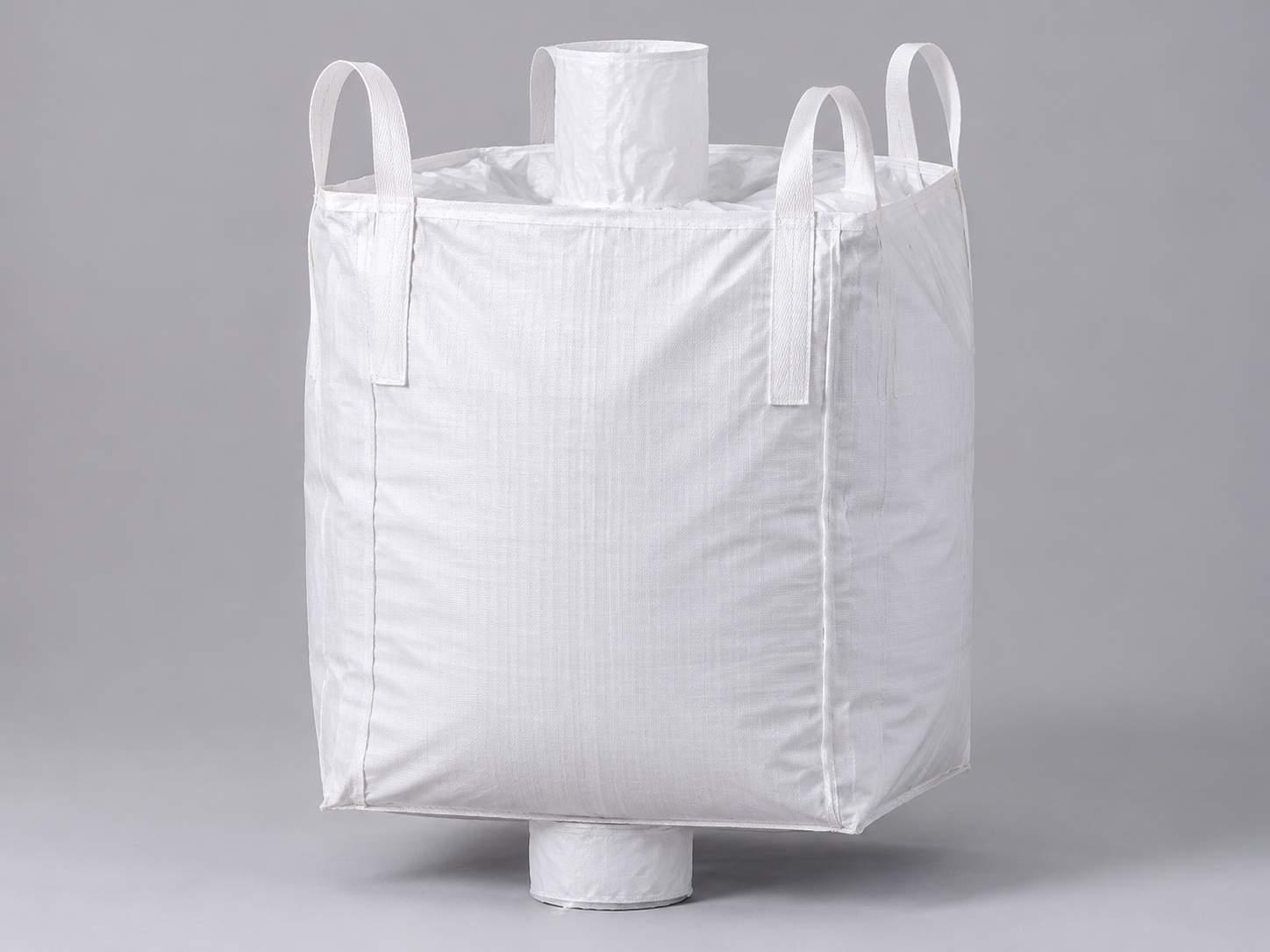
Common top options include an open top for fast manual filling, a duffle top for a closable manual opening, a spout top for controlled or dust-reduced filling, and a conical top for certain powder and discharge arrangements. Common bottom options include a flat bottom for stable storage, a discharge spout for controlled emptying, a full-open bottom for rapid dumping and a conical or duffle bottom for specific flow and closure requirements.
The right choice depends on the product and the process:
| Interface | Best suited to | What to watch |
|---|---|---|
| Open top | Fast manual filling, products that do not need a sealed top | Dust, spillage, weather exposure and closure discipline |
| Duffle top | Manual filling with a closable opening | Operator technique, closure security and liner access |
| Spout top | Controlled filling, dust reduction, connection to a filling head | Spout diameter, clamp or seal, liner neck and venting |
| Conical top | Certain powder and discharge arrangements | Headroom, product bridging and liner fit |
| Flat bottom | Stable storage and a simple base | Residual product and cleaning |
| Discharge spout | Controlled emptying into a hopper or conveyor | Spout size, liner collapse, bridging and residual heel |
| Full-open bottom | Rapid dumping of free-flowing materials | Dust, product surge and liner control |
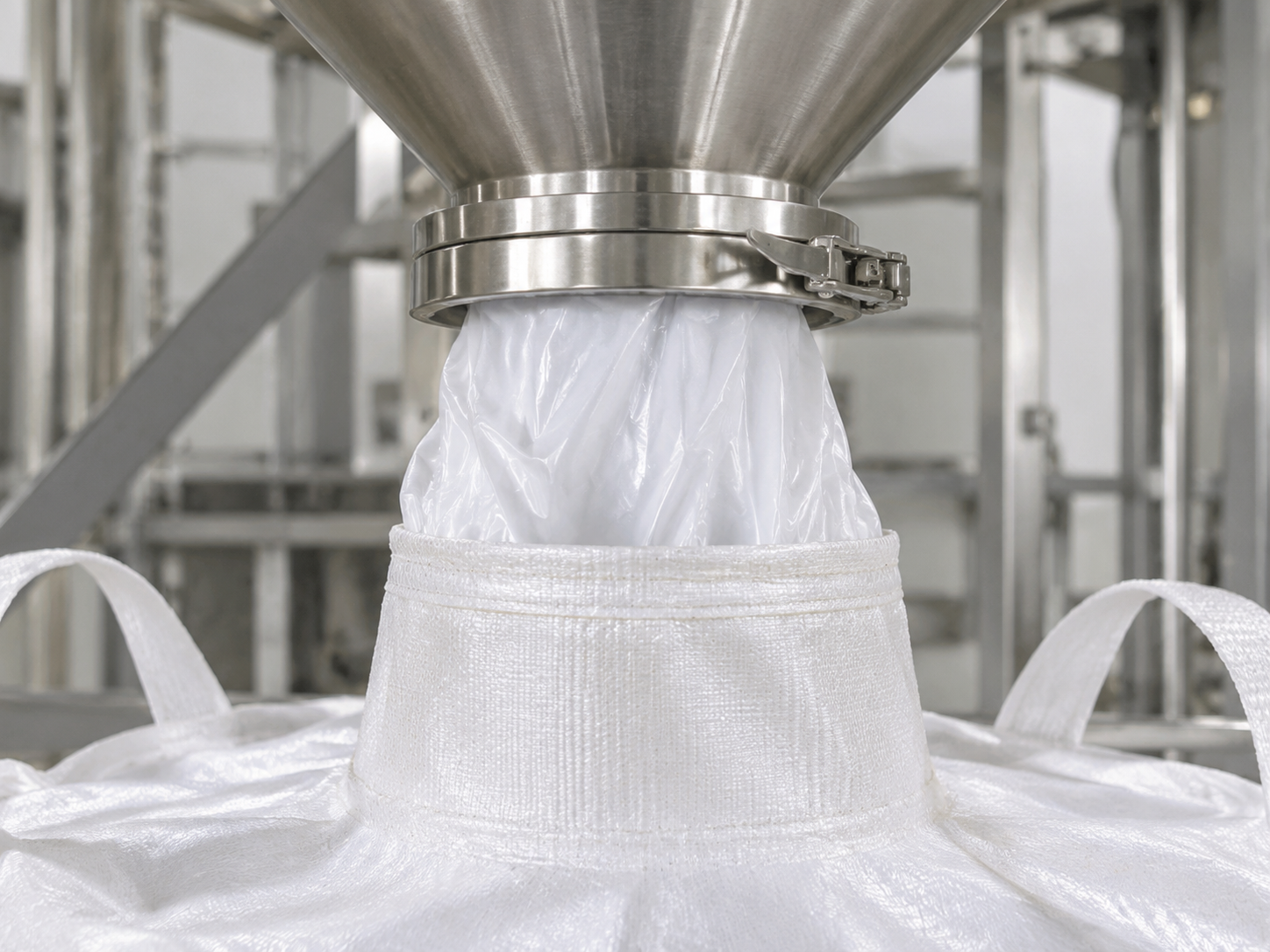
Spout dimensions are not cosmetic. A spout that is too small can slow filling or discharge and encourage bridging. A spout that is too large can release product too quickly, create a dust cloud or make the liner difficult to control. The liner neck must match the spout diameter and length, and it must be long enough to extend past the spout during filling . If the bag is filled through a liner, the liner must be pre-inflated or opened in a controlled way, secured against pull-out and tied off according to the manufacturer’s closure instructions .
The interface drawing should show the filling head, clamp or seal, spout insertion depth, liner neck, vent path and operator access. A photograph of the actual filling station is often more useful than a description. For discharge, the receiving hopper, conveyor, dust extraction and operator position are part of the same interface. The guide to eight bulk bag openings compares the common configurations, and the article on liner discharge problems covers liner movement, blocked spouts and residual powder.
Lifting Loop Configurations
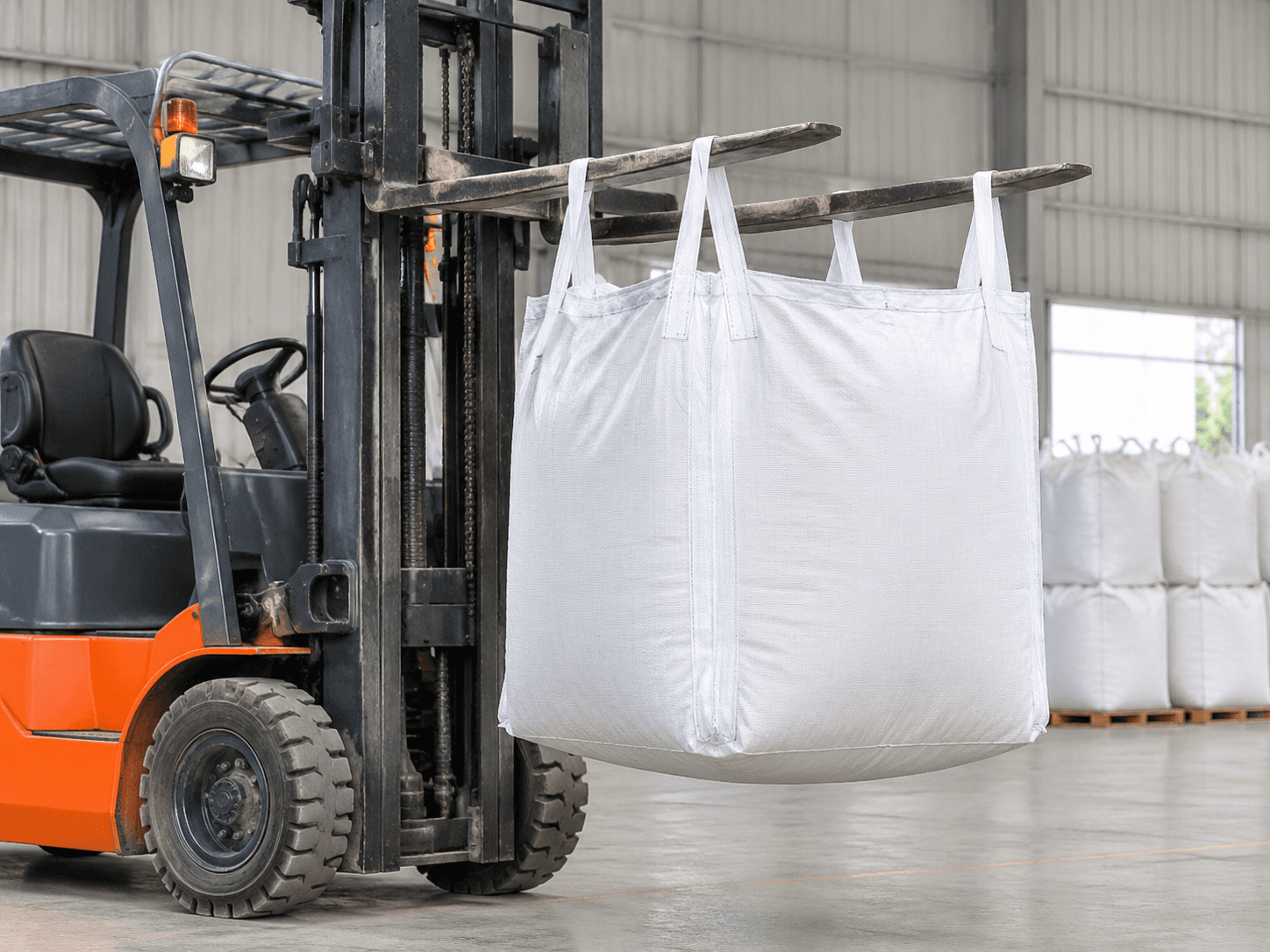
Lifting loops are part of the load path. They transfer the filled weight from the bag body to the forklift, crane or hoist, so the loop type, attachment, seam and base reinforcement must match the handling equipment and the SWL. A loop arrangement that is convenient for one site can be unsafe or inefficient at another.
Common configurations include corner loops, cross-corner loops, side-seam loops, single-point lift, two-point or four-point lift and sleeve lift . Corner loops are common on standard bags handled by forklift. Cross-corner loops place the lifting points at the corners and are often used where a more balanced lift or a particular pallet pattern is needed. Side-seam loops run along the side seams and suit certain handling arrangements. A single-point lift gathers the bag to one lifting point; it should only be used where the bag is specifically designed and approved for that method. Sleeve lift uses tubular sleeves along opposite edges.
The equipment details matter:
Forklift tine spacing and length.
Crane hook, spreader beam or hoist arrangement.
Number of lifting points the equipment can engage.
Loop length and the angle at which the loops will be loaded.
Available headroom and the height of the filled bag.
Whether the bag will be lifted from the base, the top or both.
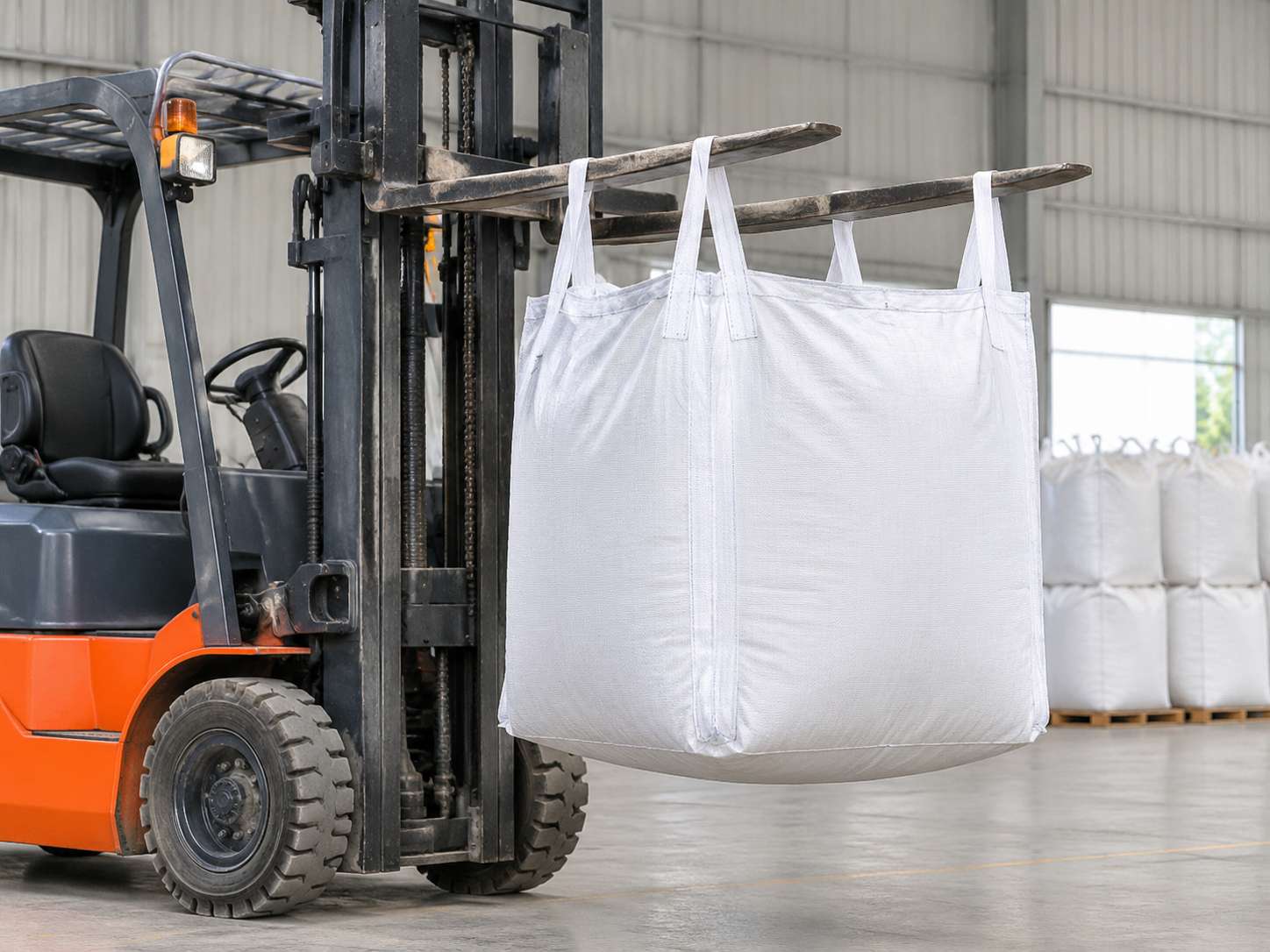
FIBCA’s safe handling guidance is direct: never suspend an FIBC using fewer lift loops than it was provided with, and never gather loops to lift with one hook unless the bag is specifically designed and approved for that method . Handling devices must be rated for the filled load, free of sharp edges and used with the loops vertical to avoid damaging lateral forces. The guidance cites a minimum 5 mm radius for edges that contact the loops . These are operating rules, not optional preferences.
Loop design also affects the bag’s dimensions and container fit. Longer loops add height. A four-point lift may require a different top panel and seam layout from a two-point lift. Cross-corner loops can change how the bag sits on a pallet. The loop drawing and the lifting equipment should be reviewed together, not chosen from a catalogue independently. The guide to 1-loop, 2-loop or 4-loop FIBC covers the selection logic in more detail.
FIBC Liners
A liner adds a barrier or a containment layer between the product and the woven bag. It may be used to reduce moisture or oxygen ingress, block light, protect against contamination, contain fine powder, support food-contact hygiene or provide a static-protective inner layer. The liner is not automatically an improvement. It changes filling, discharge, volume, weight, closure and inspection.
The two broad fit styles are tubular and form-fit . A tubular liner is a straight cylinder, with or without a sealed end. It is simple and can suit a range of bags, but it may fold, bridge or pull away from the spout. A form-fit liner is shaped to the bag, with a flat top and bottom and spout dimensions intended to match the bag’s filling and discharge openings . Form-fit construction can improve filling and discharge, but it is a manufacturing approach, not a guarantee. The liner drawing, bag drawing and spout dimensions have to be reviewed as a matched set.
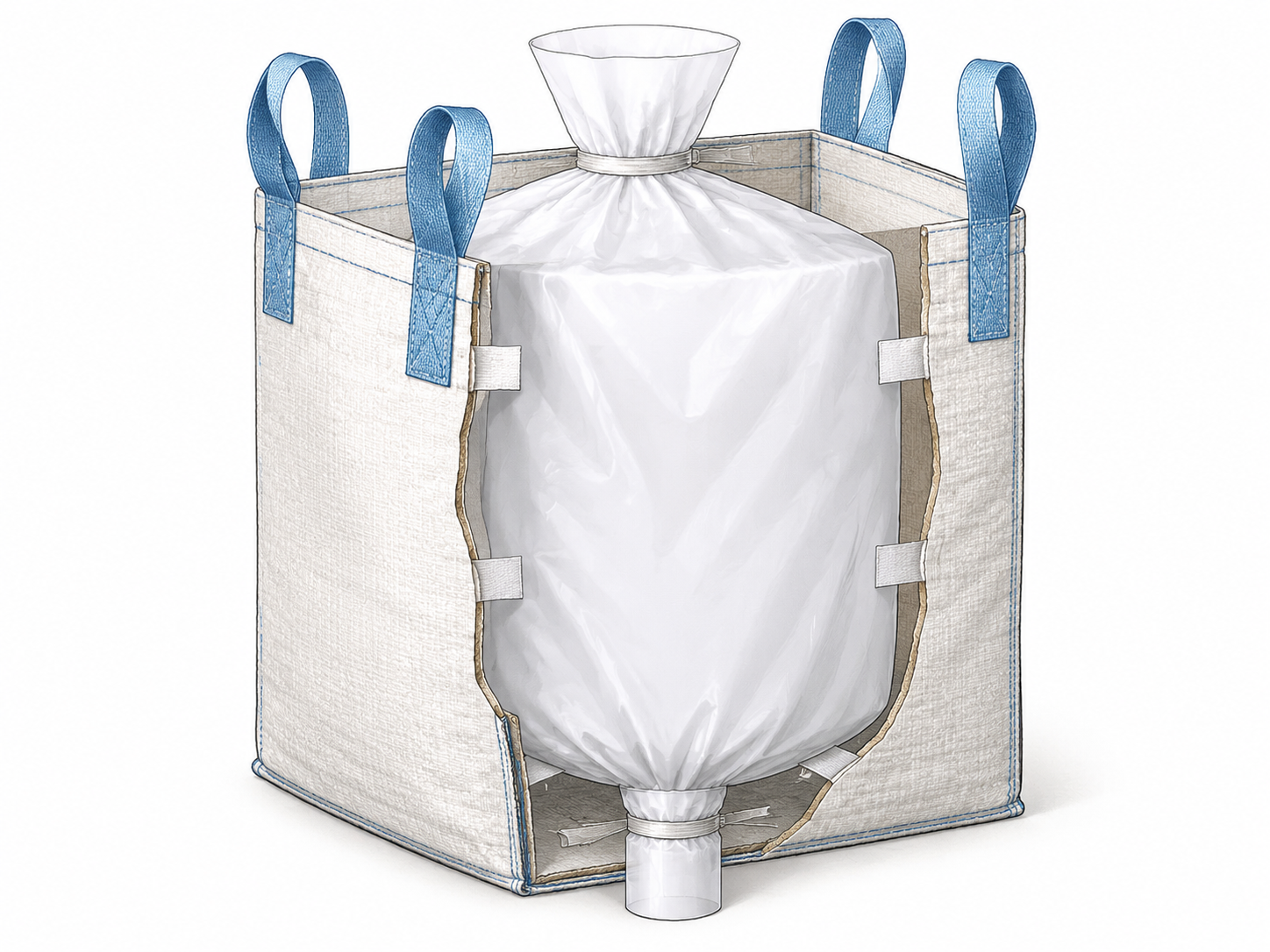
Material choice is only one part of barrier performance. A polyethylene liner, a metallized film, an aluminum foil composite and a multi-layer barrier structure behave differently, but the finished liner’s performance also depends on film thickness, pinholes, seam integrity, spout seals, fit and handling. A film data sheet is not a finished-liner guarantee. Ask for barrier data that identifies the test method, conditions, sample construction and whether the result applies to the finished liner rather than a flat film sample. The guide to PE versus aluminum foil liners explains the trade-offs, and the liner fit and interface guide lists the measurements to agree before ordering.
Liner handling is part of the specification. FIBCA recommends pre-inflating liners before filling, extending them past the fill spout or duffle, securing them so they do not pull out during discharge, and tying them off according to the manufacturer’s closure instructions . A liner that is not secured can move during filling, block the spout or collapse unevenly during discharge. A liner that is too long can gather at the base; one that is too short can detach from the spout. These are fit and interface problems, not material problems.
For food-contact applications, the liner and any closure or fitment that contacts the product need their own compliance evidence. A “food-grade” statement for the bag fabric does not automatically cover the liner, the ink, the adhesive or the spout. For static-protective applications, the liner is part of the electrostatic system; IEC 61340-4-4 classifies inner liners as well as bags, and not every liner is permitted with every bag type . The bag type alone is not enough to approve the combination.
Printing and Product Identification
Printing turns the bag into a carrying label. It can show the brand, product name, grade, lot or batch number, production date, net weight, handling symbols, warnings, country of origin, customer-specific codes and a barcode or QR code. For distributors and multi-product warehouses, that information can be as operationally important as the bag’s physical construction.

The print method is usually flexographic printing on woven polypropylene, but the practical result depends on artwork, color count, ink coverage, registration, fabric color and surface. A detailed logo with fine reverse text may not reproduce cleanly on a coarse woven surface. A light ink on a dark fabric may have low contrast. A barcode may scan poorly if the print is distorted by the weave or if the label is placed where the bag flexes. The artwork proof and the first production sample should be checked together, not separately.
Printing also has to coexist with mandatory markings. ISO 21898:2024 requires durable marking of the manufacturer, unique reference, SWL, safety factor, maximum stack count, test number, test date, approved laboratory and standard reference, among other details . A UN-certified bag carries a different marking set under the dangerous-goods transport rules . Branding and variable data should be placed so they do not obscure or imitate those markings. The label or print should remain readable after filling, handling and storage.
For food-contact products, printing on a surface that could contact the product needs separate evaluation. Inks, adhesives and coatings are not automatically covered by the bag fabric’s food-contact declaration. The safest approach is to keep printing on the external surface or behind a functional barrier and to confirm the ink and adhesive suitability for the intended use.
Useful print approval items include:
Artwork proof with the exact text, spelling and units.
Color reference and acceptable tolerance.
Print placement drawing for each panel.
Barcode or QR code scan test on the actual fabric.
Variable-data fields and the rule for lot, date and batch codes.
Resistance of the print to handling, moisture and the intended storage conditions.
Confirmation that mandatory markings remain visible and legible.
Safety Features and Special Requirements
Safety features are not a single upgrade. They are separate qualification routes, each with its own standard, test evidence and scope. A bag can be strong and still be wrong for a hazardous area. A bag can be UN-certified and still be unsuitable for a food-contact application. A bag can be Type C and still be unsafe if the grounding path is not established before filling.
The main routes are summarized below:
| Requirement | What it addresses | Evidence to request |
|---|---|---|
| SWL, safety factor and stack marking | Load rating, design class and permitted stacking | Label or marking drawing, type-test report, declaration of conformity to ISO 21898:2024 |
| UN certification for dangerous goods | Packaging performance for regulated dangerous goods transport | UN certificate or test report for the exact design, UN marking drawing, packaging code and packing group |
| Static protection | Ignition risk in flammable dust, gas or vapor atmospheres | IEC 61340-4-4 classification, test report, label, grounding instructions and permitted liner combination |
| Food contact | Materials and articles intended to contact food | Declaration of compliance, material and migration data, finished-article scope and conditions of use |
| Ventilation | Airflow for fresh produce or moisture control | Vent area and pattern, airflow rationale, produce-specific trial evidence |
| UV or weather exposure | Strength retention during outdoor or sun-exposed storage | UV stabilization specification, exposure test method, duration and evidence for the design |
| Stackability | Load-bearing capacity of a stack, not just the bag | Stack test or design calculation, maximum stack count, storage and duration conditions |
The UN route applies when the product is classified as dangerous goods for transport. Woven-plastic flexible IBCs use packaging codes such as 13H1, 13H2, 13H3 and 13H4, which distinguish coated or uncoated construction and the presence of a liner . The UN mark is tied to the tested design, including the liner and closure where applicable. A certificate for a different design, a different liner or a different packing group is not interchangeable.
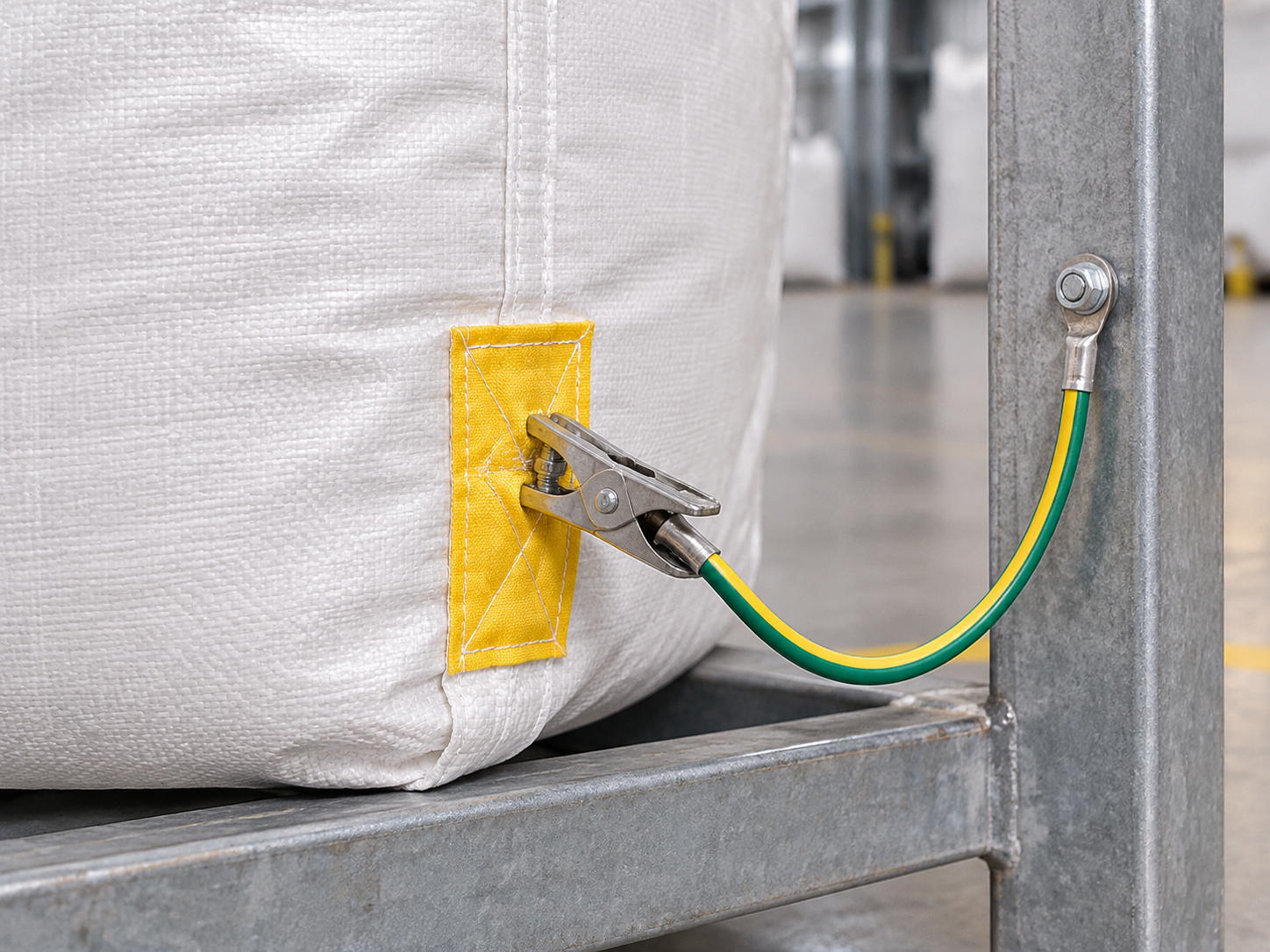
The static route is separate. IEC 61340-4-4:2018 classifies FIBCs as Type A, Type B, Type C or Type D according to construction, intended operation and performance requirements . In practical terms, Type A has no measures against static buildup; Type B limits propagating brush discharges but is not a general solution for flammable vapors; Type C uses conductive paths and must be grounded during filling and emptying; Type D uses static-dissipative fabric and does not require grounding, but its performance can be affected by contamination or coating on the surface . The liner must be part of the approved combination. A Type C bag with the wrong liner, or a Type D bag with a contaminated surface, is not automatically safe.
Food contact is another separate route. In the United States, polyolefin resins used in food-contact articles are regulated under 21 CFR 177.1520 . In the European Union, plastic food-contact materials must comply with Regulation (EU) No 10/2011, including the relevant migration requirements and conditions of use . A supplier’s “food-grade” statement should be read as a claim to be verified, not as a certificate. Ask for the declaration, the materials covered, the intended use conditions and the test basis for the finished article.
Stackability deserves its own line because it is often assumed. A bag that is strong enough to lift is not necessarily designed to be stacked. The maximum stack count, storage duration, product settling, temperature and friction between bags all affect the result. FIBCA advises stacking only when the bags are designed for it, the stack is stable and a pyramid or supported stacking method is used . A baffle can improve the filled shape, but it does not create a stack rating.
How to Choose the Right FIBC Bag Configuration
The most reliable way to choose a configuration is to work from constraints to features, not from a catalogue to a quote. The following sequence keeps the decisions in a useful order.
Classify the product. Record the product name, bulk density, particle size and shape, flow behavior, moisture sensitivity, static propensity, temperature at filling, chemical compatibility and any food or dangerous-goods status. Use the SDS or TDS where available, and confirm the actual filling temperature and product condition.
Define the load. State the SWL, target fill weight and required filled envelope. Check the filled height-to-width ratio, pallet pattern, stack height, storage duration and container door height. Do not accept an empty-bag size as a substitute for a filled-system specification.
Map the interfaces. Draw the filling head, spout, clamp or seal, liner neck, vent path, lifting equipment, discharge station and receiving hopper. Take photographs. Note the operator’s access and line of sight.
Set the protection. Decide whether the product needs a coating, a liner, a barrier structure, ventilation or a combination. Define the barrier target and the evidence required, not just the material name.
Set the compliance route. Confirm whether the product is dangerous goods, whether a UN-certified design is required, whether the area is hazardous and which static type applies, whether food contact is involved and which destination rules apply.
Draw, sample, trial and freeze the design. Approve a drawing with a revision number. Build a pre-production sample with the intended bag, liner, spout, closure and print. Trial it with the actual product and equipment, measure the filled envelope and record the result. Freeze the approved specification and control later changes.
The order matters because later choices can invalidate earlier ones. A liner selected before the filling head is known may not fit. A UN design selected before the liner is known may not be certified as a combination. A loop type selected before the lifting equipment is known may not be usable. A print layout approved before the label position is known may obscure a mandatory marking.
The following screening matrix shows common starting points. It is not a substitute for a trial or a compliance assessment.
| Application pattern | Typical starting configuration | What usually decides the final choice |
|---|---|---|
| Minerals, sand, gravel and aggregates | Standard U-panel or four-panel bag, open top or spout top, flat or discharge bottom | SWL, discharge opening, fabric robustness and handling method |
| Plastic resin pellets and granules | Standard or baffle bag, spout top, PE liner if dust or moisture control is needed | Stack height, pallet pattern, container cube and liner requirement |
| Fine chemical powders | Standard or baffle bag with a matched liner, dust-tight closure | Liner fit, seam integrity, deaeration, discharge and cleaning |
| Food ingredients | Standard or baffle bag with a food-contact liner and controlled print | Food-contact documents, hygiene, liner fit and batch traceability |
| Battery and new-energy powders | High-barrier liner, controlled closure, static assessment where required | Moisture and oxygen barrier, sealing, static/UN requirements and contamination control |
| Fresh produce and firewood | Ventilated standard bag, usually without a liner | Vent area, airflow, produce condition and storage method |
| Dangerous goods | UN-certified design with the correct packaging code and liner | UN certificate, packing group, closure, liner compatibility and destination rules |
When two options both appear workable, prefer the simpler one that satisfies the mandatory requirements. Add complexity only when it solves a defined problem. The priority order should be safety and compliance first, product protection second, handling and throughput third, and cost or appearance last. A lower unit price is not a saving if it increases product loss, line downtime or the risk of a rejected load.
Working with an Experienced FIBC Manufacturer
Customization is a design review, not a pick-and-pack transaction. The manufacturer should be able to see the bag, the liner, the filling interface, the lifting method and the discharge arrangement as one system. That review is where incompatible choices are caught before a production order.
A useful manufacturer conversation starts with the product and the process, not with a bag size. Expect questions about bulk density, particle size, flow, moisture, static, filling temperature, filling rate, dust, discharge behavior, lifting equipment, pallet pattern, stack height, transport mode, destination market and any current failure such as bulging, liner movement, blocked spouts or residual product. A supplier that quotes a custom bag without asking these questions is quoting a guess.
The output should be a written specification and a drawing, not just a price. The drawing should show dimensions, tolerances, fabric and coating, body construction, seams, loops, top and bottom openings, liner attachment, print placement and markings. It should carry a revision number. The specification should identify the SWL, safety factor, intended use class, liner construction, closure method and any test or certification scope. If the liner is part of the system, it needs its own drawing and approval.
Before production, ask for a pre-production sample made with the intended materials and construction. Trial it with the actual product or a representative sample, the actual filling equipment and the intended discharge arrangement. Measure the filled length, width and height, check the footprint and top surface, confirm the liner stays connected and centred, and record the discharge result. A sample that looks correct when empty is not a qualification.
Change control is part of the service. A new fabric supplier, a different liner film, a revised spout, a new print layout or a changed seam can alter performance. The approved drawing and the batch record should make those changes visible. Ask how the manufacturer identifies the approved revision, how it labels production lots and how it handles a nonconformance. FIBCA’s guidance treats the bag and liner as a system to be inspected and handled according to the manufacturer’s instructions .
FIBC World supplies custom FIBCs and liner systems for bulk materials, including standard and baffled bags, ventilated bags, discharge-spout and open-top designs, and form-fit or high-barrier liners. The useful first step is a review of the filled system: product data, target weight, current drawings, filling and discharge details, lifting equipment, pallet and container plan, destination market and the failure that needs to be solved. That review can identify which customization choices are necessary and which would add cost without improving the result.
Conclusion
FIBC customization is not a list of upgrades. It is a sequence of linked decisions about the filled bag and the system around it. Size and capacity set the load. Fabric and construction set the strength, sifting and exposure behavior. Filling and discharge options connect the bag to the plant. Lifting loops connect it to the handling equipment. Liners set the protection and containment. Printing supports identification and traceability. Safety features determine whether the design is acceptable for the product, the area and the destination.
The reliable approach is to start with the product and the process, define the filled envelope, identify the mandatory compliance route, choose the simplest configuration that satisfies the constraints, and then prove it with a drawing and a trial. A custom bag is only an improvement when the combination works as a system.
To review a configuration, send FIBC World the product data, target fill weight, current bag and liner drawings, filling-head and discharge details, lifting equipment, pallet and stack plan, transport mode, destination market and any current failure. Explore the standard FIBC range, the baffled FIBC range, the ventilated FIBC range, the form-fit liner range and the multi-layer aluminum foil liner range for the main starting points.
Related News
Other news you might be interested in
Standard vs Baffle FIBC Bags: Which Bulk Bag Is Right for Your Application?
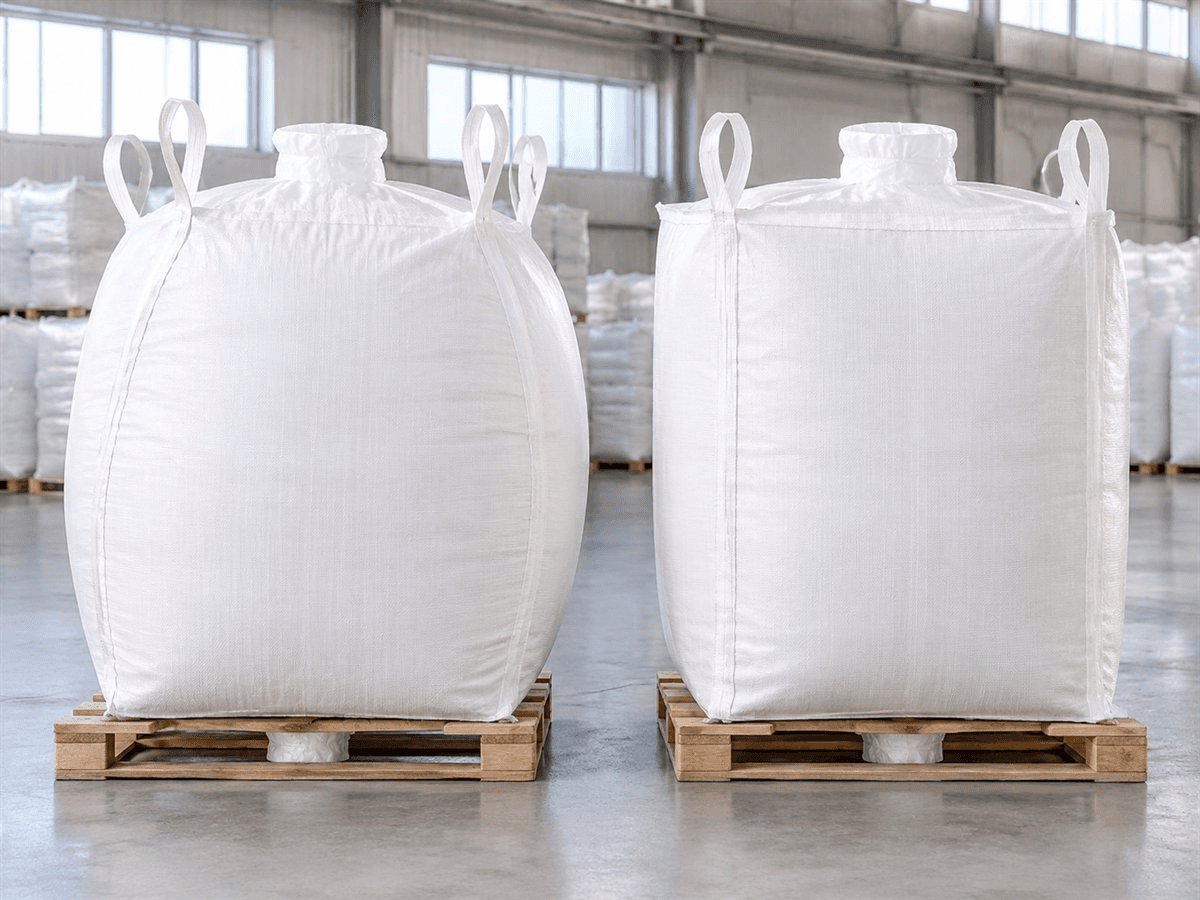
An FIBC is a flexible intermediate bulk container, also called a bulk bag or jumbo bag. The practical way to compare a standard bulk bag with a baffle bag, Q-bag or form-stable FIBC is to look at what happens after filling. The question is not which bag looks stronger in a photograph, or which one has more features. It is whether the filled shape, the liner path and the filling and discharge interfaces fit the application. A standard FIBC is usually the lower-complexity choice. A baffle FIBC earns its cost when the filled shape becomes a constraint in the warehouse, in the container or at the filling line.
The Role of Circular Design in Modern Bulk Bag Manufacturing
A bulk bag is usually described by its headline numbers: safe working load, dimensions, liner type and lifting configuration. Those numbers matter, but they hide a more important fact. An FIBC is a system of materials joined together — woven PP fabric, coating, loops, sewing thread, spouts, liners, labels, inks and closures. The way those components are combined determines not only how the bag performs in service, but also how much material is wasted in production, whether the bag can be emptied and used again, and whether its materials can be separated and recycled.
Want to know more?
Get in touch with us for more information about our services and products.